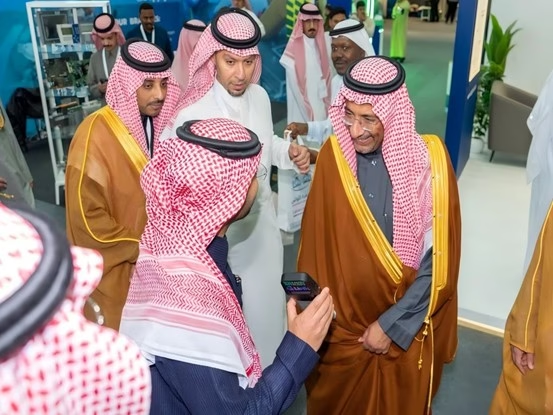
BioWavePass Partners to Launch Palm Pay and Palm Vein Technology Deployment in Saudi Arabia
Riyadh, Saudi Arabia — BioWavePass has officially announced a strategic partnership with Link Palm, X-Telcom, and Gekonova to localize the manufacturing and deployment of Palm Pay and palm vein biometric devices in the Kingdom of Saudi Arabia. This marks a major leap forward in the regional adoption of Palm Vein Technology for secure payments and digital identity authentication.
📌 A powerful few days in Saudi Arabia have opened a new chapter for palm-based payment and identity verification in the region.
This collaboration supports the Kingdom’s Vision 2030, aiming to develop, produce, and manage advanced biometric solutions locally — serving Saudi Arabia first and expanding globally.
Strategic Agreement Signed for Localized Manufacturing
Under the agreement, Link Palm will hold exclusive rights to manufacture, operate, and deploy palm-based biometric devices across both the public and private sectors in Saudi Arabia.
BioWavePass brings its proprietary biometric technology platform, while X-Telcom and Gekonova will support the local manufacturing pipeline, including production, supply chain, and workforce enablement — laying the foundation for a homegrown biometric ecosystem.
🗨️ “Pushing with the palm of your hand is no longer a futuristic idea, but a reality we are creating today — with national hands from inside the Kingdom.”
— Abdullah Al-Othman, Founder and CEO, Link
Scaling Palm Pay Across the Kingdom
Starting in 2026, the project aims to manufacture and deploy up to 1 million palm vein devices, with an expected economic impact exceeding SAR 600 million in the first two years.
Palm Pay technology will allow users to:
- ✅ Pay securely without cards or devices
- ✅ Verify identity without documents or passwords
- ✅ Access services across retail, banking, government, healthcare, and transit
The rollout will begin in key urban centers like Riyadh, Jeddah, and NEOM.
A Technology Ecosystem Built in Saudi Arabia
This initiative is more than a product launch — it is a full-scale investment in the digital identity and biometric payment infrastructure of Saudi Arabia.
It combines:
- 🔧 Local hardware manufacturing
- 💾 Secure biometric software integration
- 📊 Regulatory compliance and data privacy
- 🧑🏭 Job creation and industrial capability development
BioWavePass and its partners are creating a scalable, export-ready biometric solution that starts in the Kingdom — and is designed to scale globally.
🫸 Starting means we are ready to face and overcome more challenges together.
💜 Link Palm aims to support more people in solving issues related to digital identity verification and payment.
✋ Your Palm, Your ID, Your Wallet.
Looking Ahead
BioWavePass is proud to be part of this transformational project. By integrating Palm Vein Technology and Palm Pay into everyday services — and doing so with local partnerships — we are building a future where secure, touchless identity and payments are accessible, scalable, and sovereign.
💡 This is not just technology deployment — it’s local solution-building for global digital challenges.
Learn more from: https://biowavepass.com/biowavepass-palm-vein-scanner-products/
Share this article
About the Author

You might also like
How Does Tokenization Work in Palm Vein Payment Architecture?
Can Palm Registration and Payment Be Done in One Tap? A Practical View from BioWavePass
As a Developer, How Can We Upgrade from a Small Model to a Large Model Palm Vein Recognition Algorithm Without Re-Registering Users?
How Secure Is Palm Vein Technology Against Spoofing Attacks?
How to Choose the Right Palm Vein Recognition Device for Your Project?
Why Is It Not Recommended to Use a Single Palm Scan for Both Identification and Registration?
What Is the Next-Gen Contactless Payment Method?
Which Is the Best EMV & PCI Certified Palm Vein POS Terminal?
Will Palm Vein POS Support Existing EMV, NFC, and QR Payment Ecosystem?
