What Part of the Palm Does a Palm Vein Scanner Actually Capture?
Palm vein technology is quickly rising as the most trusted form of biometric identification. It’s contactless, hygienic, et more secure than traditional fingerprint or facial recognition.
But have you ever wondered — which part of your palm does a biometric palm scanner actually read?
And does an injury affect its ability to verify?
Let’s break it down.
📍 The Core Zone: Your Central Palm Area
Au BioWavePass, our palm recognition algorithms don’t require scanning the entire hand.
We focus on the central region of the palm, where vascular patterns are dense, consistent, and stable.
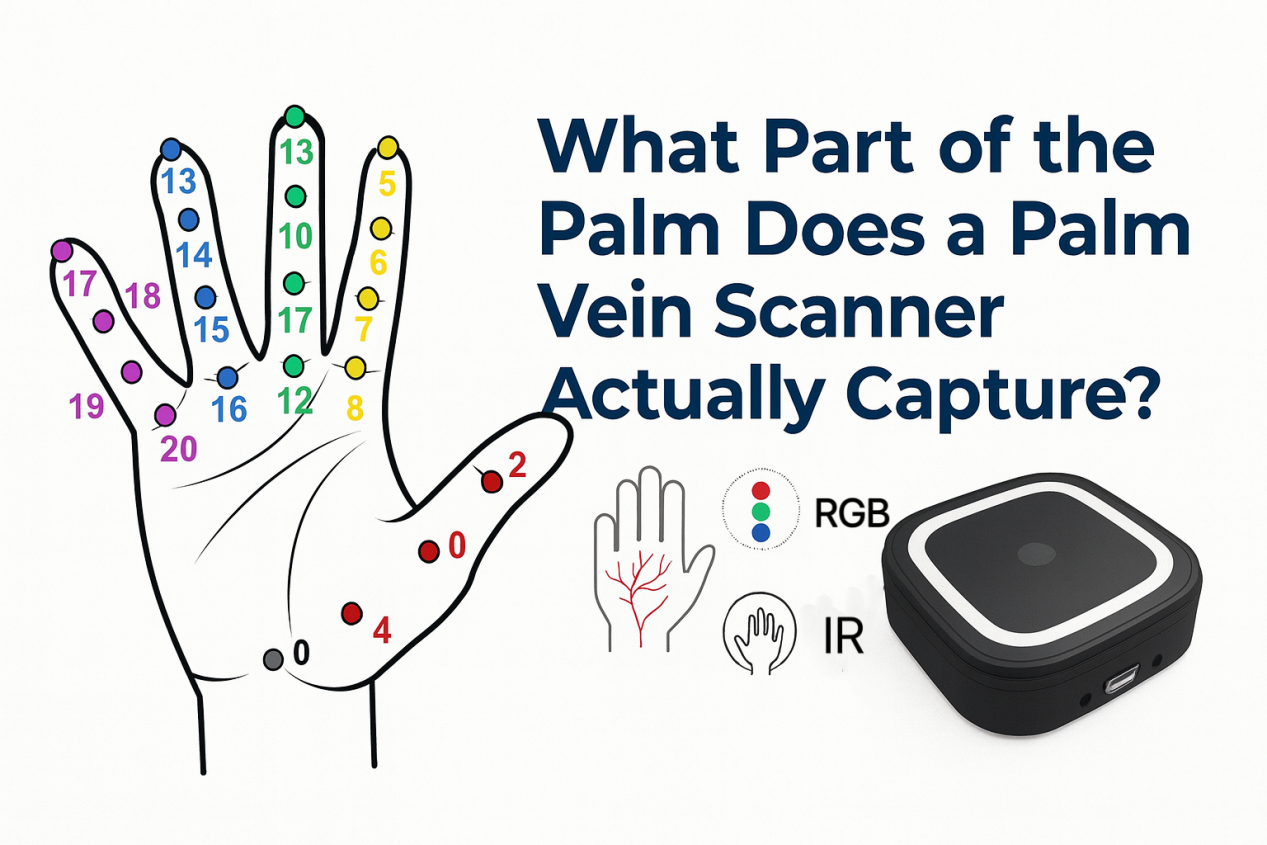
By using five anchor coordinates (20 → 16 → 12 → 8 → 0), the system confirms palm presence and positioning — ensuring it detects a live human hand and not a spoof object.
Even if the user has cuts, scars, or finger injuries, as long as the palm center is intact, recognition remains highly reliable.
🧠 RGB + IR Dual Sensing = High Fidelity Biometrics
Unlike single-mode vein scanners that rely on only infrared, BioWavePass devices combine:
- 🌈 RGB Imaging — capturing palmprint textures from the skin’s surface
- 🌌 IR/NIR Imaging — analyzing vein networks beneath the skin layer
This dual-capture strategy means two biometric factors are verified independently, offering both higher accuracy et advanced liveness detection.
🔐 Real-World Accuracy Metrics
Our system’s recognition engine is trained on large-scale data sets, tested with millions of identities. Here’s what we achieve:
| Mode | FRR @ FAR = 1e-6 |
|---|---|
| RGB (Palmprint) | ✅ ~1.00% |
| IR (Vein Map) | ✅ ~1.52% |
Combined mode accuracy:
For an error to occur, both modes must fail at the same time:
1 in 100,000 (RGB) × 1 in 1,000,000 (IR) = 1 in 100,000,000,000
That’s a 1 in 100 billion false match rate — ideal for banking, healthcare, or citizen ID systems.
💡 Why Focused Palm Center Scanning Works Best
- 🖐 Contactless & Sanitary — no touch, no contamination
- 🧬 Resilient to Skin Damage — works even with aging or injured hands
- 🔐 Spoof-Resistant — dual-mode liveness detection
- 🧩 SDK Ready — easy to integrate into new or existing systems
🔧 Trusted for These Applications
- 💳 Palm-Pay Authentication in Retail & Transit
- 🏛️ eKYC + Financial ID Verification
- 🏥 Patient Identity Validation in Healthcare
- 🧾 Government Services: National ID, Subsidy Distribution
🧪 Try It Remotely
We offer:
- ✅ Remote SDK testing access
- ✅ Support for private or cloud deployment
- ✅ Full technical docs and integration support
📩 Email: [email protected]
📱 WhatsApp: +86 198 6084 3404
Web:https://biowavepass.com/
Let’s build biometric ID systems that are safe, accurate — and future-ready.
🔖 Tags
#PalmVein #BioWavePass #PalmScanner #ContactlessBiometrics #RGBIR #LivenessDetection #AIbiometrics #SecureIdentity #Fintech #HealthcareTech
Partager cet article
A propos de l'auteur

Vous pourriez aussi aimer
Which Is the Best EMV & PCI Certified Palm Vein POS Terminal?
Will Palm Vein POS Support Existing EMV, NFC, and QR Payment Ecosystem?

Why Palm Vein Technology Is Emerging as a Payment-Grade Biometric Standard
Where Is Palm Vein Biometric Data Stored and How Is It Secured?
How Do You Choose the Best Palm Vein Technology for Real Projects?
How to Solve Power Issues in Palm Vein Scanner Projects?
What Is Palm Scanning Technology?
How Palm Vein Biometrics Can Be Integrated Into Mobile Payment Systems: A BioWavePass Implementation Guide
How to setup Palm Payment? Designing a Seamless Palm Payment Flow for Fintech and Payment Platforms