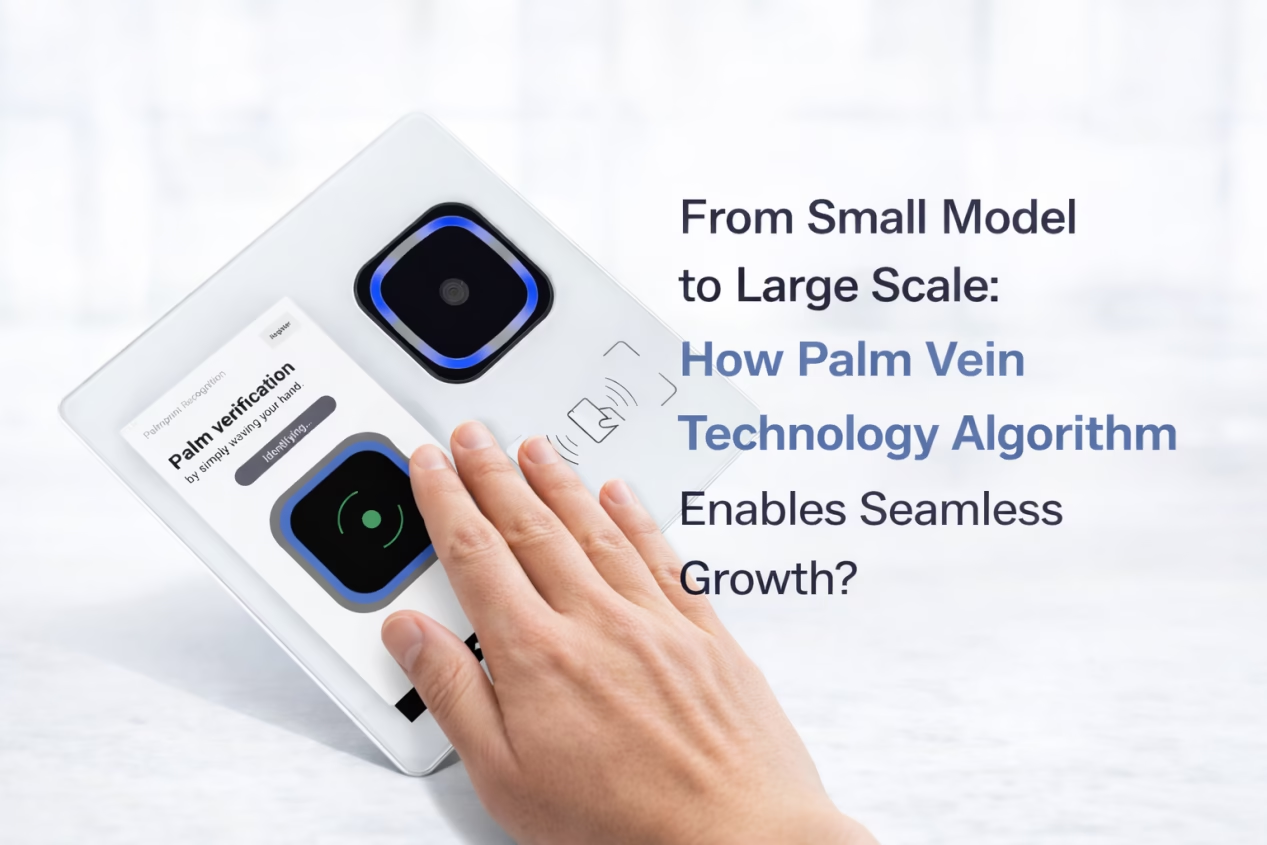
From Small Model to Large Scale: How Palm Vein Technology Algorithm Enables Seamless Growth?
Introduction
For many biometric projects, the journey does not start at scale.
Most systems begin with:
- Pilot testing
- Limited user groups
- Proof of concept (PoC) deployments
But a key challenge quickly emerges:
How can a system scale from thousands to millions of users without rebuilding everything?
This is where palm vein technology algorithm introduces a fundamentally different approach — enabling seamless growth from small model to large scale deployment.
The Traditional Scaling Problem
In many biometric systems, scaling creates major challenges:
- Systems designed for small datasets fail at large scale
- Accuracy drops as user numbers increase
- Re-enrollment becomes necessary when upgrading systems
- Infrastructure must be redesigned
This leads to:
- High operational cost
- Poor user experience
- Deployment delays
The Concept of Small Model vs Large Model
Palm vein systems are typically designed with two stages:
Small Model
- Supports up to ~10,000 users
- Lightweight deployment
- Ideal for MVP, pilot, and early-stage testing
- Faster setup with minimal infrastructure
Large Scale Model
- Supports hundreds of thousands to millions of users
- Optimized for high concurrency
- Requires GPU + vector database architecture
- Designed for real-world commercial deployment
The Key to Seamless Growth: Data Strategy
The most critical design principle is:
Store both RGB and IR images during registration.
Why this matters:
- Enables future algorithm upgrades
- Eliminates the need for re-enrollment
- Supports advanced feature extraction
Why RGB + IR Data Is Essential
During registration, the system captures:
- RGB images → palm surface features
- IR images → vein structure
At small scale, feature vectors alone may be sufficient.
However, at large scale:
- The system requires re-extraction of features using improved algorithms
- Stored images allow continuous optimization without user impact
Large Scale Algorithm: Multi-Factor Matching
At scale, the system uses a four-factor matching mechanism:
- Device-side palm print features
- Device-side vein features
- Server-side palm print features (from RGB images)
- Server-side vein features (from IR images)
This ensures:
- Higher accuracy
- Better stability
- Lower false acceptance rate
Real Performance in Large-Scale Scenarios
To validate scalability, large-scale testing was conducted:
Test Conditions
- Database: 5 million users
- Concurrency: 100,000 parallel operations
- Infrastructure: GPU (NVIDIA A10) + Milvus
Results
- Average response time: ~300 ms
- Recognition success rate: ~99% level
- Stable performance under high concurrency
Seamless Upgrade Without Re-Enrollment
One of the biggest advantages of this architecture:
👉 No need to re-register users when upgrading from small model to large scale
Because:
- Original RGB + IR images are already stored
- New algorithms can reprocess existing data
- Feature vectors can be regenerated
This enables:
- Zero disruption to users
- Faster system evolution
- Lower operational cost
Architecture That Supports Growth
A scalable system is built with future growth in mind:
Device Layer
- Consistent data capture (RGB + IR)
- Standardized input quality
Algorithm Layer
- Upgradeable models
- Feature reprocessing capability
Data Layer
- Image + vector storage
- Supports re-indexing
Infrastructure Layer
- GPU scalability
- Distributed deployment
Why This Matters for Real-World Deployment
In real applications:
- User bases grow rapidly
- Business requirements evolve
- Security standards increase
A system that cannot scale smoothly will:
- Require costly rebuilds
- Interrupt operations
- Lose user trust
Palm vein technology avoids this by designing for growth from day one.
Conclusion
Scaling biometric systems is not just about adding more servers.
It requires a forward-thinking algorithm and data architecture.
Palm vein technology enables seamless growth by:
- Capturing RGB + IR data from the start
- Supporting feature re-extraction
- Using multi-factor matching
- Leveraging GPU + vector database architecture
Final Thought
A scalable biometric system is not built for today’s users,
but for tomorrow’s millions.
Palm vein technology ensures that your system can grow —
without rebuilding, without re-enrollment, and without compromise.
CTA
If you are planning a biometric system that needs to evolve from pilot to large-scale deployment,
this architecture provides a future-ready path.
👉 Learn more: https://biowavepass.com/biowavepass-palm-vein-scanner-products/
Share this article
About the Author

You might also like
What is Palm Vein Technology Solution? And What Are the Costs?
How Palm Vein Technology Large Scale Algorithm Handles Millions of Users in Real-Time?
Why Capture Consistency Matters More Than Algorithms in Palm Vein Recognition?

Who Owns Tokenization in Palm Vein Payment Projects?
How Does Tokenization Work in Palm Vein Payment Architecture?

Can Palm Registration and Payment Be Done in One Tap? A Practical View from BioWavePass
As a Developer, How Can We Upgrade from a Small Model to a Large Model Palm Vein Recognition Algorithm Without Re-Registering Users?

How Secure Is Palm Vein Technology Against Spoofing Attacks?
How to Choose the Right Palm Vein Recognition Device for Your Project?