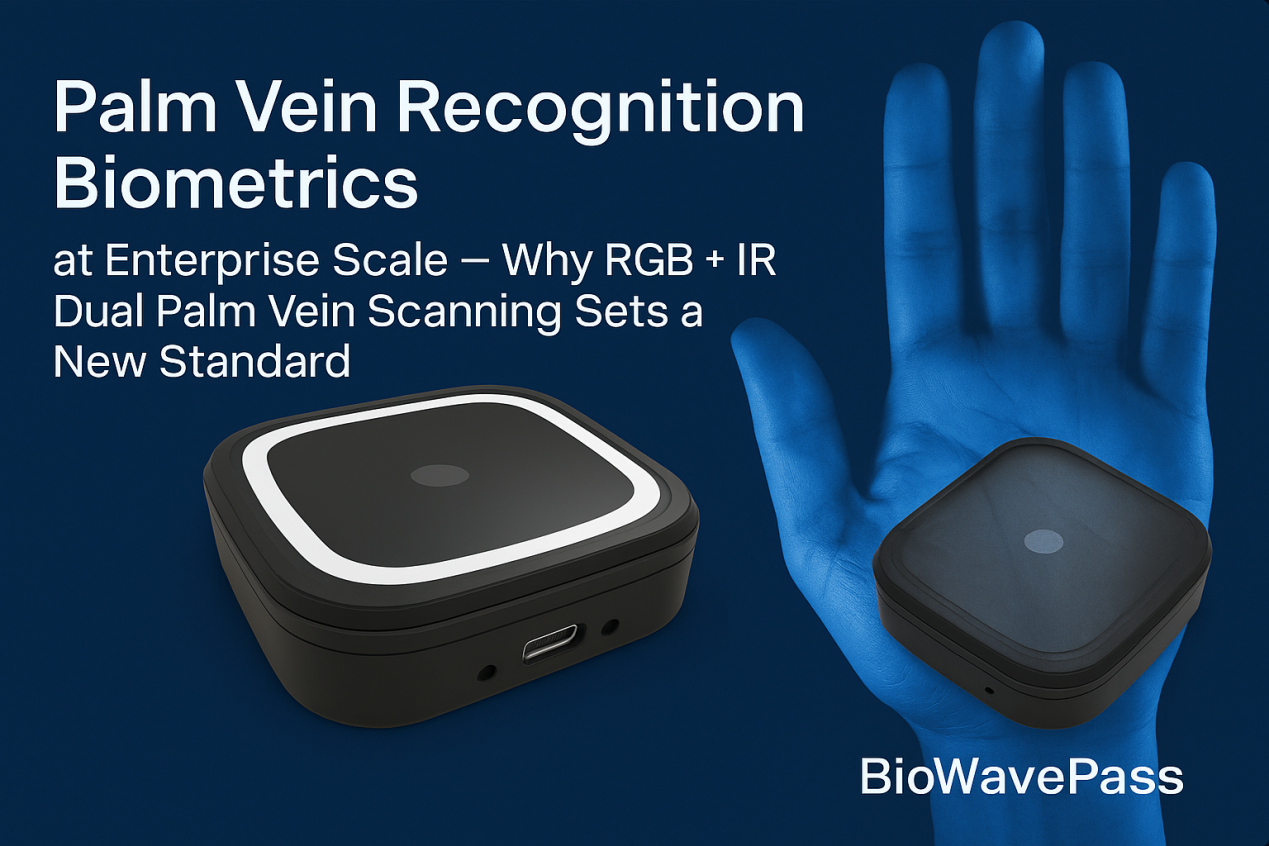
Palm Vein Recognition Biometrics at Enterprise Scale — Why RGB+ IR Dual Palm Vein Scanning Sets a New Standard
As industries seek deeper trust in digital identity, BioWavePass is pushing biometric authentication to a new threshold — with a dual-spectrum palm recognition system that fuses AI, IR vascular imaging, and visible-light palm print analysis.
It’s not just about scanning hands.
It’s about scaling trust, securely and accurately.
🔬 More Than Skin Deep: How BioWavePass Scans Work
Traditional biometrics look at the body.
BioWavePass looks into it.
Using synchronized RGB (visible light) and IR (near-infrared) cameras, our system generates a biometric profile from both:
- Surface-level skin creases (palm print)
- Subdermal vascular structures (palm vein)
The combination produces a dual-dimensional signature that’s far more spoof-resistant than single-mode solutions.
⚙️ Behind the Scenes: Identity Verification in Motion
Every authentication session follows a secure six-stage process:
Sensing
User presents palm; RGB + IR capture occurs in less than 1 second.Vectorization
Device SDK extracts core features from both modalities (locally, on device).Encrypted Transmission
No raw image ever leaves the sensor.
Instead, vectors are transmitted via SSL-protected API to your server.Biometric Match
Your system compares it against a biometric index (cloud or on-prem).Business Binding
Matched user ID triggers access logic in your app — unlocks, logs in, authorizes, etc.Real-Time Feedback
Confirmation and response sent back to the device or gate terminal.
📊 Accuracy by Design: 1 in 100 Billion Match Integrity
Unlike IR-only scanners that stop at vascular data, BioWavePass dual-mode architecture enables significantly higher confidence scoring.
| Signal Source | Rejection Rate @ FAR 1e-6 |
|---|---|
| RGB Palmprint | ~1.00% |
| IR Vein Pattern | ~1.52% |
Together, the probability of a false positive across both is:
1 in 100,000,000,000 (100 billion)
That’s beyond forensic-grade — it’s fintech-grade.
🌟 Why Dual-Spectrum Is the Future
Organizations choosing BioWavePass benefit from:
- Advanced liveness detection (resists fake hands or photos)
- Dual-sensor fallback for higher uptime
- RGB module that also enables QR scanning workflows
- Enhanced compatibility with high-volume databases
- 0.3–0.4s recognition even under 5M+ IDs
- Clean scan angle tolerance up to 30° pitch / roll
🧱 Core Hardware Options
| Model | Key Use Case | Supported OS |
|---|---|---|
| WavePass500 | Standalone Android terminal (wall-mount, NFC ready) | Android 11 |
| PalmVein 01 | Embedded USB scanner for kiosk/gate integrations | Windows / Linux / Android |
Both support:
- Dual-modality RGB + IR acquisition
- AES-256 secure feature storage
- SDK for local/remote deployment
- Compatible with on-premise or hybrid cloud infrastructure
💼 Typical Applications
- ✅ Cashless hand-pay terminals
- ✅ Healthcare admissions without ID cards
- ✅ eKYC onboarding in digital banking
- ✅ Touchless access to controlled zones
- ✅ Municipal or enterprise self-service kiosks
📦 Added Value: Built-in QR Scan Capability
Unlike IR-only sensors, BioWavePass uses its RGB module to read QR codes at 3–20 cm range.
This enables:
- Seamless fallback with QR if palm fails
- Dual ID path (biometric + code) for flexible UX
- Reduced cost — no external QR module required
Client software handles QR decoding.
🔐 Designed with Data Integrity in Mind
- Transport Layer: SSL-protected, encrypted API
- Storage: AES-256 secured vectors only (no raw image data)
- User Privacy: Pseudonymous by default — your system handles binding
- Compliance-Ready: Aligned with global fintech security norms
🧭 Final Thought
Most biometric systems force you to choose: speed, security, or scalability.
BioWavePass is engineered to give you all three — powered by multi-layered intelligence, and ready for mission-critical deployment.
The next era of authentication isn’t just about who you are.
It’s about how deeply your identity can be trusted.
PalmVein #BiometricSecurity #BioWavePass #TouchlessVerification #KYC #HealthcareBiometrics #AccessControl #DualSpectrumScanner #PalmScanner #IRBiometrics #RGBAI
Share this article
About the Author

You might also like
How Does Tokenization Work in Palm Vein Payment Architecture?
Can Palm Registration and Payment Be Done in One Tap? A Practical View from BioWavePass
As a Developer, How Can We Upgrade from a Small Model to a Large Model Palm Vein Recognition Algorithm Without Re-Registering Users?
How Secure Is Palm Vein Technology Against Spoofing Attacks?
How to Choose the Right Palm Vein Recognition Device for Your Project?
Why Is It Not Recommended to Use a Single Palm Scan for Both Identification and Registration?
What Is the Next-Gen Contactless Payment Method?
Which Is the Best EMV & PCI Certified Palm Vein POS Terminal?
Will Palm Vein POS Support Existing EMV, NFC, and QR Payment Ecosystem?
