The Story Under Your Hand- Palm Vein Scanning
How BioWavePass Is Redefining Palm Vein Biometrics
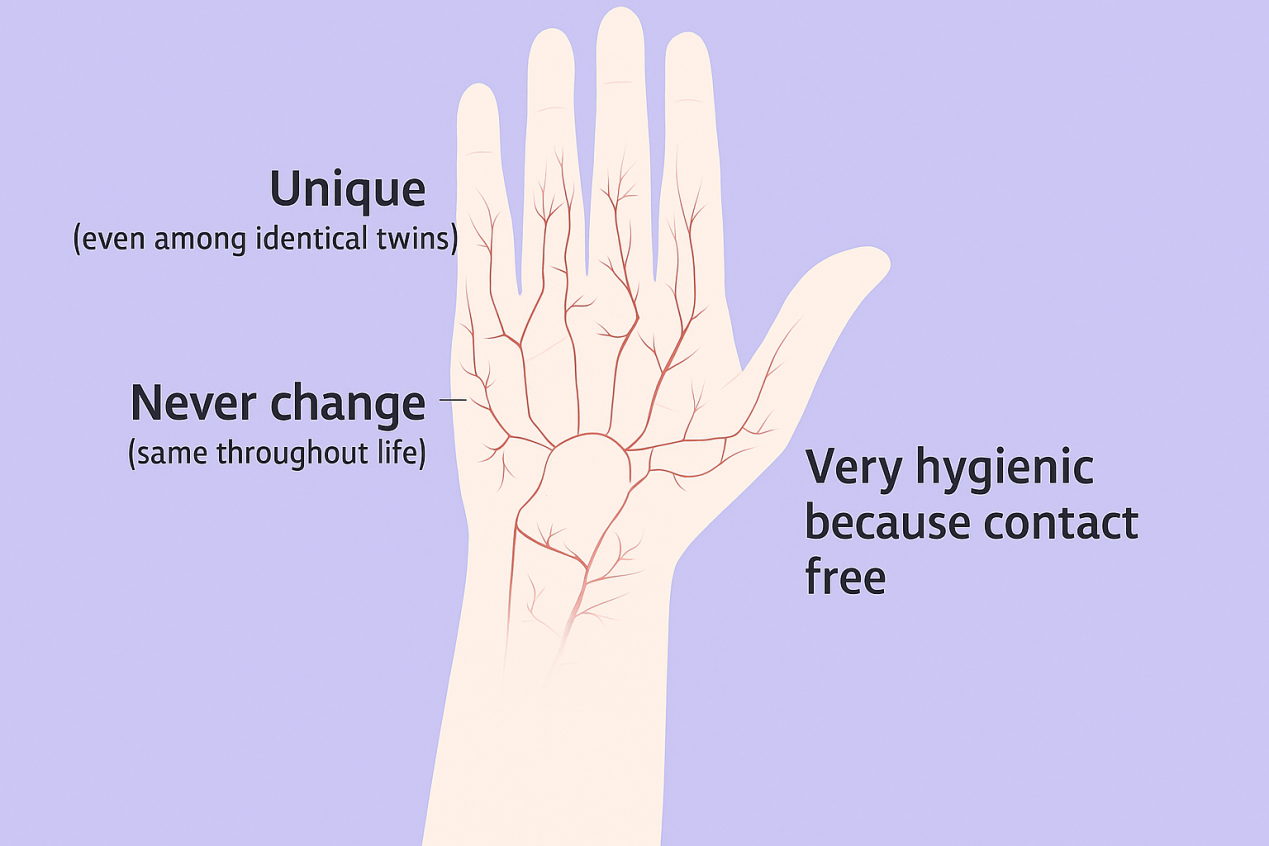
When you look at your palm, you might see familiar lines and folds — but hidden just beneath is a world that’s uniquely yours. A network of invisible palm veins, distinct in every human, even identical twins. This invisible identity is now becoming the foundation of a new generation of secure, contactless authentication — and BioWavePass is at the heart of it.
🔍 What is Palm Vein Scanning?
Palm vein biometrics is a revolutionary form of identification that uses near-infrared light to scan the internal vein patterns in your hand plus RGB Palm Vein image technology. Unlike fingerprints, which are visible and vulnerable to spoofing or wear, palm vein patterns are internal and invisible to the naked eye, making them highly secure and resistant to forgery.
At BioWavePass, we’ve embraced this innovation to develop secure, high-speed, AI-powered biometric systems designed for government ID programs, eKYC, and palm-based payment infrastructure.
💡 Why BioWavePass?
Co-developed with China’s leading Palm Payment platform, BioWavePass devices are optimized for:
- 🔐 High-security, high-volume matching
- ⚡ Real-time identity verification
- 🧼 Contactless hygiene — perfect for post-COVID environments
Whether you’re building a banking platform, an access control system, or a public sector welfare distribution app, our palm vein devices are designed to match in less than 0.35 seconds — with 99%+ accuracy even across millions of IDs.
🔬 How Does It Work?
- Scan – The user waves their palm over the scanner.
- Capture – RGB + IR sensors capture both color and infrared patterns.
- Extract – AI algorithms extract feature points from the palm vein map.
- Match – These features are matched against a secure local or cloud database.
- Authenticate – If a match is found, access is granted or a payment is approved.
Each palm scan creates a biometric signature that’s near impossible to replicate, and because it’s non-contact, it’s also inherently more hygienic and tamper-proof than fingerprint or face scans.
🆚 Why Not Fingerprints?
Unlike fingerprints, which can be damaged, faked, or worn down, palm vein biometrics are:
- ✅ Internal (not left on surfaces)
- ✅ Uniquely secure (no two vein patterns are alike)
- ✅ Stable over a lifetime
- ✅ Contactless and friction-free
This makes BioWavePass the go-to solution in healthcare, fintech, eKYC, and public infrastructure.
🌍 Real-World Impact
BioWavePass is already enabling:
- 💳 Palm-based payments in rural banking apps
- 🆔 Biometric eKYC for government subsidies
- 🏥 National ID & healthcare integration in emerging markets
With open SDKs, MDM device control, and support for Android, Linux, and Windows, developers can deploy scalable, secure biometric solutions without reinventing the wheel.
🚀 The Future in Your Hand
We believe the future of digital identity and authentication is invisible, seamless, and secure — and it starts in the palm of your hand.
With BioWavePass, we’re not just building hardware — we’re co-creating a world where your palm becomes your passport, your payment method, and your identity key.
Share this article
About the Author

You might also like
How Does Tokenization Work in Palm Vein Payment Architecture?
Can Palm Registration and Payment Be Done in One Tap? A Practical View from BioWavePass
As a Developer, How Can We Upgrade from a Small Model to a Large Model Palm Vein Recognition Algorithm Without Re-Registering Users?
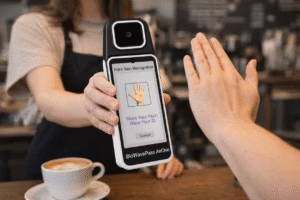
How Secure Is Palm Vein Technology Against Spoofing Attacks?
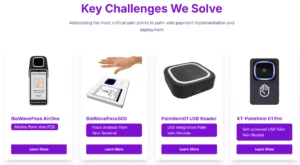
How to Choose the Right Palm Vein Recognition Device for Your Project?
Why Is It Not Recommended to Use a Single Palm Scan for Both Identification and Registration?
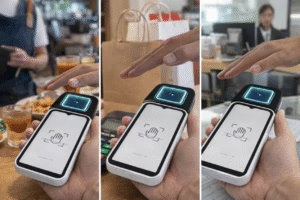
What Is the Next-Gen Contactless Payment Method?
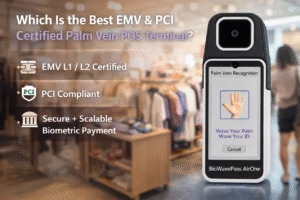
Which Is the Best EMV & PCI Certified Palm Vein POS Terminal?
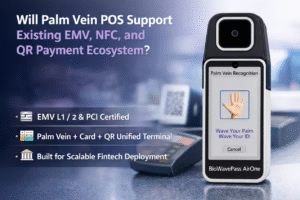
Will Palm Vein POS Support Existing EMV, NFC, and QR Payment Ecosystem?
