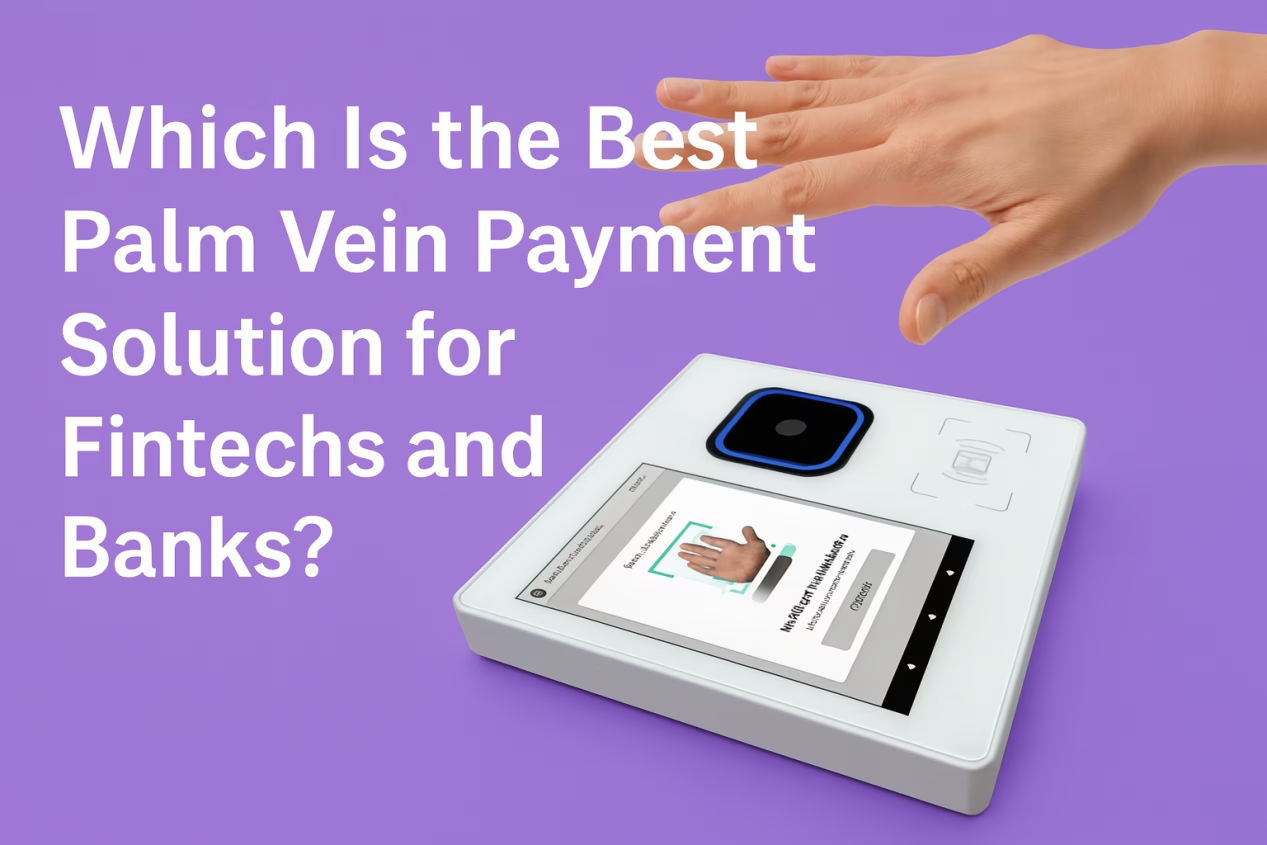
Which Is the Best Palm Vein Payment Solution for Fintechs and Banks?
Introduction
FinTech companies and banks are under growing pressure to deploy secure, frictionless biometric payment systems that scale reliably. As traditional cards and mobile wallets evolve, the industry’s focus is shifting to Palm Vein Payment Solutions—combining security, hygiene, and speed.
This article explains how to choose the best Palm Vein Payment, Palm Vein Scanner, and Biometric POS solution for enterprise-grade deployments.
1. Why Palm Vein Payment Matters for FinTechs & Banks
| Challenge | How Palm Vein Helps | Key Advantage |
|---|---|---|
| High fraud & cloning risk | Subcutaneous vein patterns are unique and highly spoof-resistant (Security Journal Americas) | Stronger authentication |
| Need for speed & hygiene | Contactless palm authentication suits retail, branch, ATM, and POS (Ingenico Blog) | Better UX & throughput |
| Legacy investment | Mature solutions offer POS compatibility + SDKs | Lower retrofit cost |
2. Essential Criteria for Evaluating Solutions
| Criterion | Why It Matters | What to Look For |
|---|---|---|
| Accuracy & Anti-Spoofing | Payments can’t tolerate high FAR/FRR | Dual-mode RGB + IR scanning with published metrics (ResearchGate Study) |
| Deployment Speed | Time-to-market is a competitive advantage | Plug-and-play hardware + clear SDK/API docs |
| POS Compatibility | Banks/FinTechs already run large estates | USB/OTG/RS232/RJ45; SDKs for Android/Linux/Windows |
| Scalability & Performance | Millions of IDs, low latency | Proven at enterprise scale (Global Market Insights) |
| Compliance & Data Sovereignty | Financial data governance | On-prem/private-cloud matching; encrypted templates |
| Dev & Integration Support | Capacity varies by team | Complete SDKs, samples, and dedicated engineers |
3. Palm Vein Payment Solution Types
| Solution Type | Typical Offering | Pros | Cons |
|---|---|---|---|
| Palm Print Only | Single-spectrum imaging | Lower cost | Less secure; easier to spoof |
| Dual-Mode (Print + Vein) | RGB + IR fusion | High security; anti-spoof | Slightly higher device cost |
| Full-Stack Provider | Hardware + SDK + integration | Turnkey for banks/FinTechs | Fewer vendors; potential dependency |
For banks and FinTechs, dual-mode or full-stack options usually strike the best balance of security, developer control, and infrastructure compatibility.
4. Why BioWavePass Leads the Market
- Dual-mode RGB + IR imaging with extremely low false acceptance (≈ 1e-11, one in tens of billions).
- Palm Vein SDK with APIs, reference apps, and cross-platform support (Android/Linux/Windows).
- POS compatibility: USB / RS232 / RJ45 / OTG retrofit into existing terminals.
- Private-cloud or on-prem deployments for compliance and data sovereignty.
- Dedicated integration engineers support end-to-end delivery for payment and eKYC flows.
5. Implementation Roadmap for FinTechs & Banks
| Phase | Timeline | Key Activities |
|---|---|---|
| Pilot | 1–2 weeks | Integrate SDK, enrol 1,000–10,000 users, verify accuracy — includes free small-model algorithm support (up to 10,000 IDs). |
| Roll-out | 3–6 weeks | Connect to payment gateway / POS network. |
| Scale-up | Continuous | Optimize performance for millions of IDs — requires paid large-model algorithm license with seamless transition from the small model. |
BioWavePass enables clients to deploy private servers within one hour and provides end-to-end Palm Vein Payment integration.
Engineering teams in India and the UK support both sandbox pilots and commercial-scale rollouts.
6. Key Takeaways for Decision-Makers
- Fraud reduction: Internal, live-blood vein signatures cut spoof risk.
- Contactless UX: Hygienic 5–15 cm hover improves trust and throughput.
- POS Compatibility: Retrofit instead of rip-and-replace.
- Faster time-to-market: SDK + reference apps + dedicated engineers.
- Scale & compliance: On-prem/private cloud, encrypted biometric templates.
Conclusion
For institutions evaluating biometric options, Palm Vein Payment offers the strongest blend of security, hygiene, and scalability.
With dual-mode imaging, SDK-first integration, and proven POS compatibility, BioWavePass sets a practical standard for Biometric POS and Contactless Payment in banking and FinTech.
Learn More: BioWavePass Palm Vein Payment Solution
Share this article
About the Author

You might also like
Which Is the Best EMV & PCI Certified Palm Vein POS Terminal?
Will Palm Vein POS Support Existing EMV, NFC, and QR Payment Ecosystem?

Why Palm Vein Technology Is Emerging as a Payment-Grade Biometric Standard
Where Is Palm Vein Biometric Data Stored and How Is It Secured?
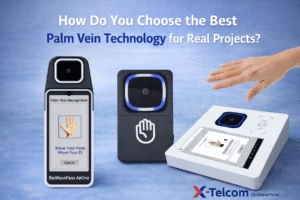
How Do You Choose the Best Palm Vein Technology for Real Projects?
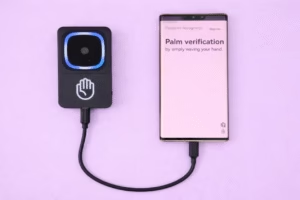
How to Solve Power Issues in Palm Vein Scanner Projects?
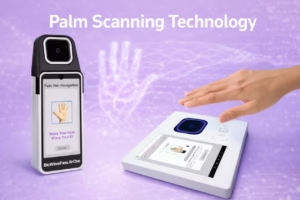
What Is Palm Scanning Technology?
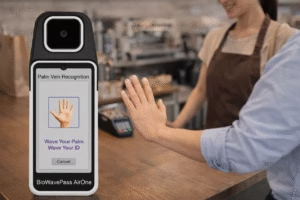
How Palm Vein Biometrics Can Be Integrated Into Mobile Payment Systems: A BioWavePass Implementation Guide
How to setup Palm Payment? Designing a Seamless Palm Payment Flow for Fintech and Payment Platforms