La sécurité de la veine palmaire expliquée : Pourquoi le BioWavePass est immunisé contre la reconstruction du signal EM
Comprendre l'étude EMPalm et comment BioWavePass redéfinit la sécurité du Palm Vein.
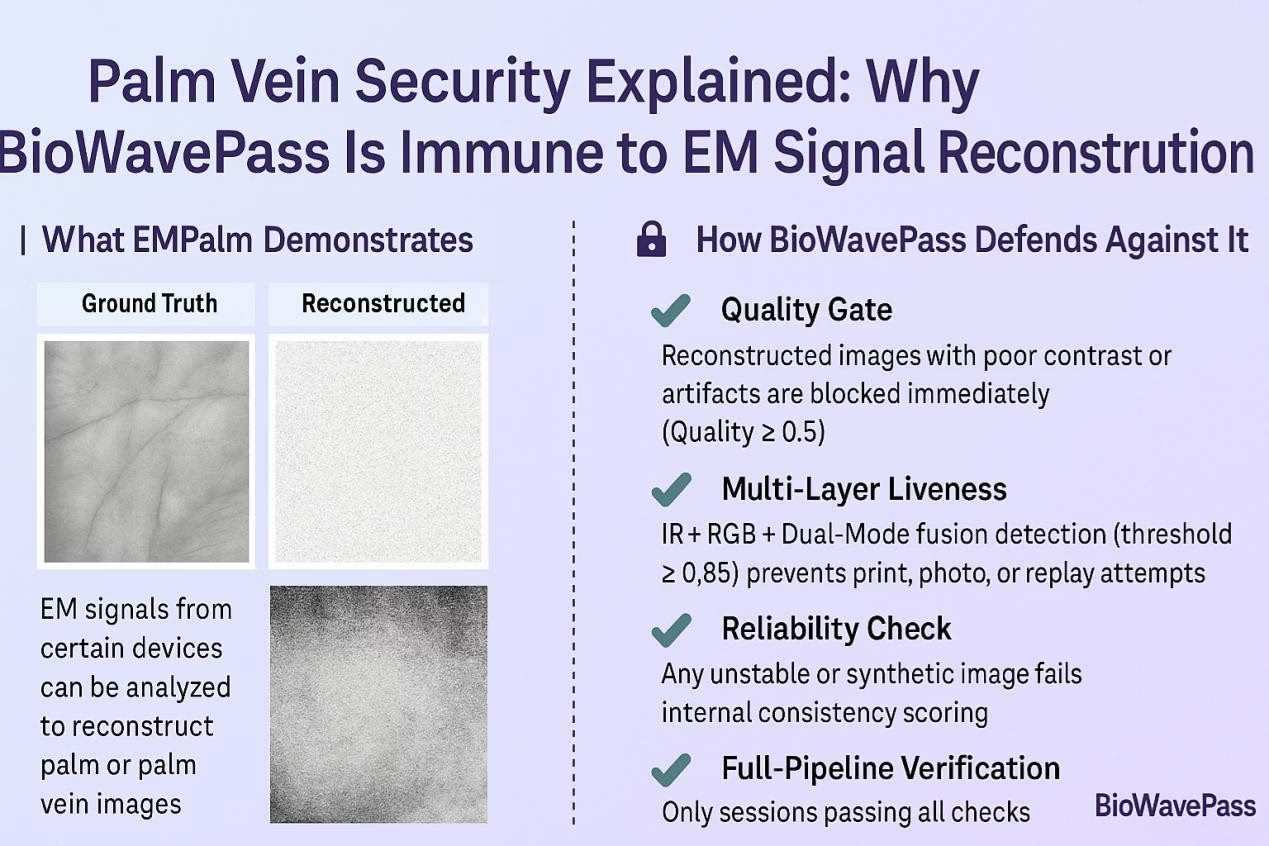
⚡ Ce que l'EMPalm démontre
Un document académique récent, “EMPalm : Exfiltrer les données biométriques de la paume de la main via des canaux secondaires électromagnétiques”.” a suscité un débat dans le secteur de la biométrie.
La recherche a cherché à savoir si les émissions électromagnétiques (EM) provenant de dispositifs biométriques pourraient être analysées pour reconstruire les images de la paume ou de la veine de la main.
Voici les conclusions de l'étude :
- Les signaux EM provenant de configurations matérielles spécifiques peuvent être capturés et analysés pour reconstruire les images partielles de la paume de la main.
- Ces reconstructions présentent une similarité structurelle modérée (SSIM ≈ 0,79), mais ont montré bruit important, distorsion et perte de détails de la veine.
- La recherche met principalement en évidence une théorique que les fuites de données au niveau du matériel doivent être prises en compte dans la conception du système.
🔒 Comment BioWavePass s'en défend-il ?
Au BioWavePass, Notre équipe d'ingénieurs en biométrie a analysé en profondeur les conclusions de l'EMPalm.
Nous avons conclu qu'une telle reconstruction des canaux latéraux ne pas compromettre les systèmes de veines de la paume de la main en situation réelle, construits sur architecture bimode RVB + IR comme la nôtre.
Notre défense commence au cœur de l'algorithme, où chaque image doit passer par de multiples portes de validation avant toute comparaison ou extraction de caractéristiques.
✅ 1. Portail de qualité
Les images de mauvaise qualité, bruyantes ou présentant des distorsions de contraste sont immédiatement bloquées.
Qualité ≥ 0,5 garantit que les artefacts EM reconstruits ne peuvent pas entrer dans le pipeline.
✅ 2. Détection du caractère vivant à plusieurs niveaux
BioWavePass utilise trois points de contrôle de l'existence :
- Caractère vivant de l'IR (
≥ 0.5) - Luminosité RVB (
≥ 0.5) - Fusion bimodale Caractère vivant (
≥ 0.85)
Cette défense multicouche empêche l'usurpation d'identité au moyen d'impressions, de photos ou de reproductions d'écran, garantissant ainsi que seules les personnes qui ont un accès à l'Internet sont autorisées à accéder à l'Internet. des palmiers bien vivants sont reconnues.
✅ 3. Reliability Check
Any inconsistent or synthetic frames fail internal reliability scoring (ReliabilityError), blocking unstable or AI-generated patterns from proceeding.
✅ 4. Full-Pipeline Verification
Only sessions where all checks return success (kDimPalmSuccess) advance to feature extraction.
If any gate fails, no biometric data is produced — completely nullifying potential side-channel replays.
📘 Our View
The EMPalm research is valuable as a theoretical benchmark, but its reconstructed images would never pass BioWavePass’s multi-gate security process.
Our dual-mode palm vein technology already mitigates the very weaknesses EMPalm highlights.
True palm vein recognition demands:
- Dual-sensor validation (RGB + IR)
- Liveness integrity across all layers
- Full-chain verification before feature extraction
These elements define BioWavePass Palm Vein Technology — secure, adaptive, and future-ready.
Conclusion
Electromagnetic side-channel analysis might expose abstract signal patterns, but it cannot recreate the biological integrity of a live palm.
BioWavePass’s deep-learning architecture, combined with sensor-level quality and liveness validation, ensures unmatched biometric safety.
Your palm remains your identity —
Your Palm, Your ID.
Partager cet article
A propos de l'auteur

Vous pourriez aussi aimer
Which Is the Best EMV & PCI Certified Palm Vein POS Terminal?
Will Palm Vein POS Support Existing EMV, NFC, and QR Payment Ecosystem?

Why Palm Vein Technology Is Emerging as a Payment-Grade Biometric Standard
Where Is Palm Vein Biometric Data Stored and How Is It Secured?
How Do You Choose the Best Palm Vein Technology for Real Projects?
How to Solve Power Issues in Palm Vein Scanner Projects?
What Is Palm Scanning Technology?
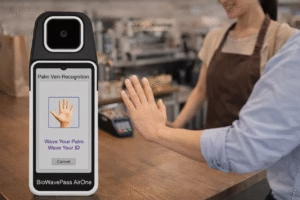
How Palm Vein Biometrics Can Be Integrated Into Mobile Payment Systems: A BioWavePass Implementation Guide
How to setup Palm Payment? Designing a Seamless Palm Payment Flow for Fintech and Payment Platforms