Palm Vein Security Explained: Why BioWavePass Is Immune to EM Signal Reconstruction
Understanding the EMPalm Study and How BioWavePass Redefines Palm Vein Security.
⚡ What EMPalm Demonstrates
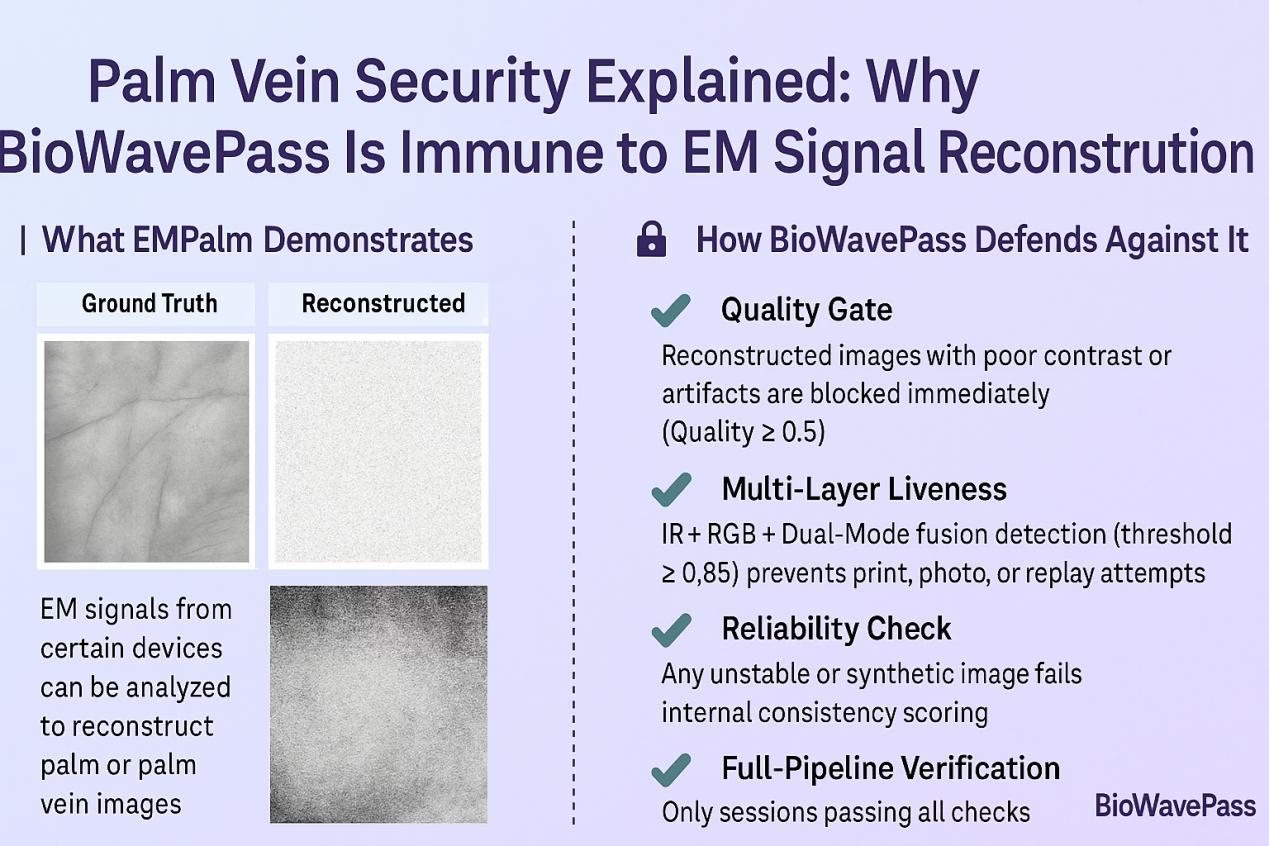
A recent academic paper, “EMPalm: Exfiltrating Palm Biometric Data via Electromagnetic Side-Channels,” sparked discussion in the biometric industry.
The research investigated whether electromagnetic (EM) emissions from biometric devices could be analyzed to reconstruct palm or palm vein images.
Here’s what the study found:
- EM signals from specific hardware setups can be captured and analyzed to reconstruct partial palm images.
- These reconstructions achieved moderate structural similarity (SSIM ≈ 0.79) but showed severe noise, distortion, and loss of vein detail.
- The research primarily highlights a theoretical vulnerability — that hardware-level data leakage must be considered in system design.
🔒 How BioWavePass Defends Against It
At BioWavePass, our team of biometric engineers analyzed the EMPalm findings in depth.
We concluded that such side-channel reconstruction does not compromise real-world palm vein systems built on dual-mode RGB + IR architecture like ours.
Our defense starts at the algorithmic core — where each image must pass through multiple validation gates before any comparison or feature extraction occurs.
✅ 1. Quality Gate
Low-quality, noisy, or contrast-distorted images are immediately blocked.
Quality ≥ 0.5 ensures that reconstructed EM artifacts cannot enter the pipeline.
✅ 2. Multi-Layer Liveness Detection
BioWavePass employs three liveness checkpoints:
- IR Liveness (
≥ 0.5) - RGB Liveness (
≥ 0.5) - Dual-Mode Fusion Liveness (
≥ 0.85)
This layered defense prevents spoofing by printouts, photos, or screen replays — ensuring that only real, live palms are recognized.
✅ 3. Reliability Check
Any inconsistent or synthetic frames fail internal reliability scoring (ReliabilityError), blocking unstable or AI-generated patterns from proceeding.
✅ 4. Full-Pipeline Verification
Only sessions where all checks return success (kDimPalmSuccess) advance to feature extraction.
If any gate fails, no biometric data is produced — completely nullifying potential side-channel replays.
📘 Our View
The EMPalm research is valuable as a theoretical benchmark, but its reconstructed images would never pass BioWavePass’s multi-gate security process.
Our dual-mode palm vein technology already mitigates the very weaknesses EMPalm highlights.
True palm vein recognition demands:
- Dual-sensor validation (RGB + IR)
- Liveness integrity across all layers
- Full-chain verification before feature extraction
These elements define BioWavePass Palm Vein Technology — secure, adaptive, and future-ready.
Conclusion
Electromagnetic side-channel analysis might expose abstract signal patterns, but it cannot recreate the biological integrity of a live palm.
BioWavePass’s deep-learning architecture, combined with sensor-level quality and liveness validation, ensures unmatched biometric safety.
Your palm remains your identity —
Your Palm, Your ID.
Share this article
About the Author

You might also like
Bringing Palm Vein Scanning into a Web Workflow
From Palm Payment MVP to Commercial Deployment: Building a Scalable Biometric Payment System
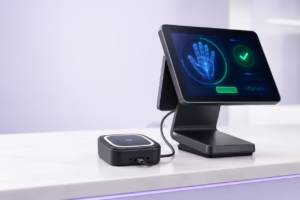
How to Integrate a USB Palm Vein Scanner with a POS Terminal
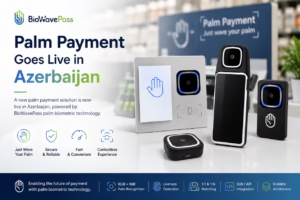
Palm Payment Goes Live in Azerbaijan: From Biometric Technology to Real-World Payment
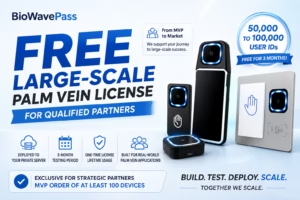
From MVP to Market: Scaling Palm Vein Technology with BioWavePass
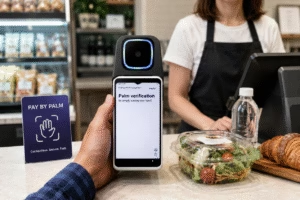
Palm Vein Payment: How Biometric Payments Work Without Cards or Phones
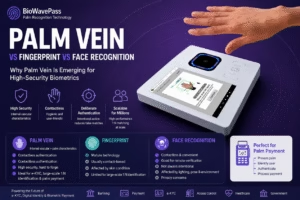
Palm Vein vs Fingerprint vs Face Recognition: Why Palm Vein Is Emerging for High-Security Biometrics
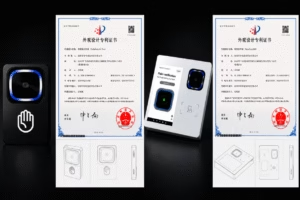
BioWavePass Palm Vein Scanner Products Receive Design Patent Certification
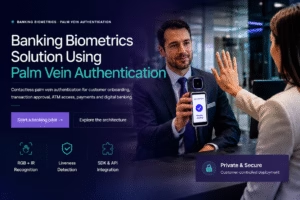
Palm Vein Authentication: The Future of Secure Digital Identity and Payments