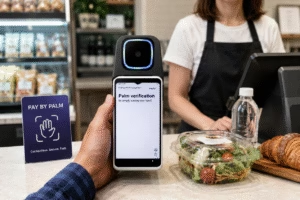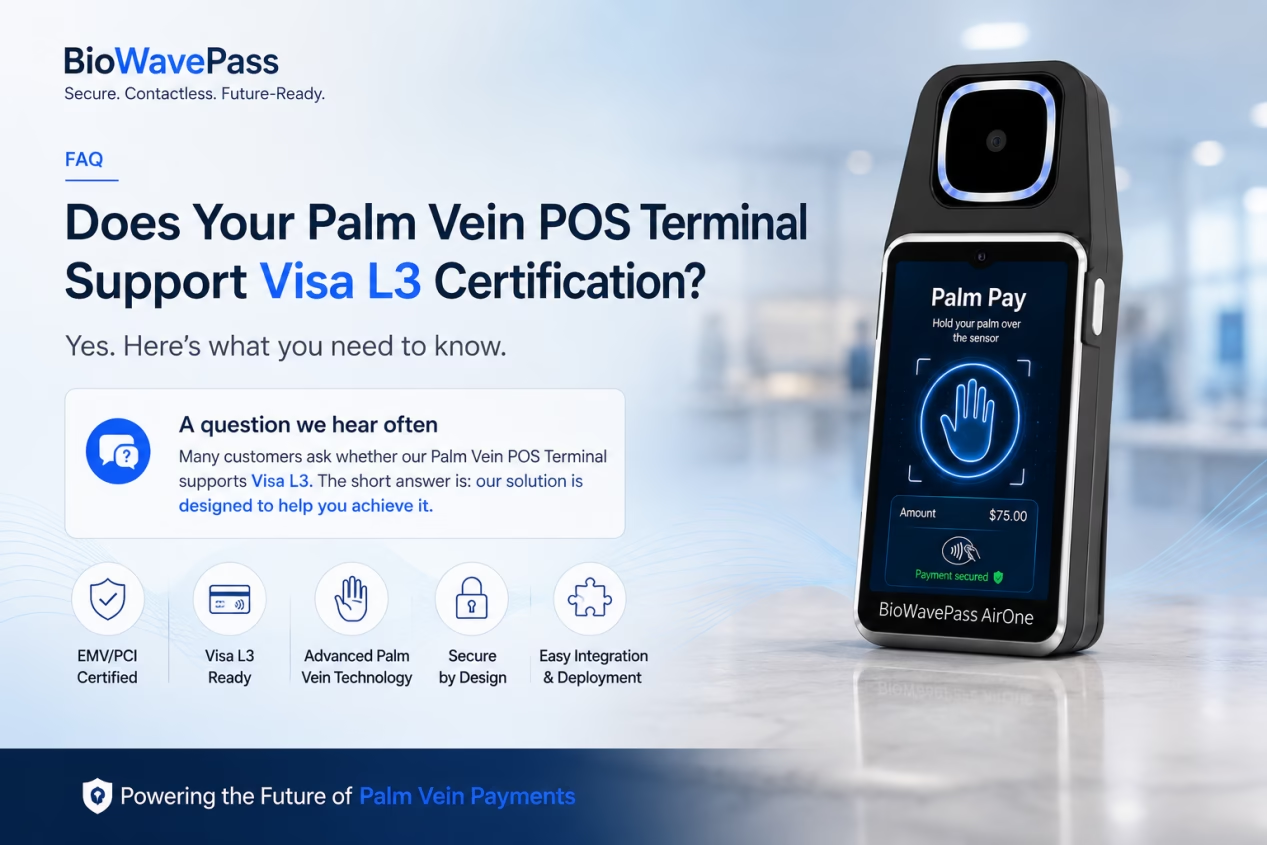
Does Your Palm Vein POS Terminal Support Visa L3? Here's What You Need to Know
If you’ve been researching Palm Vein Payment Technology, you’ve probably asked the same question we hear almost every week:
"Does your Palm Vein POS Terminal support Visa L3?"
It’s a great question, but there’s also a common misunderstanding about what Visa Level 3 (L3) actually is.
The short answer is:
Yes, BioWavePass AirOne is designed to support Visa L3 payment projects. However, Visa L3 is not a hardware certification of the POS terminal itself.
Understanding the difference can save payment providers, software developers, and system integrators significant time during project planning.
First, What Is Visa L3?
Visa certification consists of several different levels.
- EMV Level 1 (L1) validates the payment hardware interface.
- EMV Level 2 (L2) validates the EMV payment kernel.
- Visa Level 3 (L3) validates the complete payment application and transaction flow.
Unlike EMV L1 and L2, Visa L3 focuses on how the payment application communicates with Visa payment networks through the acquiring bank.
That means Visa L3 is typically completed by:
- Payment solution providers
- Software developers
- Merchants
- Acquiring banks
rather than by the POS hardware manufacturer.
Why Customers Ask About Visa L3
Many customers assume that if they purchase a Palm Vein POS Terminal, the hardware itself must already have "Visa L3 certification."
In reality, Visa L3 is project-specific.
The same payment terminal may be deployed in different countries, by different acquiring banks, running different payment applications.
Each payment application follows its own Visa L3 certification process.
This is why asking whether a POS terminal "has Visa L3" is not always the right question.
A better question is:
Is the Palm Vein POS Terminal designed to support Visa L3 payment applications?
For BioWavePass AirOne, the answer is yes.
BioWavePass AirOne Was Built for Payment Projects
The BioWavePass AirOne Palm Vein POS Terminal was developed specifically for modern biometric payment applications.
Rather than combining biometric authentication directly into the payment kernel, AirOne uses a modular architecture that keeps palm vein authentication separate from the certified payment functions.
This means the biometric system performs identity verification without modifying:
- EMV payment kernel
- Secure Element
- Cryptographic functions
- Payment transaction processing
- Secure Boot architecture
This approach simplifies integration while maintaining compatibility with established payment ecosystems.
Why This Matters
For software developers and payment providers, architecture matters.
By keeping biometric authentication independent from payment processing, AirOne enables developers to integrate Palm Vein Payment Technology into their applications while preserving the existing payment workflow.
The result is a flexible platform that supports innovation without introducing unnecessary complexity.
Built for Palm Vein Payment Technology
BioWavePass AirOne is more than a payment terminal.
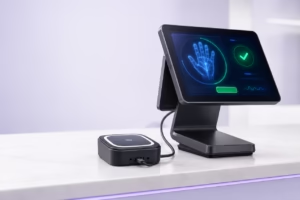
It is a complete Palm Vein POS Terminal designed for next-generation biometric payments.
The platform combines:
- Palm Vein Payment Technology
- Android operating system
- Contactless biometric authentication
- SDK and API integration
- Cloud or private deployment
- Enterprise biometric identity management
Whether the application is retail, banking, healthcare, transportation, or government services, AirOne provides developers with a secure foundation for biometric payment solutions.
A Faster Path to Deployment
Every payment project is different.
Different countries use different acquiring banks.
Different merchants deploy different payment applications.
Different software providers implement different user experiences.
Because Visa L3 certification is performed at the payment application level, AirOne provides a flexible platform that can be integrated into a wide variety of Visa payment projects.
Our goal is simple:
Help partners focus on building innovative Palm Vein Payment solutions instead of redesigning payment hardware.
The Future of Palm Vein Payments
Consumers increasingly expect payments to be:
- Contactless
- Fast
- Secure
- Convenient
Palm Vein Payment Technology delivers all four.
By combining advanced biometric authentication with a payment-ready Android platform, the BioWavePass AirOne Palm Vein POS Terminal helps financial institutions, fintech companies, and payment providers deliver a smoother and more secure customer experience.
As biometric payments continue to expand worldwide, flexible platforms like AirOne will play an increasingly important role in supporting the next generation of digital commerce.
Final Thoughts
So, does the BioWavePass AirOne Palm Vein POS Terminal support Visa L3?
Absolutely.
More importantly, it is designed to support the payment applications that undergo Visa L3 certification.
By combining a modular payment architecture, advanced Palm Vein Payment Technology, and enterprise-ready integration capabilities, AirOne provides a practical platform for organizations building the future of biometric payments.
If you’re planning your next Palm Vein POS Terminal project and have questions about EMV, PCI, Visa L3, or payment integration, our team is always happy to discuss your technical requirements.
Share this article
About the Author

You might also like
Scaling Palm Vein Payment: Single Server or Kubernetes Cluster?
Before You Scale Palm Vein POS: A Terminal Management Checklist
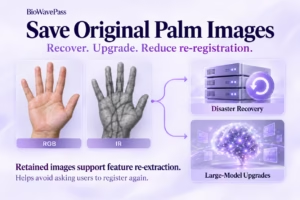
Why Saving Original Palm Images Matters for Biometric Recovery and Future Upgrades By BioWavePass
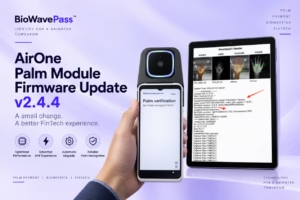
Optimizing Palm Payment Performance: AirOne Palm Module Firmware v2.4.4
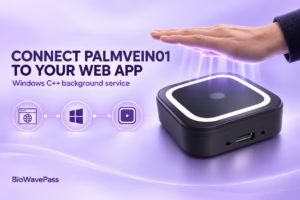
Bringing Palm Vein Scanning into a Web Workflow
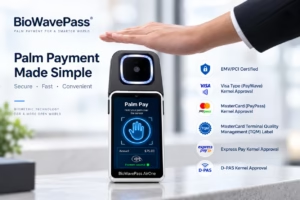
From Palm Payment MVP to Commercial Deployment: Building a Scalable Biometric Payment System
How to Integrate a USB Palm Vein Scanner with a POS Terminal
Palm Payment Goes Live in Azerbaijan: From Biometric Technology to Real-World Payment
From MVP to Market: Scaling Palm Vein Technology with BioWavePass