Palm Payment Goes Live in Azerbaijan: From Biometric Technology to Real-World Payment
Palm payment is moving from concept to commercial reality.
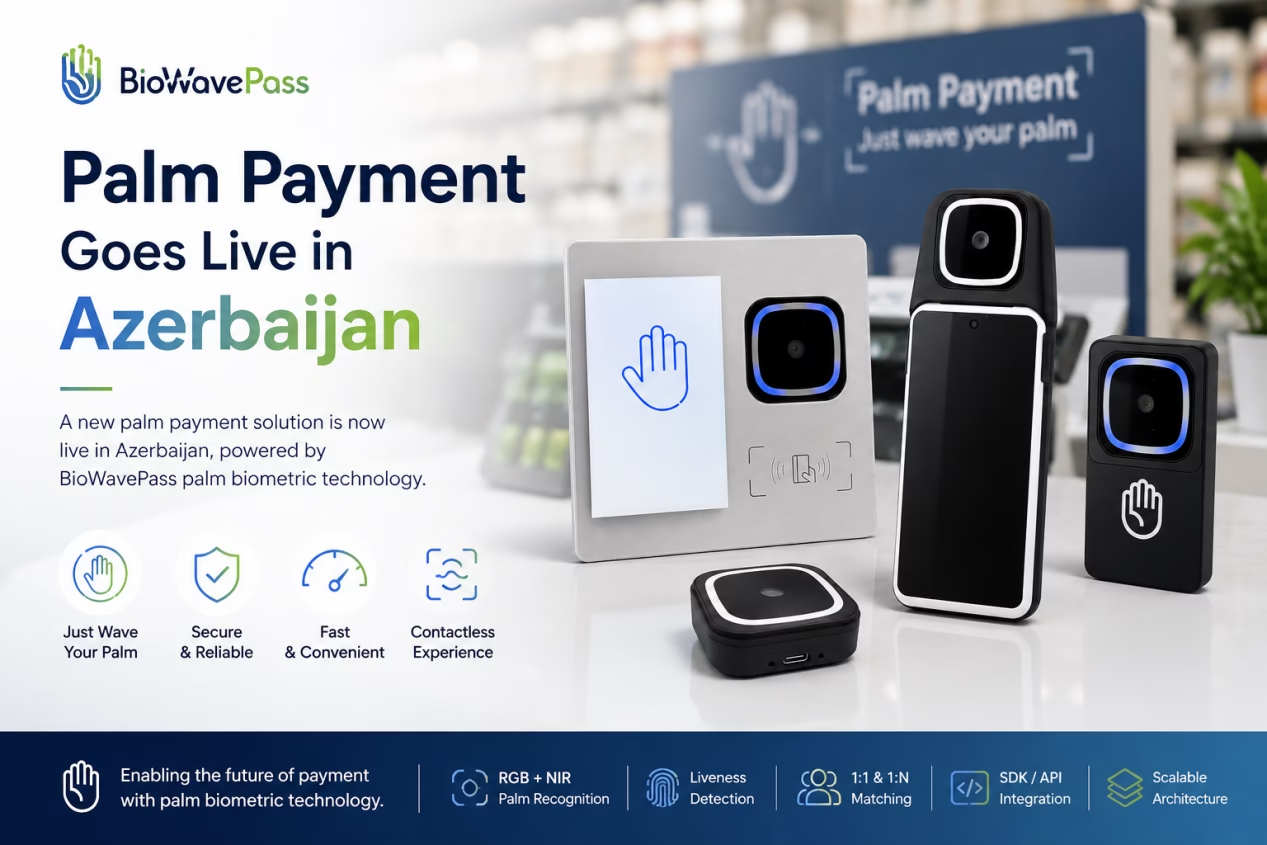
A new palm payment solution has now officially launched in Azerbaijan, allowing registered consumers to authenticate payments simply by presenting their palm.
For BioWavePass, this represents exactly the type of real-world application that palm biometric technology was designed to support.
Moving from laboratory testing and proof-of-concept projects into a live payment environment is an important milestone. It demonstrates how palm recognition can become part of an everyday consumer payment experience.
From Palm Recognition to Palm Payment
Palm payment may look simple to the consumer.
Present your palm.
Authenticate.
Pay.
Behind that simple interaction, however, is a much more sophisticated technology and payment ecosystem.
A typical architecture combines:
Palm Recognition + Digital Identity + User Account + Payment Platform + API Integration + Bank / Acquirer / Wallet + Payment Hardware
BioWavePass provides the biometric technology that enables the palm recognition and authentication layer within this ecosystem.
The payment platform and local financial infrastructure then manage the transaction itself.
Why Palm Payment Changes the User Experience
Contactless cards and mobile wallets have already made payment significantly easier.
But they still require the consumer to carry something.
Palm payment can remove that requirement from the point of interaction.
Once enrolled and connected to the appropriate payment account, the user can authenticate using only their palm.
No physical card.
No phone at checkout.
No additional device to present.
Just your palm.
This becomes particularly useful in everyday situations.
You might be carrying shopping bags, holding a coffee, travelling with luggage or simply want to complete a transaction without searching for a card or unlocking a phone.
The technology becomes valuable not because it adds another step, but because it removes one.
The Biometric Technology Behind the Experience
A palm payment system requires more than simply capturing an image of a hand.
BioWavePass palm recognition technology combines multiple components within the biometric authentication process.
RGB and NIR Palm Recognition
Palm characteristics can be captured using both RGB and near-infrared imaging.
NIR imaging enables the system to capture palm vein characteristics beneath the surface of the skin, while RGB imaging provides additional palm characteristics for biometric recognition.
Deteção de vivacidade
For payment applications, verifying that the biometric sample comes from a genuine live palm is an important part of the security architecture.
Liveness detection helps protect the authentication process against presentation attacks.
Biometric Feature Extraction
The captured biometric information is processed into a digital biometric template for matching.
The system does not need to compare conventional photographs of users during every authentication. Instead, biometric characteristics are extracted and converted into data suitable for secure matching.
1:N Biometric Matching
One of the most important capabilities for palm payment is 1:N identification.
Instead of requiring the customer to first present a card or another account identifier, the system can search the registered biometric database:
1 Palm → Search Registered Users → Identify User → Authenticate
This creates the possibility of a genuinely palm-first payment experience.
Palm Payment Is an Ecosystem
A successful palm payment deployment cannot be created by biometric hardware alone.
It requires cooperation between biometric technology, software platforms and financial infrastructure.
The complete ecosystem can include:
- Palm recognition hardware
- Biometric algorithms
- Liveness detection
- User enrollment
- Digital identity management
- API integration
- Payment platform
- Bank or acquiring infrastructure
- Merchant systems
- Transaction authorization
- Device management
This is why commercial palm payment projects require strong technical capabilities from every participant in the ecosystem.
The biometric technology must integrate effectively with an existing and mature fintech infrastructure.
Designed for Commercial Deployment
Moving from a small biometric demonstration to a live payment environment creates very different technical requirements.
A commercial system needs to consider:
- Recognition accuracy
- Authentication speed
- Liveness detection
- Database scale
- Concurrent transaction demand
- System availability
- Server architecture
- Device deployment
- Segurança
- Integration with existing payment infrastructure
BioWavePass technology has been developed with these larger-scale biometric applications in mind, including e-KYC, digital identity and palm payment.
Depending on the project architecture, solutions can support 1:1 verification as well as scalable 1:N biometric identification.
From Technology to Everyday Use
The launch of palm payment in Azerbaijan is important because consumers can now experience the technology in a genuine payment environment.
For the user, all of the underlying complexity disappears.
They do not need to understand RGB imaging, NIR palm vein capture, biometric templates or matching architecture.
They simply present their palm.
The system authenticates their identity.
The connected payment ecosystem handles the transaction.
That is when biometric technology becomes truly useful: when sophisticated technology creates a simpler experience.
A New Chapter for Palm Payment
We believe palm payment is entering an important stage of development.
The conversation is moving beyond:
“Can palm recognition be used for payment?”
The more relevant question is becoming:
“How do we deploy palm payment successfully at commercial scale?”
Real-world deployments are helping answer that question.
For BioWavePass, seeing our palm biometric technology move into practical payment environments represents an important step in that journey.
The future of payment may not always require consumers to reach for something.
Sometimes, all they need is already in their hand.
Just your palm.
FAQ
What is palm payment?
Palm payment uses biometric palm recognition to identify or authenticate a registered user and connect that identity with a payment ecosystem.
Can palm payment work without presenting a card or phone?
Yes. Once the user has completed enrollment and their identity has been connected to the appropriate payment account, the palm can be used as the authentication method at the point of interaction.
Does BioWavePass process financial transactions?
BioWavePass provides biometric recognition technology used within the payment ecosystem. Financial transactions are handled through the relevant payment platforms, banks, acquirers, wallets or payment processors.
Why is 1:N matching important for palm payment?
1:N biometric matching allows a palm to be searched against a registered user database to identify the user. This can eliminate the need to first present another identifier before biometric authentication.
Where can palm payment be used?
Palm payment can potentially be integrated into retail, hospitality, transportation, self-service, membership and other payment environments where fast and convenient biometric authentication can improve the customer experience.
Partilhar este artigo
Sobre o autor

Também pode gostar

Scaling Palm Vein Payment: Single Server or Kubernetes Cluster?

Before You Scale Palm Vein POS: A Terminal Management Checklist

Why Saving Original Palm Images Matters for Biometric Recovery and Future Upgrades By BioWavePass

Optimizing Palm Payment Performance: AirOne Palm Module Firmware v2.4.4

Bringing Palm Vein Scanning into a Web Workflow

From Palm Payment MVP to Commercial Deployment: Building a Scalable Biometric Payment System

How to Integrate a USB Palm Vein Scanner with a POS Terminal

From MVP to Market: Scaling Palm Vein Technology with BioWavePass

Palm Vein Payment: How Biometric Payments Work Without Cards or Phones