BioWavePass Blogs
Insights & Innovations in Palm Vein Technology
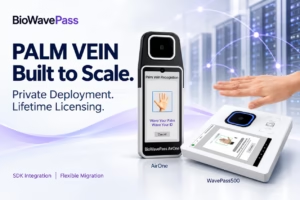
Scaling Palm Vein Payment: Single Server or Kubernetes Cluster?
A palm vein payment pilot may begin with a few terminals and a limited group of users. As the project grows, one infrastructure question becomes increasingly important: Should your palm vein recognition system run on a single server or a Kubernetes cluster? The answer starts with your expected registered user population and expansion plans. A larger infrastructure investment is not...
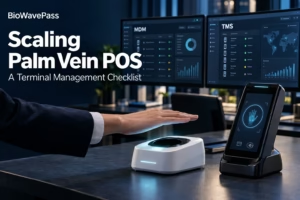
Before You Scale Palm Vein POS: A Terminal Management Checklist
Your pilot has demonstrated the user experience. The next question is how to operate the terminals across multiple locations. Who will prepare new devices? How will applications be distributed? What can a support team do when a terminal needs attention? Can the management platform run on your own infrastructure? For a BioWavePass project, these questions should be answered alongside hardware...
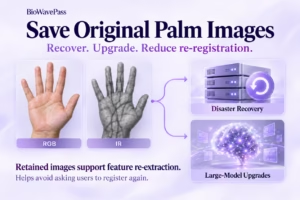
Why Saving Original Palm Images Matters for Biometric Recovery and Future Upgrades By BioWavePass
A successful Palm Vein Recognition deployment needs to support more than today’s matching requirements. It should also be prepared for server failures, lost biometric feature data and future algorithm upgrades. One integration decision can support all three: securely retain the original RGB and infrared palm images during registration. These images provide the source data needed to extract biometric features again....
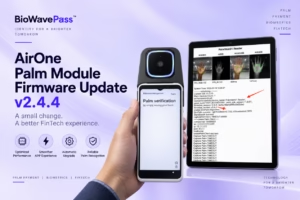
Optimizing Palm Payment Performance: AirOne Palm Module Firmware v2.4.4
In a palm payment system, recognition accuracy is important, but the overall user experience also depends on how efficiently the biometric technology works together with the payment application. BioWavePass has introduced a new non-streaming firmware, v2.4.4, for the palm recognition module used in the AirOne Palm Payment POS. The change itself is small: instead of continuously streaming camera data, the...
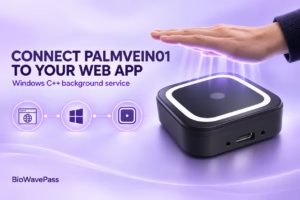
Bringing Palm Vein Scanning into a Web Workflow
Web applications are effective at managing users and business workflows. Connecting one to a USB palm vein scanner requires an additional software layer, because BioWavePass does not currently provide a Web SDK for direct browser integration. For a Windows deployment, developers can use the C++ SDK to build a local program that the web application calls. Running that program as...
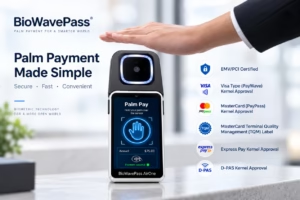
From Palm Payment MVP to Commercial Deployment: Building a Scalable Biometric Payment System
Launching a palm payment MVP is one thing. Building a biometric payment system capable of supporting 100,000, 1 million or even more users is a very different challenge. For FinTech companies, banks, digital wallets and payment service providers, the architecture selected during the MVP stage can determine how easily the project can later move into commercial deployment. At BioWavePass, we...
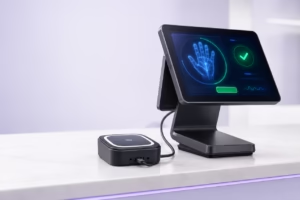
How to Integrate a USB Palm Vein Scanner with a POS Terminal
Palm payment can make checkout faster and more convenient by allowing customers to confirm their identity with a simple, contactless palm gesture. However, integrating a standalone USB Palm Vein Scanner with an existing POS terminal requires more than connecting a USB cable. Before deployment, businesses and payment solution providers need to verify the POS terminal’s USB power output, data transmission...
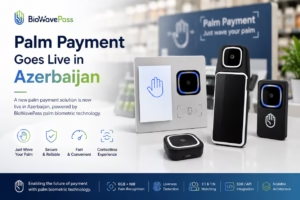
Palm Payment Goes Live in Azerbaijan: From Biometric Technology to Real-World Payment
Palm payment is moving from concept to commercial reality. A new palm payment solution has now officially launched in Azerbaijan, allowing registered consumers to authenticate payments simply by presenting their palm. For BioWavePass, this represents exactly the type of real-world application that palm biometric technology was designed to support. Moving from laboratory testing and proof-of-concept projects into a live payment...
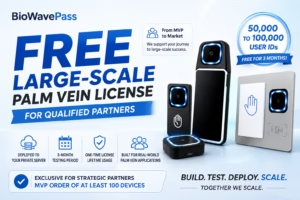
From MVP to Market: Scaling Palm Vein Technology with BioWavePass
Palm vein technology is moving rapidly from proof-of-concept projects towards real-world commercial applications. For technology partners, successfully demonstrating palm vein recognition with a small number of users is only the beginning. The next challenge is proving that the solution can perform effectively when a project moves from an MVP to tens of thousands of users and beyond. To help our...
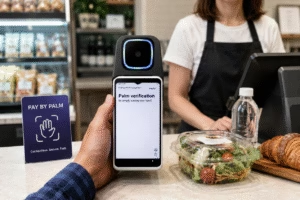
Palm Vein Payment: How Biometric Payments Work Without Cards or Phones
Payments have evolved from cash and magnetic stripe cards to contactless cards, smartphones, QR codes and digital wallets. The next step could be even simpler: Your palm becomes your authentication method. Palm vein payment allows a registered user to identify and authenticate themselves by presenting their palm, without needing to present a physical card or smartphone during the biometric interaction....