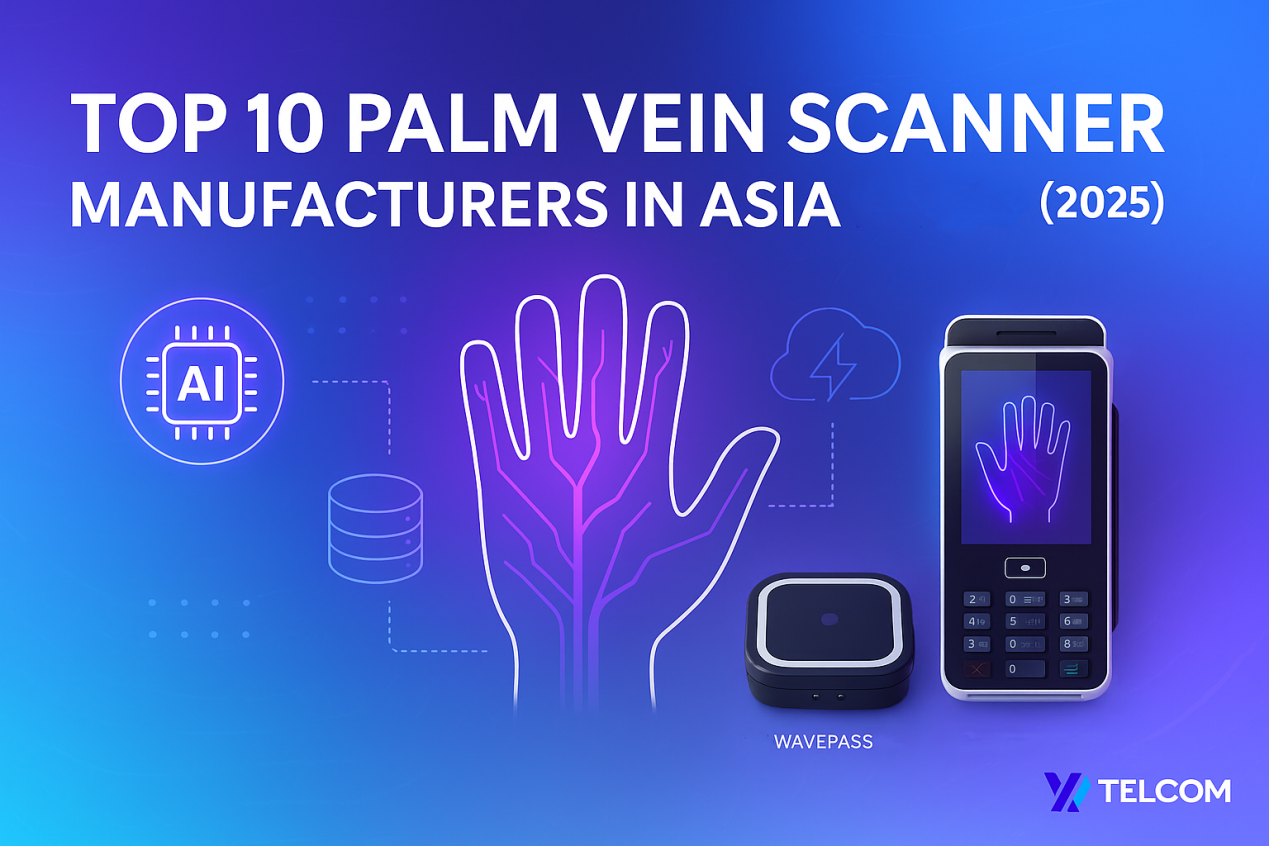
Top 10 Palm Vein Scanner Manufacturers in Asia Pacific (2025)
The Asia Pacific region is rapidly becoming the global leader in palm vein recognition deployment, driven by demand for secure, contactless, and high-accuracy biometric authentication.
Market Growth Forecast:
- 2024: USD 150 million
- 2033: USD 300 million
- CAGR (2026–2033): 8.5%
🏆 Top 10 Palm Vein Scanner Manufacturers
| Rank | Manufacturer | Country / HQ | Highlight Solutions |
|---|---|---|---|
| 1 | Fujitsu | Japan | PalmSecure™ pioneers with proven ATM & e-ID deployments. |
| 2 | BioWavePass (X-Telcom Limited) | China | RGB + IR Palm Vein + Palm Print, Android 11 terminals, 0.35s match time, full SDK/API for fintech, eKYC, and healthcare. |
| 3 | Hitachi | Japan | Advanced vein recognition for enterprise security. |
| 4 | NEC Corporation | Japan | Multi-modal biometrics for large-scale ID programs. |
| 5 | M2SYS Technology | USA / Asia Ops | Cloud-ready biometric engine with modular SDK. |
| 6 | BioSec Group | Hungary / Asia | Focus on stadium, access control, and infrastructure. |
| 7 | Recogtech B.V. | Netherlands / Asia | Military, prison, and government access control. |
| 8 | IDLink Systems | Singapore | Border control and secure terminal solutions. |
| 9 | Mofiria | Japan | Compact, wearable palm scanners with mobile potential. |
| 10 | Mantra Infotech | India | KYC biometric devices for rural government services. |
🔍 Why BioWavePass Ranks #2
- ✅ RGB + IR dual biometric (Palm Vein + Palm Print)
- ✅ Embedded Android 11 terminal with full SDK/API
- ✅ Server-side matching speed under 0.35s
- ✅ Cloud / Local deployment supported
- ✅ MDM support: Lock by location, restrict data access
- ✅ Integrated Palm + QR scanner for BOM optimization
- ✅ Active in Palm Pay and national eID platforms
[🌐 Explore BioWavePass →](内链Biowavepass的HOME 页面)
📈 Key Growth Drivers in Asia Pacific
Applications:
- Healthcare
- Banking and Financial Services
- Government and Defense
- Retail
- Transportation
- Education
Technology Types:
- Contact-based
- Contactless
- Portable
Deployment Modes:
- On-premises
- Cloud-based
Components:
- Hardware
- Software
- Services
End Users:
- Hospitals and Clinics
- Financial Institutions
- Government Agencies
- Retail Chains
- Educational Institutions
🌐 Country-Specific Highlights
- 🇨🇳 China: AI-driven smart cities, e-Government, Palm Pay
- 🇮🇳 India: Aadhaar-based hospital ID & MedTech systems
- 🇯🇵 Japan: Biometrics in elder care and robotics
- 🇰🇷 South Korea: Public fintech access and smart campuses
- 🇸🇬 Singapore: Biometric school entry and digital KYC onboarding
- 🇦🇺 Australia: Healthcare R&D and smart city deployments
📊 Asia-Pacific Biometric Market Trends (2026–2033)
- CAGR (biometric overall): 18.6%
- CAGR (healthcare biometrics): 17.2%
- Urban population by 2030: 3.3 billion
- Palm vein system accuracy: 99.9%+
🧠 Future Tech Trends in Palm Biometrics
- 🔋 Battery-powered portable palm readers
- ☁️ Cloud APIs and Palm-as-a-Service platforms
- 🤖 AI-optimized matching for big-data ID systems
- 📦 Subscription-based digital ID models
- 🌿 Eco-friendly materials and sustainable hardware
Palm vein biometrics is shifting from innovation to infrastructure.
📞 Contact BioWavePass
BioWavePass (X-Telcom Limited)
📍 Shenzhen | U.K
📧 Websie: https://biowavepass.com/
BioWavePass — Your Palm. Your ID. Just a Wave.
Share this article
About the Author

You might also like
How Does Tokenization Work in Palm Vein Payment Architecture?
Palm vein payment is quickly becoming a leading solution in biometric authentication, offering a seamless and highly secure user experience. By identifying unique vascular patterns beneath the skin, it removes
Can Palm Registration and Payment Be Done in One Tap? A Practical View from BioWavePass
In palm vein payment system design, one question often comes up: Can registration and payment be completed in a single palm tap? From a UX perspective, this sounds ideal. However,
As a Developer, How Can We Upgrade from a Small Model to a Large Model Palm Vein Recognition Algorithm Without Re-Registering Users?
When building a biometric system, developers often face an important architectural question: If we start with a small model palm vein recognition algorithm, how can we upgrade to a larger
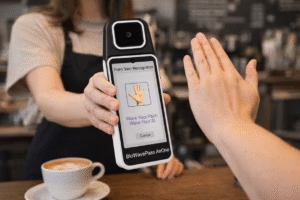
How Secure Is Palm Vein Technology Against Spoofing Attacks?
Biometric authentication is rapidly becoming a core technology in payments, identity verification, and access control. Among the emerging biometric methods, Palm Vein recognition has gained strong attention due to its
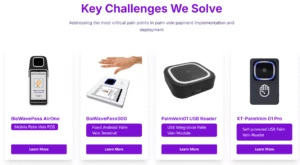
How to Choose the Right Palm Vein Recognition Device for Your Project?
A Developer’s Perspective on Choosing Palm Vein Hardware When our team started integrating palm vein recognition into our system, we quickly realized that selecting the right biometric device was just
Why Is It Not Recommended to Use a Single Palm Scan for Both Identification and Registration?
As palm vein biometrics become increasingly adopted in fintech, payment systems, and identity platforms, many developers and solution providers ask a seemingly logical question: Why not use a single palm
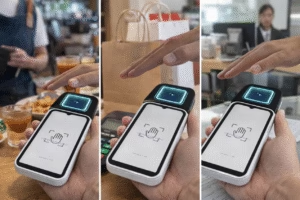
What Is the Next-Gen Contactless Payment Method?
Contactless payment has evolved rapidly over the past decade. From tap-to-pay cards to mobile wallets and QR codes, consumers have grown accustomed to faster and more convenient transactions. However, most
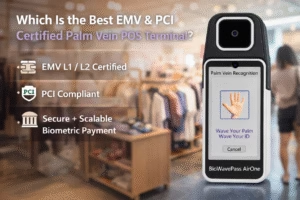
Which Is the Best EMV & PCI Certified Palm Vein POS Terminal?
For banks, fintech platforms, and e-wallet providers, selecting a biometric payment terminal is not just about innovation. It is about certification, integration capability, scalability, and long-term ecosystem compatibility. So the
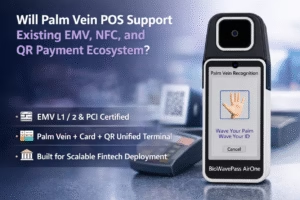
Will Palm Vein POS Support Existing EMV, NFC, and QR Payment Ecosystem?
For banks, fintech platforms, and e-wallet providers, introducing biometric authentication is never about replacing what already works. It is about strengthening it. The key question is simple: Can palm vein

Why Palm Vein Technology Is Emerging as a Payment-Grade Biometric Standard
The recent announcement that the UAE Central Bank has launched the Middle East’s first central bank–led biometric payment proof of concept marks an important milestone for the region’s payment ecosystem.