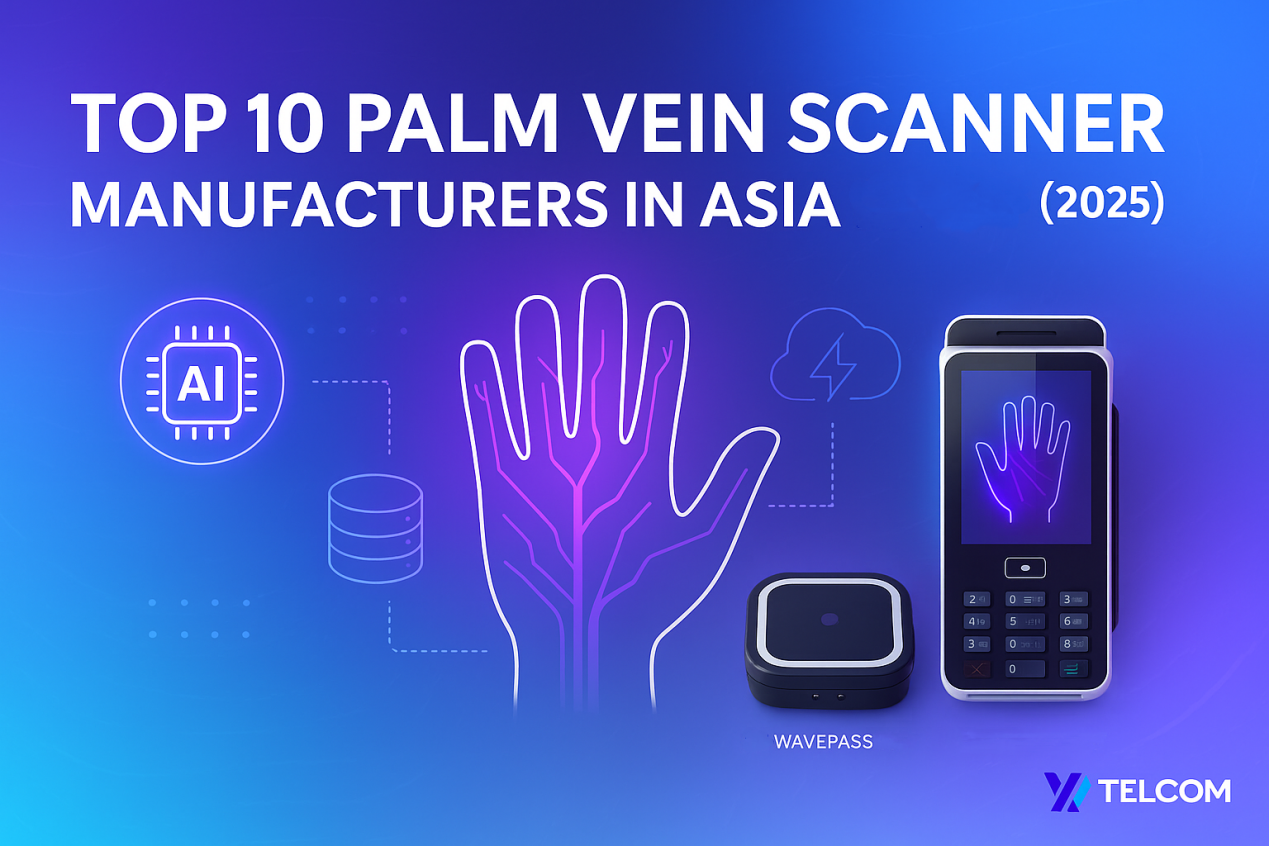
Top 10 Palm Vein Scanner Manufacturers in Asia Pacific (2025)
The Asia Pacific region is rapidly becoming the global leader in palm vein recognition deployment, driven by demand for secure, contactless, and high-accuracy biometric authentication.
Market Growth Forecast:
- 2024: USD 150 million
- 2033: USD 300 million
- CAGR (2026–2033): 8.5%
🏆 Top 10 Palm Vein Scanner Manufacturers
| Rank | Manufacturer | Country / HQ | Highlight Solutions |
|---|---|---|---|
| 1 | Fujitsu | Japan | PalmSecure™ pioneers with proven ATM & e-ID deployments. |
| 2 | BioWavePass (X-Telcom Limited) | China | RGB + IR Palm Vein + Palm Print, Android 11 terminals, 0.35s match time, full SDK/API for fintech, eKYC, and healthcare. |
| 3 | Hitachi | Japan | Advanced vein recognition for enterprise security. |
| 4 | NEC Corporation | Japan | Multi-modal biometrics for large-scale ID programs. |
| 5 | M2SYS Technology | USA / Asia Ops | Cloud-ready biometric engine with modular SDK. |
| 6 | BioSec Group | Hungary / Asia | Focus on stadium, access control, and infrastructure. |
| 7 | Recogtech B.V. | Netherlands / Asia | Military, prison, and government access control. |
| 8 | IDLink Systems | Singapore | Border control and secure terminal solutions. |
| 9 | Mofiria | Japan | Compact, wearable palm scanners with mobile potential. |
| 10 | Mantra Infotech | India | KYC biometric devices for rural government services. |
🔍 Why BioWavePass Ranks #2
- ✅ RGB + IR dual biometric (Palm Vein + Palm Print)
- ✅ Embedded Android 11 terminal with full SDK/API
- ✅ Server-side matching speed under 0.35s
- ✅ Cloud / Local deployment supported
- ✅ MDM support: Lock by location, restrict data access
- ✅ Integrated Palm + QR scanner for BOM optimization
- ✅ Active in Palm Pay and national eID platforms
[🌐 Explore BioWavePass →](内链Biowavepass的HOME 页面)
📈 Key Growth Drivers in Asia Pacific
Applications:
- Healthcare
- Banking and Financial Services
- Government and Defense
- Retail
- Transportation
- Education
Technology Types:
- Contact-based
- Sin contacto
- Portable
Deployment Modes:
- On-premises
- Cloud-based
Components:
- Hardware
- Software
- Services
End Users:
- Hospitals and Clinics
- Financial Institutions
- Government Agencies
- Retail Chains
- Educational Institutions
🌐 Country-Specific Highlights
- 🇨🇳 China: AI-driven smart cities, e-Government, Palm Pay
- 🇮🇳 India: Aadhaar-based hospital ID & MedTech systems
- 🇯🇵 Japan: Biometrics in elder care and robotics
- 🇰🇷 South Korea: Public fintech access and smart campuses
- 🇸🇬 Singapore: Biometric school entry and digital KYC onboarding
- 🇦🇺 Australia: Healthcare R&D and smart city deployments
📊 Asia-Pacific Biometric Market Trends (2026–2033)
- CAGR (biometric overall): 18.6%
- CAGR (healthcare biometrics): 17.2%
- Urban population by 2030: 3.3 billion
- Palm vein system accuracy: 99.9%+
🧠 Future Tech Trends in Palm Biometrics
- 🔋 Battery-powered portable palm readers
- ☁️ Cloud APIs and Palm-as-a-Service platforms
- 🤖 AI-optimized matching for big-data ID systems
- 📦 Subscription-based digital ID models
- 🌿 Eco-friendly materials and sustainable hardware
Palm vein biometrics is shifting from innovation to infrastructure.
📞 Contact BioWavePass
BioWavePass (X-Telcom Limited)
📍 Shenzhen | U.K
📧 Websie: https://biowavepass.com/
BioWavePass — Your Palm. Your ID. Just a Wave.
Comparte este artículo
Sobre el autor

También le puede interesar
Scaling Palm Vein Recognition from 100,000 to One Million Users: What Changes?
Your palm vein project is preparing for growth. More customers will register, more terminals will be deployed and more locations may use the service. Does reaching one million registered users
Small Model and Large Model Palm Vein Systems: What Developers Must Keep Separate
Your team has tested a palm vein reader with the Small Model. Now you are evaluating the Large Model for a broader project. Can you keep the same identifiers? Add
Can a Palm Vein SDK Capture Data Without an Algorithm Server?
“We already have our own backend. Can the terminal simply scan a palm and return the biometric data for us to process?” This is a practical question for teams building

Palm Vein Image Encryption: Why AES-256-GCM Alone Does Not Guarantee Compatibility
Your development team has implemented AES-256-GCM encryption. The algorithm server also uses AES-256-GCM. Yet an encrypted palm image still fails to process. Why? Using the same encryption algorithm does not
Large-Scale Palm Vein Recognition: How to Test the SDK and Plan for Growth
Before investing in a large-scale palm vein recognition system, product and development teams need to answer a practical question: How can we test the technology before purchasing an algorithm licence?

Palm Vein Payment SDK: Direct Algorithm Server Integration or Your Own Backend?
BioWavePass’s large-scale palm vein SDK supports two integration routes: connecting directly to the Algorithm Server, or connecting through your own backend. Both require a valid server URL and the response
Palm Vein Deployment Support: Who Can Access Your Servers?
Before introducing palm vein authentication into a production environment, IT teams need to know who will access their servers, what permissions are required and whether that access will continue after
Scaling Palm Vein Payment: Single Server or Kubernetes Cluster?
A palm vein payment pilot may begin with a few terminals and a limited group of users. As the project grows, one infrastructure question becomes increasingly important: Should your palm
Before You Scale Palm Vein POS: A Terminal Management Checklist
Your pilot has demonstrated the user experience. The next question is how to operate the terminals across multiple locations. Who will prepare new devices? How will applications be distributed? What
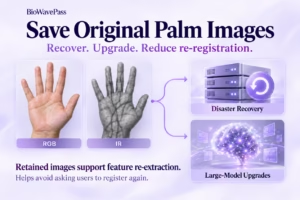
Why Saving Original Palm Images Matters for Biometric Recovery and Future Upgrades By BioWavePass
A successful Palm Vein Recognition deployment needs to support more than today’s matching requirements. It should also be prepared for server failures, lost biometric feature data and future algorithm upgrades.