BioWavePass Blogs
Insights & Innovations in Palm Vein Technology
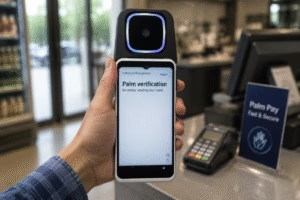
Beyond Authentication: How Palm Vein Technology Prevents Duplicate Digital Identities
As biometric technology continues to expand into palm vein payment, digital identity verification, banking, and FinTech platforms, one challenge is becoming increasingly important: How can organisations ensure that one biometric identity is not registered multiple times? A secure biometric system should not only answer: "Who is this user?" It should also answer: "Has this biometric identity already been registered?" For...
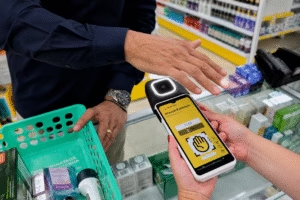
Palm Payment Goes Live in Brazil: A Major Milestone for the Future of Biometric Payments
The way people pay is evolving. Consumers increasingly expect payment experiences that are fast, secure, and effortless. As retailers continue investing in digital transformation, biometric authentication is emerging as one of the most promising technologies for delivering frictionless transactions. At BioWavePass, we are excited to celebrate an important milestone. Through our local partner, PalmVein, BioWavePass palm biometric technology is now...
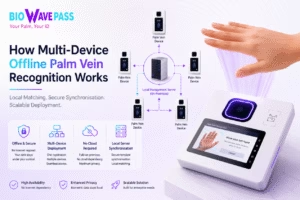
How Multi-Device Offline Palm Vein Recognition Works
Understanding Local Matching, Feature Template Synchronisation and Scalable Deployment When designing an offline palm vein recognition system, one of the first questions organisations ask is: If we deploy multiple palm vein devices, do users need to register on every device? The answer depends entirely on the deployment architecture. Many people assume that an offline biometric system means every device must...
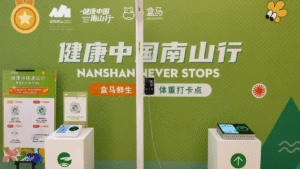
Beyond Palm Vein Payments: How Palm Vein Recognition Is Creating Better Public Health Experiences
For years, discussions around palm vein recognition have focused on technical specifications. How accurate is it? How fast is it? How secure is it? These are all important questions. But as the technology matures, they are no longer the biggest challenge. A recent public health initiative in Shenzhen, China, offers an important lesson for the entire biometric industry. The future...
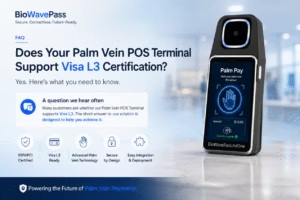
Does Your Palm Vein POS Terminal Support Visa L3? Here's What You Need to Know
If you’ve been researching Palm Vein Payment Technology, you’ve probably asked the same question we hear almost every week: "Does your Palm Vein POS Terminal support Visa L3?" It’s a great question, but there’s also a common misunderstanding about what Visa Level 3 (L3) actually is. The short answer is: Yes, BioWavePass AirOne is designed to support Visa L3 payment...
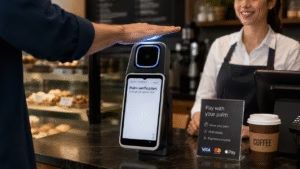
Why BioWavePass Palm Vein Payment Technology Is Shaping the Future of Secure Payments
Payments are changing quickly. Customers want checkout to be faster, safer, and easier. Businesses, meanwhile, need better ways to reduce fraud, protect identity, and create a smoother payment experience. This is where BioWavePass palm vein payment technology becomes highly relevant. By combining contactless biometric authentication with secure identity verification, BioWavePass offers a practical way to support the next generation of...
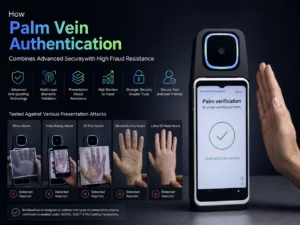
How Palm Vein Authentication Combines Advanced Security with High Fraud Resistance
As organisations increasingly adopt biometric authentication for payments, digital identity, access control, healthcare, and public services, security remains one of the most important considerations. A common question asked by decision-makers is: How resistant is a biometric system to fraud and spoofing attacks? While no security technology can guarantee absolute immunity from attack, the most effective solutions combine advanced anti-spoofing technologies...
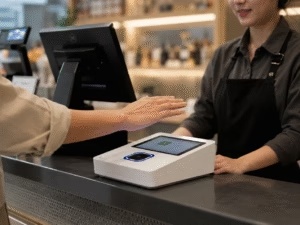
How to Choose the Right Palm Payment Hardware Platform for Your Fintech or Banking Project
As Palm Pay continues to gain momentum across banking, digital wallets, government services, and fintech ecosystems, selecting the right hardware platform has become one of the most important decisions in any deployment. Many organizations focus primarily on biometric accuracy, but successful Palm Pay projects require much more than a scanner. The hardware platform must support integration, scalability, security, and future...
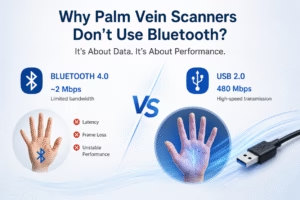
Why Palm Vein Scanners Don't Use Bluetooth Communication Way?
One of the most common questions we receive is: "Why can fingerprint scanners use Bluetooth, but Palm Vein Scanners cannot?" The answer comes down to one key factor: data transmission requirements. Fingerprint Scanners Transmit Small Amounts of Data Most fingerprint scanners capture the fingerprint image internally, extract the biometric features, and generate a small template. Only this template is transmitted...
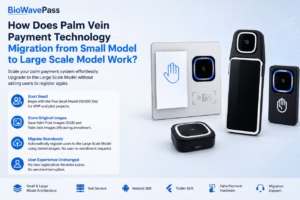
How Does Palm Vein Payment Technology Migration from Small Model to Large Scale Model Work?
As fintech platforms, digital wallets, and banking projects grow, one question frequently arises: "If we start with the free Small Model and later upgrade to the Large Scale Model, will all existing users need to register again?" The answer is: No. A properly designed palm vein payment architecture should allow future expansion without forcing users to repeat the enrollment process....