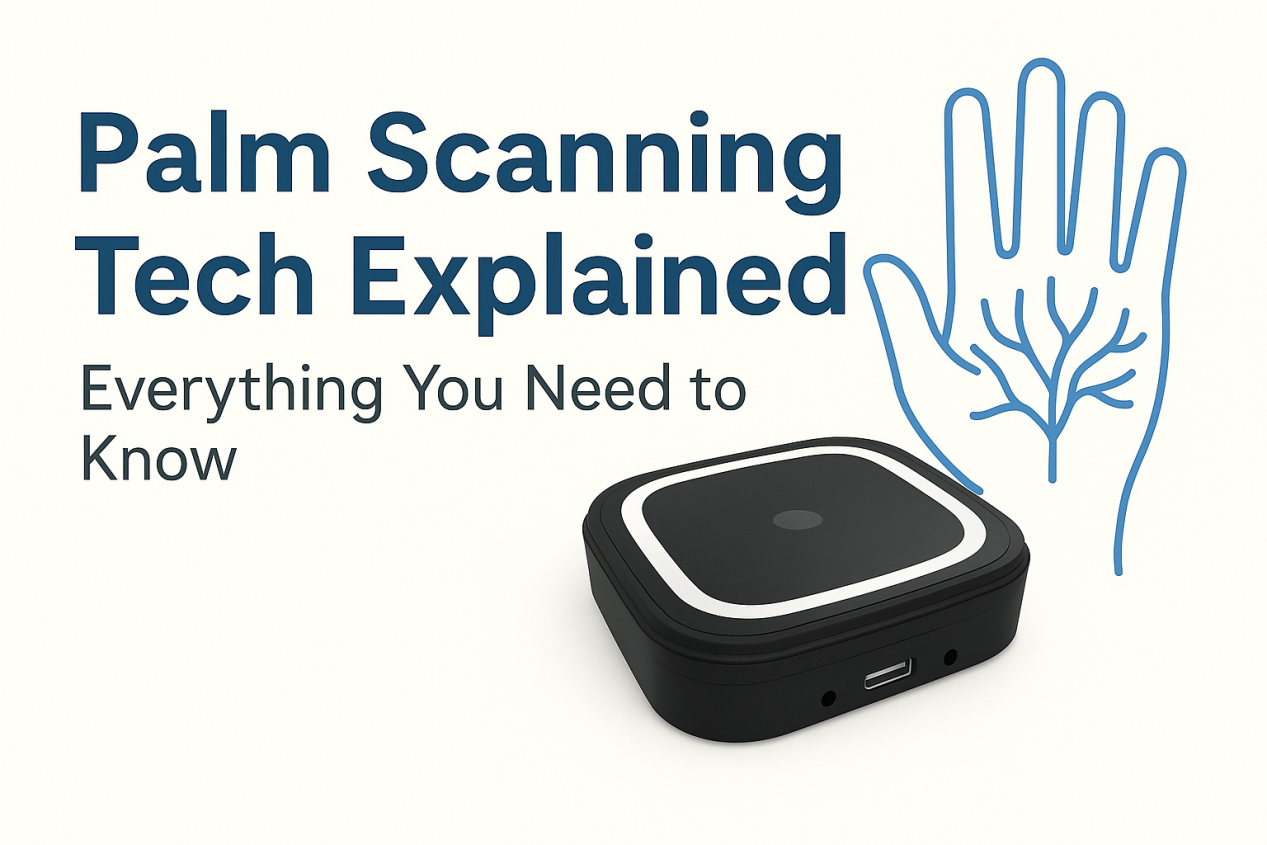
Palm Scanning Tech Explained: Everything You Need to Know
Your palm holds more than you think.
Beneath the surface lies a complex, unique pattern of veins—now powering the next generation of identity authentication and payments.
En BioWavePass, we develop cutting-edge Tecnología de reconocimiento de venas de la palma de la mano that captures both surface palm prints y subdermal vein data for precision-grade verification.
🖐 What Is Palm Scanning?
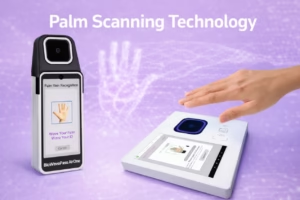
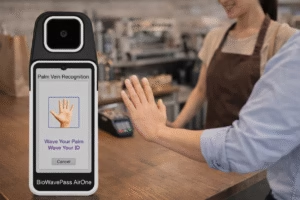
Palm scanning is a biometric method that verifies identity by capturing the internal vascular map of your palm using near-infrared (IR) y RGB sensors.
This internal map is then encrypted into a digital biometric signature, making it:
- Impossible to copy or lift like fingerprints
- Resistant to surface damage or manipulation
- Perfectly suited for contactless, privacy-first environments
🔬 How It Works: Dual Imaging = High Trust
Every BioWavePass device captures two types of biometric data in real time:
- RGB Sensor captures palm surface features (texture, ridges, creases)
- IR Sensor captures deep vein patterns invisible to the human eye
- AI engine extracts both features and fuses them into a biometric vector
- Identity is confirmed only when both layers match
This multi-modal matching reduces false acceptance to just 1 in 100 billion (1e-11) — ideal for high-security use cases.
🧠 Where Palm Scanning Is Already Changing the Game
- 💳 Palm-Based Payments in transit, retail, or banking
- 🏥 Patient ID & Hospital Entry
- 🚪 Secure Access Control in corporate/government buildings
- 🧾 eKYC & National ID Systems
- 🧑💼 Time Attendance & Workforce Identity
Palm scanning is fast, frictionless, and independent of external appearance, which makes it inclusive for all age groups and skin tones.
🌟 Why Choose BioWavePass
| Feature | BioWavePass Advantage |
|---|---|
| Dual RGB + IR Imaging | Combines internal and external biometrics for unmatched accuracy |
| Lightning-Fast Matching | ~0.35s even on databases with 5M+ users |
| SDK/API Support | Developer-ready tools for government, fintech, healthcare |
| USB + Android Options | From embedded modules to standalone terminals |
| QR Code Enabled (via RGB) | One device supports both ID y pago scenarios |
| Contactless & COVID-Safe | No touch required, no surface degradation risk |
| MDM & Geofencing | Optional enterprise controls for field deployment |
🤔 Addressing Common Questions
| Concern | Our Solution |
|---|---|
| High Entry Cost | USB-based models available for cost-sensitive applications |
| IR-Only Systems Inflexible | Our dual-mode architecture reduces errors and spoof attempts |
| Skin Conditions or Injuries | Internal vein patterns remain readable even when surface is compromised |
| Database Performance | Scalable across millions of IDs without speed or accuracy degradation |
✅ Resumen
Palm vein scanning is no longer a concept of the future—it’s now field-proven technology, already powering critical systems across payments, public services, and digital ID infrastructure.
En BioWavePass, we focus on delivering scalable, secure, and privacy-respecting palm biometrics built for modern deployment environments.
📩 Want to test your own palm authentication system?
We offer free SDK access, API docs, and remote test environments for developers.
Contact: [email protected]
WhatsApp: +86 198 6084 3404
PalmVein #PalmScanner #PalmAuthentication #BiometricSecurity #ContactlessID #eKYC #AIbiometrics #PalmPrint #BioWavePass #DigitalIdentity
Comparte este artículo
Sobre el autor

También le puede interesar
Which Is the Best EMV & PCI Certified Palm Vein POS Terminal?
Will Palm Vein POS Support Existing EMV, NFC, and QR Payment Ecosystem?

Why Palm Vein Technology Is Emerging as a Payment-Grade Biometric Standard
Where Is Palm Vein Biometric Data Stored and How Is It Secured?
How Do You Choose the Best Palm Vein Technology for Real Projects?
How to Solve Power Issues in Palm Vein Scanner Projects?
What Is Palm Scanning Technology?
How Palm Vein Biometrics Can Be Integrated Into Mobile Payment Systems: A BioWavePass Implementation Guide
How to setup Palm Payment? Designing a Seamless Palm Payment Flow for Fintech and Payment Platforms