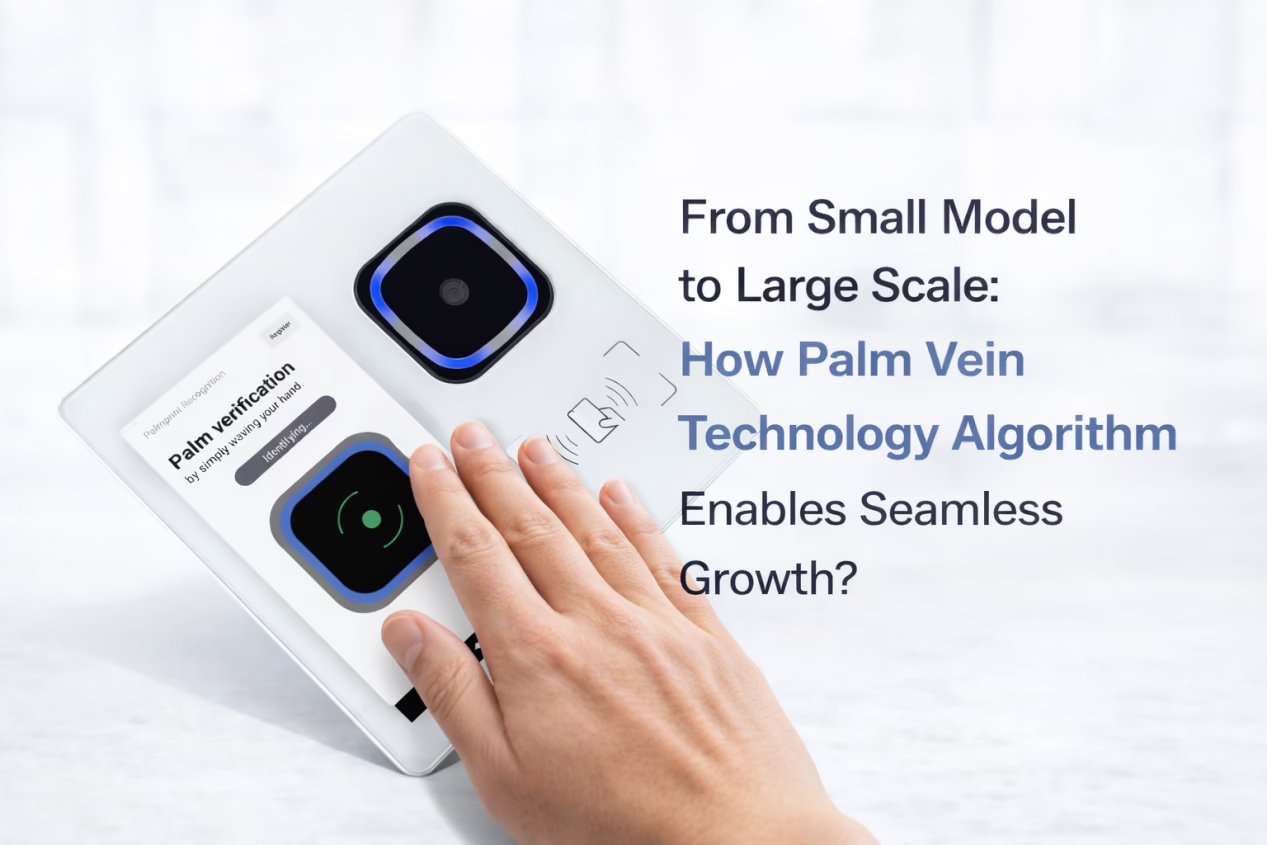
From Small Model to Large Scale: How Palm Vein Technology Algorithm Enables Seamless Growth?
Introduction
For many biometric projects, the journey does not start at scale.
Most systems begin with:
- Pilot testing
- Limited user groups
- Proof of concept (PoC) deployments
But a key challenge quickly emerges:
How can a system scale from thousands to millions of users without rebuilding everything?
This is where palm vein technology algorithm introduces a fundamentally different approach — enabling seamless growth from small model to large scale deployment.
The Traditional Scaling Problem
In many biometric systems, scaling creates major challenges:
- Systems designed for small datasets fail at large scale
- Accuracy drops as user numbers increase
- Re-enrollment becomes necessary when upgrading systems
- Infrastructure must be redesigned
This leads to:
- High operational cost
- Poor user experience
- Deployment delays
The Concept of Small Model vs Large Model
Palm vein systems are typically designed with two stages:
Small Model
- Supports up to ~10,000 users
- Lightweight deployment
- Ideal for MVP, pilot, and early-stage testing
- Faster setup with minimal infrastructure
Large Scale Model
- Supports hundreds of thousands to millions of users
- Optimized for high concurrency
- Requires GPU + vector database architecture
- Designed for real-world commercial deployment
The Key to Seamless Growth: Data Strategy
The most critical design principle is:
Store both RGB and IR images during registration.
Why this matters:
- Enables future algorithm upgrades
- Eliminates the need for re-enrollment
- Supports advanced feature extraction
Why RGB + IR Data Is Essential
During registration, the system captures:
- RGB images → palm surface features
- IR images → vein structure
At small scale, feature vectors alone may be sufficient.
However, at large scale:
- The system requires re-extraction of features using improved algorithms
- Stored images allow continuous optimization without user impact
Large Scale Algorithm: Multi-Factor Matching
At scale, the system uses a four-factor matching mechanism:
- Device-side palm print features
- Device-side vein features
- Server-side palm print features (from RGB images)
- Server-side vein features (from IR images)
This ensures:
- Higher accuracy
- Better stability
- Lower false acceptance rate
Real Performance in Large-Scale Scenarios
To validate scalability, large-scale testing was conducted:
Test Conditions
- Database: 5 million users
- Concurrency: 100,000 parallel operations
- Infrastructure: GPU (NVIDIA A10) + Milvus
Results
- Average response time: ~300 ms
- Recognition success rate: ~99% level
- Stable performance under high concurrency
Seamless Upgrade Without Re-Enrollment
One of the biggest advantages of this architecture:
👉 No need to re-register users when upgrading from small model to large scale
Because:
- Original RGB + IR images are already stored
- New algorithms can reprocess existing data
- Feature vectors can be regenerated
This enables:
- Zero disruption to users
- Faster system evolution
- Lower operational cost
Architecture That Supports Growth
A scalable system is built with future growth in mind:
Device Layer
- Consistent data capture (RGB + IR)
- Standardized input quality
Algorithm Layer
- Upgradeable models
- Feature reprocessing capability
Data Layer
- Image + vector storage
- Supports re-indexing
Infrastructure Layer
- GPU scalability
- Distributed deployment
Why This Matters for Real-World Deployment
In real applications:
- User bases grow rapidly
- Business requirements evolve
- Security standards increase
A system that cannot scale smoothly will:
- Require costly rebuilds
- Interrupt operations
- Lose user trust
Palm vein technology avoids this by designing for growth from day one.
Conclusion
Scaling biometric systems is not just about adding more servers.
It requires a forward-thinking algorithm and data architecture.
Palm vein technology enables seamless growth by:
- Capturing RGB + IR data from the start
- Supporting feature re-extraction
- Using multi-factor matching
- Leveraging GPU + vector database architecture
Final Thought
A scalable biometric system is not built for today’s users,
but for tomorrow’s millions.
Palm vein technology ensures that your system can grow —
without rebuilding, without re-enrollment, and without compromise.
CTA
If you are planning a biometric system that needs to evolve from pilot to large-scale deployment,
this architecture provides a future-ready path.
👉 Learn more: https://biowavepass.com/biowavepass-palm-vein-scanner-products/
Share this article
About the Author

You might also like

Scaling Palm Vein Payment: Single Server or Kubernetes Cluster?

Before You Scale Palm Vein POS: A Terminal Management Checklist
Why Saving Original Palm Images Matters for Biometric Recovery and Future Upgrades By BioWavePass
Optimizing Palm Payment Performance: AirOne Palm Module Firmware v2.4.4

Bringing Palm Vein Scanning into a Web Workflow

From Palm Payment MVP to Commercial Deployment: Building a Scalable Biometric Payment System
How to Integrate a USB Palm Vein Scanner with a POS Terminal

Palm Payment Goes Live in Azerbaijan: From Biometric Technology to Real-World Payment
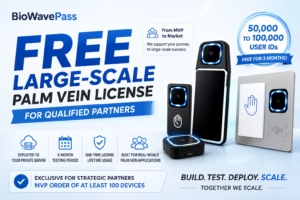
From MVP to Market: Scaling Palm Vein Technology with BioWavePass