Do Palm Vein Payments Replace OTP and Tokenization? Understanding the Future of Palm Pay
Introdução
As Palm Pay solutions gain popularity around the world, many fintech companies, banks, and payment platforms are asking the same question:
If a customer can pay with their palm vein, do we still need OTP verification or tokenization?
The short answer is:
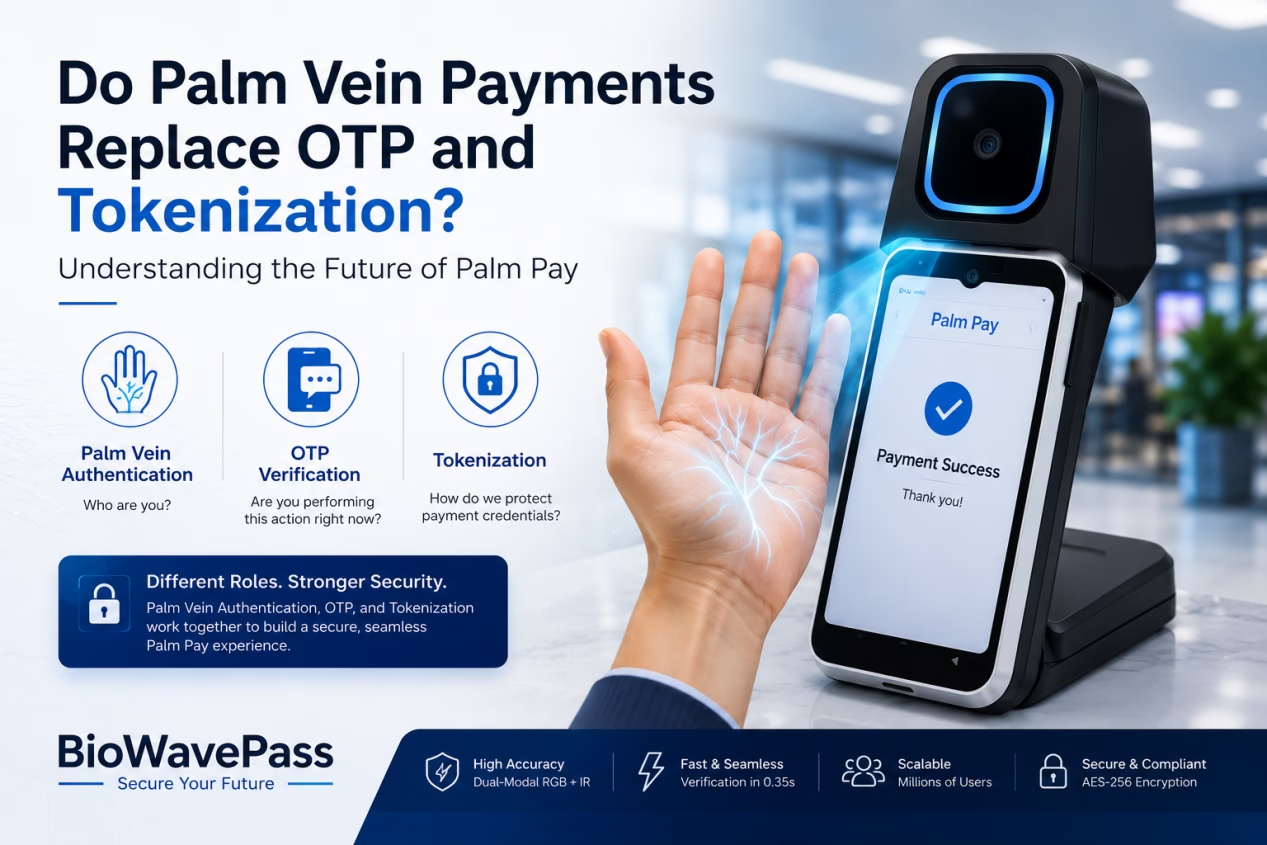
Palm Vein Authentication, OTP, and Tokenization solve different security challenges.
Understanding the difference is essential for anyone planning to build a secure Palm Pay ecosystem.
Let’s break it down.
What Is Palm Pay?
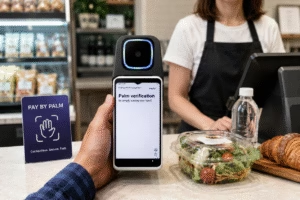
Palm Pay is a payment method that allows users to complete transactions using their palm vein and palm print biometrics instead of cards, phones, or passwords.
The process is simple:
- User presents their palm.
- Palm vein scanner captures RGB and IR biometric data.
- Biometric features are matched against a secure database.
- Identity is verified.
- Payment authorization is completed.
With platforms powered by BioWavePass technology, verification can be completed in approximately 0.35 seconds while supporting large-scale databases with millions of enrolled users.
What Problem Does Palm Vein Authentication Solve?
Palm vein technology answers one critical question:
"Who Is This Person?"
Traditional payment systems rely on:
- Cards
- Passwords
- Mobile phones
- PIN codes
All of these can be:
- Lost
- Shared
- Stolen
- Forgotten
Palm vein authentication verifies the actual individual rather than the device they carry.
This is why many banks and fintech providers see palm biometrics as the next step beyond cards and mobile wallets.
What Is OTP?
OTP stands for One-Time Password.
It is typically delivered through:
- SMS
- Mobile App notifications
OTP answers a different question:
"Is the Authorized User Actively Performing This Transaction Right Now?"
For example:
- User logs in.
- System sends a six-digit code.
- User enters the code.
- Transaction proceeds.
OTP provides an additional layer of security but also creates friction.
Many payment providers report transaction abandonment caused by:
- Delayed SMS delivery
- Lost mobile devices
- Poor network coverage
- User inconvenience
What Is Tokenization?
Tokenization protects sensitive payment credentials.
Instead of storing a real card number such as:
5412 1234 5678 9876The payment platform stores:
TOKEN_9A8B7C6DThe token has no value outside the payment ecosystem.
Even if attackers gain access to the database, the actual payment credentials remain protected.
Major payment networks including Visa, Mastercard, Apple Pay, and Google Pay use tokenization extensively to secure transactions.
Can Palm Vein Authentication Replace OTP?
Sometimes.
But not always.
In lower-risk transactions, palm vein authentication may be sufficient because the biometric itself provides strong identity verification.
However, many banking regulations still require:
- Multi-factor authentication
- Step-up verification
- Risk-based authentication
In these situations:
Palm Vein + OTPmay still be required.
The palm confirms identity.
The OTP confirms transaction intent.
Can Palm Vein Authentication Replace Tokenization?
No.
This is one of the most common misconceptions.
Palm vein authentication and tokenization serve completely different purposes.
Palm vein authentication verifies identity.
Tokenization protects payment credentials.
A secure Palm Pay ecosystem typically looks like this:
Palm Vein Authentication
          ↓
User Identity Verified
          ↓
Tokenized Payment Account
          ↓
Payment Network
          ↓
Transaction Approved
Even when palm biometrics are used, tokenization remains a critical component of payment security.
What Does the Future Palm Pay Architecture Look Like?
The most secure future payment platforms will likely combine:
Layer 1: Palm Vein Authentication
Verifies who the user is.
Layer 2: Liveness Detection
Verifies the user is physically present.
Layer 3: Tokenized Payment Credentials
Protects financial information.
Layer 4: Risk-Based Verification
Triggers OTP only when necessary.
This approach delivers:
- Faster transactions
- Better user experience
- Reduced fraud
- Lower dependence on passwords
- Improved compliance
Why Is BioWavePass Different?
Most palm vein systems on the market rely only on IR vein images.
BioWavePass uses both:
- RGB Palm Print Features
- IR Palm Vein Features
This dual-modal architecture improves both recognition accuracy and anti-spoofing capability.
During enrollment and verification, the system collects:
- RGB Images
- IR Images
- RGB Feature Points
- IR Feature Points
These are uploaded simultaneously to the customer’s platform.
Because BioWavePass compares both image data and feature data, recognition performance can achieve:
- Up to 99% success rate in internal testing on databases containing up to 5 million identities
- Verification speed as fast as 0.35 seconds
This is not a traditional IR-only palm vein algorithm.
It is an AI-powered biometric matching architecture designed for large-scale Palm Pay deployments.
How Does BioWavePass Support Palm Pay Projects?
BioWavePass provides the biometric authentication layer for Palm Pay platforms.
Key capabilities include:
- PalmVein01 USB Palm Vein Reader for Windows, Linux and Android
- WavePass500 Android Palm Vein Scanner Device
- Cloud-based large-scale comparison architecture
- SDK support for Android, Windows and Linux
- Palm Pay integration APIs
- Million-level user database support
- AES-256 encrypted biometric storage
- Customer-owned infrastructure and data control
All biometric data and photos are encrypted using AES-256 and stored only within the customer’s own system.
BioWavePass does not participate in customer data management.
Customers retain full ownership and control of their platform and data, ensuring GDPR alignment and enterprise compliance.
Final Thoughts
Palm Vein Authentication, OTP, and Tokenization are not competitors.
They are complementary technologies.
Think of it this way:
| Tecnologia | Core Question |
|---|---|
| Palm Vein Authentication | Who are you? |
| OTP | Are you performing this action right now? |
| Tokenization | How do we protect payment credentials? |
The future of Palm Pay is not about replacing one security technology with another.
It is about combining identity, intelligence, and trust into a seamless payment experience.
As financial institutions continue to explore biometric payments, the strongest platforms will be those that integrate all three layers effectively.
About BioWavePass
BioWavePass provides advanced palm vein and palm print biometric technology for:
- Palm Pay
- Carteiras digitais
- Banca
- Fintech Platforms
- Healthcare Identity Verification
- Programas governamentais
- Large-Scale Citizen Authentication
Saiba mais:
Partilhar este artigo
Sobre o autor

Também pode gostar
Scaling Palm Vein Payment: Single Server or Kubernetes Cluster?
Before You Scale Palm Vein POS: A Terminal Management Checklist
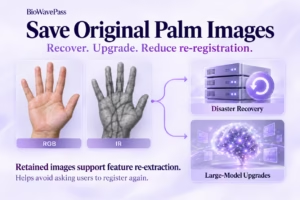
Why Saving Original Palm Images Matters for Biometric Recovery and Future Upgrades By BioWavePass
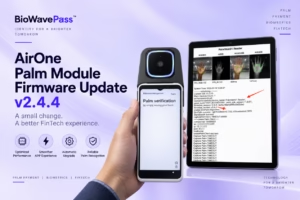
Optimizing Palm Payment Performance: AirOne Palm Module Firmware v2.4.4
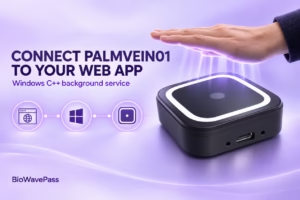
Bringing Palm Vein Scanning into a Web Workflow
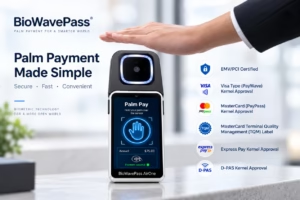
From Palm Payment MVP to Commercial Deployment: Building a Scalable Biometric Payment System
How to Integrate a USB Palm Vein Scanner with a POS Terminal
Palm Payment Goes Live in Azerbaijan: From Biometric Technology to Real-World Payment
From MVP to Market: Scaling Palm Vein Technology with BioWavePass