Why Is BioWavePass Palm Vein Hardware More Accurate?
Introdução
In biometric systems, accuracy is often attributed to algorithms.
But in real-world deployments, accuracy starts much earlier — at the moment of data capture.
Em BioWavePass, accuracy is not treated as a single metric.
It is engineered through a full-stack approach, combining hardware design, capture control, and algorithm architecture.
Accuracy Starts with Data Quality
Palm vein recognition depends on extracting stable and complete biometric features.
This requires:
- Clear imaging
- Correct positioning
- Controlled lighting
If the input data is inconsistent, even the best algorithms will fail.
BioWavePass addresses this by ensuring that every scan begins with high-quality data.
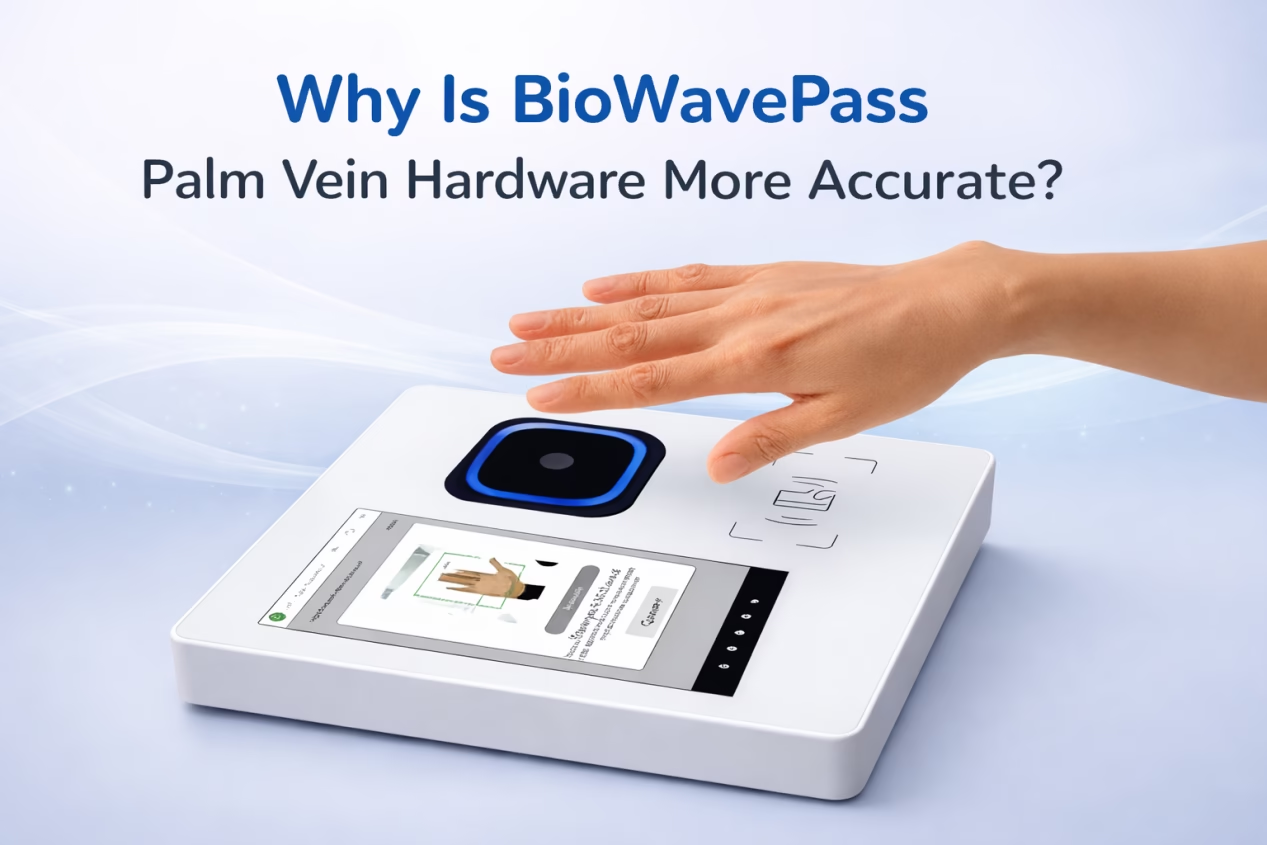
Dual-Mode Capture: RGB + IR
BioWavePass devices are designed with:
- RGB imaging → captures palm surface features
- IR imaging → captures sub-dermal vein patterns
This dual-mode approach enables:
- Multi-dimensional identity verification
- Higher recognition accuracy
- Stronger resistance to spoofing
Unlike single-mode systems, BioWavePass ensures that identity is validated from both external and internal biometric layers.
PSensor: Controlling the Capture Process
A key innovation in BioWavePass hardware is the PSensor (distance detection module).
Core Capabilities:
- Real-time distance detection (0–2000 mm)
- Optimal capture range: 50–150 mm
- Prevention of invalid scans (too close or too far)
Why It Matters:
Palm vein recognition is highly sensitive to distance.
PSensor ensures:
- Consistent positioning
- Stable image acquisition
- Repeatable capture conditions
This shifts the system from:
user-dependent → hardware-controlled
Intelligent Lighting and Capture Synchronization
BioWavePass hardware integrates automatic coordination between:
- Lighting
- Capture timing
- RGB + IR data acquisition
When the palm enters the optimal range:
- White fill light is activated automatically
- Capture is triggered at the right moment
This ensures:
- High-quality images in any lighting condition
- Reduced noise and distortion
- Reliable feature extraction
Designed for Large-Scale Accuracy
Accuracy must remain stable not only in testing, but at scale.
BioWavePass systems support:
- Millions-level database comparison
- Recognition speed: ~0.3–0.35 seconds
- High success rate in large deployments
This is achieved through:
- Multi-feature fusion
- Optimized data pipelines
- Efficient matching architecture
Built for Real-World Environments
BioWavePass is designed for real applications such as:
- Palm vein payment systems
- eKYC and digital identity
- Banking and fintech
- Healthcare and public services
These environments are:
- Dynamic
- Uncontrolled
- High-frequency
Combinando hardware control + intelligent capture + algorithm optimization, BioWavePass maintains consistent accuracy across all scenarios.
Conclusão
At BioWavePass, accuracy is not a feature — it is a system outcome.
It is achieved through:
- Dual-mode biometric capture (RGB + IR)
- PSensor-driven distance control
- Intelligent lighting and capture coordination
- AI-based large-scale recognition
Accuracy is not just calculated. It is engineered.
Learn More
Discover how BioWavePass enables next-generation biometric systems:
👉 https://biowavepass.com/biowavepass-palm-vein-scanner-products/
Partilhar este artigo
Sobre o autor

Também pode gostar
Scaling Palm Vein Payment: Single Server or Kubernetes Cluster?

Before You Scale Palm Vein POS: A Terminal Management Checklist
Why Saving Original Palm Images Matters for Biometric Recovery and Future Upgrades By BioWavePass
Optimizing Palm Payment Performance: AirOne Palm Module Firmware v2.4.4
Bringing Palm Vein Scanning into a Web Workflow
From Palm Payment MVP to Commercial Deployment: Building a Scalable Biometric Payment System
How to Integrate a USB Palm Vein Scanner with a POS Terminal
Palm Payment Goes Live in Azerbaijan: From Biometric Technology to Real-World Payment
From MVP to Market: Scaling Palm Vein Technology with BioWavePass