How Does Palm Pay Work—and What Happens When You Pay With Your Hands?
Biometric payment has entered a new era. With بالم باي, users no longer need to carry cards, phones, or IDs—your palm becomes your secure identity. At بايو وايف باس, we’ve designed a hardware-agnostic platform to make Palm Pay truly scalable, privacy-compliant, and real-time ready.
So how exactly does Palm Pay work? What happens behind the scenes from a raised palm to a completed transaction?
This blog explains the core architecture of Palm Pay—optimized by BioWavePass technology and tested in real-world deployments across banks, government, and fintech.
Step 1: Biometric Registration Without Boundaries
Every Palm Pay journey starts with identity enrollment—binding the user’s palm to their digital profile. With BioWavePass devices, registration is fast, hygienic, and secured by AI-enhanced imaging.
Key Process:
-
Palm + ID Binding
Link national ID, phone number, or user account to a new Palm ID. -
RGB + IR Dual-Mode Capture
We collect both surface palmprint and subcutaneous vein patterns. -
Feature String Extraction
Our dual-modality AI engine generates four biometric markers:- RGB image
- IR image
- RGB feature string
- IR feature string
-
Secure Binding & Sync
These are locally or remotely encrypted and stored under a unique biometric index.
Our devices require users to remove gloves to ensure clean IR & RGB imaging.
Step 2: Real-Time Matching at the Terminal
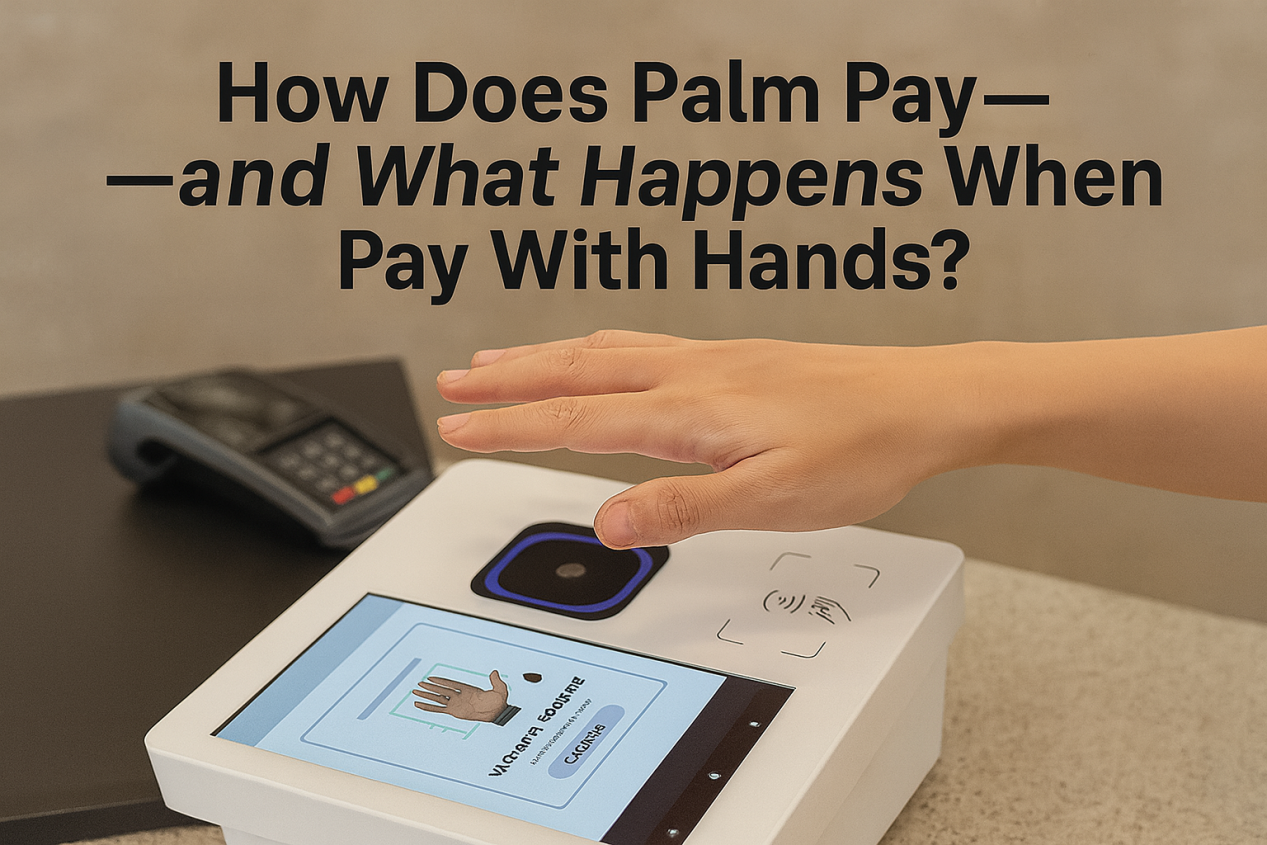
At checkout, subsidy points, or access control, users simply raise their hand.
Our terminal (e.g., بيوويف باس 500) instantly:
- Detects palm presence
- Captures new RGB + IR image streams
- Extracts fresh feature strings
- Matches against the database (cloud or local)
Only if all four factors match will Palm ID verification pass.
Algorithm Performance:
| Metric | Result |
|---|---|
| Matching Speed | 0.315 seconds (5M database) |
| Accuracy (FRR@FAR) | RGB: 0.002% / IR: 1.52% |
| Combined Risk | < 1 in 100 billion |
If either RGB or IR fails, the match will be denied. This ensures dual-liveness detection and zero tolerance for forgery.
Step 3: Payment Token Issuance
Once matched, the system generates a one-time payment token. This token acts as the user’s approval for the backend to proceed.
Token Payload Includes:
BioPalmID: Anonymous user match keyTerminal ID: Origin device identityMerchant Session: Transaction session codeNonce: Random anti-replay stringTimestamp: Token validity (e.g. 30–60s)Signature: Encrypted hash of the above
No financial data or real identity leaves the device—only the secure token is transmitted.
Step 4: Payment Authorization
The token is sent to the connected payment platform, which may be:
- A bank payment gateway
- A government digital subsidy portal
- A private fintech cloud wallet
The backend verifies the token, checks permissions, and completes the transaction.
The result (success/failure) is then returned to the terminal in real time.
Palm Pay enables completely hands-free, cardless, password-free authentication while maintaining security.
BioWavePass Advantages
| Feature | Value Proposition |
|---|---|
| RGB + IR Dual Imaging | True biometric liveness detection |
| 4-Factor Matching | Enhanced security with AI feature fusion |
| Large-Scale Matching Engine | Tested on 5M+ private ID databases |
| Cloud & Edge Compatible | Works with remote or local matching servers |
| Token-Based Security | Compliant with PCI-DSS and data privacy standards |
| Flexible SDK Integration | Support for Android, Windows, Linux environments |
| No Vendor Lock-In | Open API structure, compatible with any platform |
Real-World Scenarios
- National subsidy collection — bind palm + ID once, then redeem without carrying documents
- Smart retail checkout — reduce checkout time and eliminate physical contact
- eKYC onboarding — biometric registration for banks and e-wallets
- Healthcare access — verify patients without cards or typing
- Borderless travel — secure biometric boarding without passports
BioWavePass: Own Your ID. Wave Your Palm.
BioWavePass isn’t just a hardware provider—it’s a platform partner for governments, banks, fintechs, and integrators looking to build secure, compliant, real-time biometric ecosystems.
نحن نقدم:
- Embedded palm vein devices
- Fully documented SDKs
- On-device encryption
- Token-based middleware
- Custom licensing (10K IDs free, large DBs supported)
- End-End Solutions
Learn more at: [www.biowavepass.com]
شارك هذه المقالة
نبذة عن الكاتب

قد يعجبك أيضاً
Bringing Palm Vein Scanning into a Web Workflow
From Palm Payment MVP to Commercial Deployment: Building a Scalable Biometric Payment System
How to Integrate a USB Palm Vein Scanner with a POS Terminal
Palm Payment Goes Live in Azerbaijan: From Biometric Technology to Real-World Payment
From MVP to Market: Scaling Palm Vein Technology with BioWavePass
Palm Vein Payment: How Biometric Payments Work Without Cards or Phones
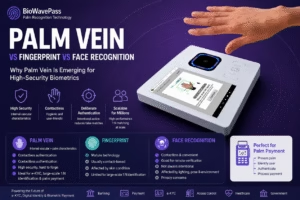
Palm Vein vs Fingerprint vs Face Recognition: Why Palm Vein Is Emerging for High-Security Biometrics
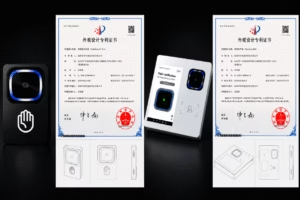
BioWavePass Palm Vein Scanner Products Receive Design Patent Certification
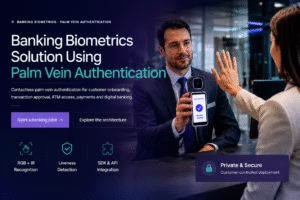
Palm Vein Authentication: The Future of Secure Digital Identity and Payments