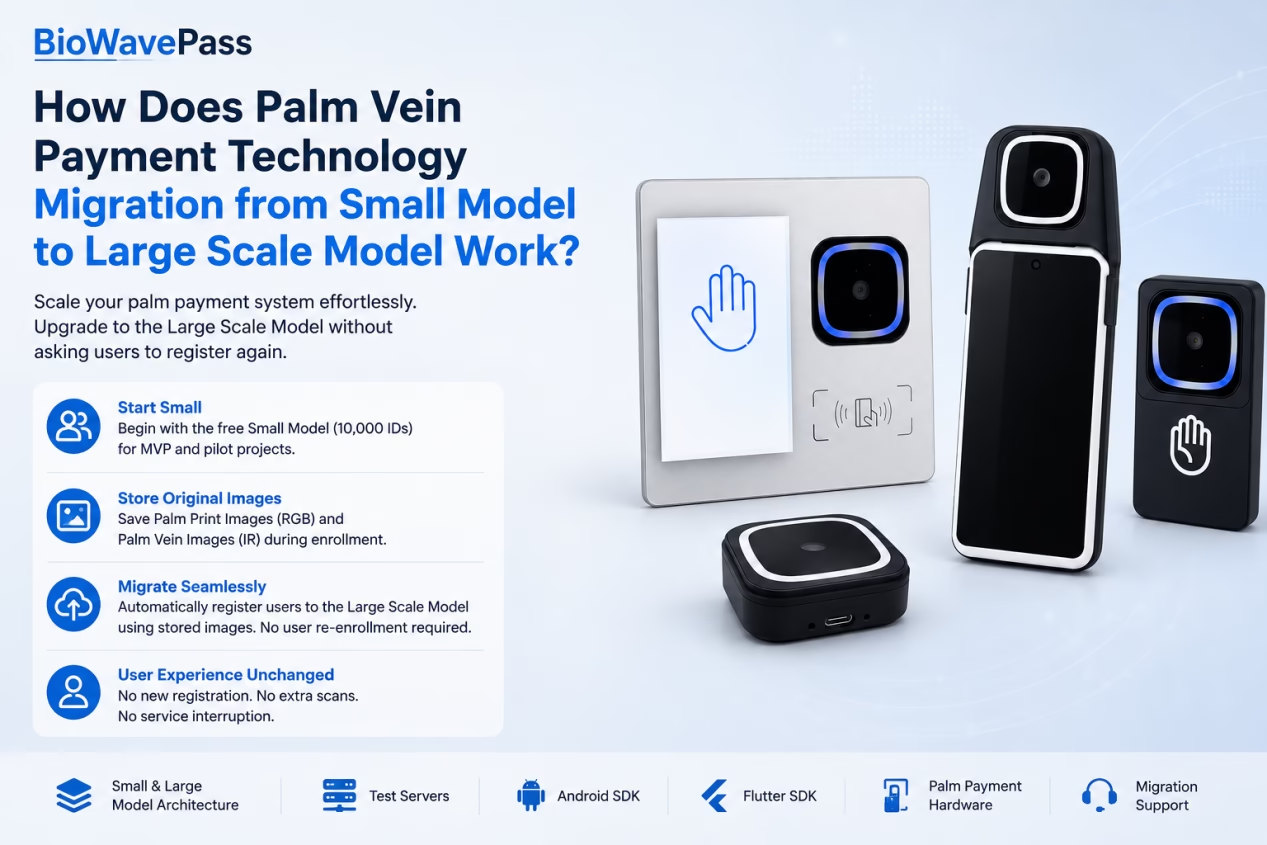
How Does Palm Vein Payment Technology Migration from Small Model to Large Scale Model Work?
As fintech platforms, digital wallets, and banking projects grow, one question frequently arises:
"If we start with the free Small Model and later upgrade to the Large Scale Model, will all existing users need to register again?"
The answer is:
No.
A properly designed palm vein payment architecture should allow future expansion without forcing users to repeat the enrollment process.
Understanding the Difference Between Small Model and Large Scale Model
BioWavePass provides two algorithm deployment options.
Small Model
The Small Model is designed for:
- MVP testing
- Pilot projects
- Early-stage fintech deployments
It supports:
✅ Up to 10,000 Free User IDs
The Small Model primarily uses:
- End-side Palm Print Feature (RGB)
- End-side Palm Vein Feature (IR)
Only extracted biometric features are used for verification.
Large Scale Model
The Large Scale Model is designed for:
- Commercial deployments
- Banking platforms
- National-scale projects
- Million-level biometric databases
Unlike the Small Model, the Large Scale Model introduces additional server-side verification capabilities.
The algorithm uses:
- Palm Print Image (RGB)
- Palm Vein Image (IR)
to build and maintain large-scale biometric databases.
Does Migration Mean Users Must Register Again?
This is where many customers misunderstand the process.
The answer depends on whose perspective we are discussing.
From the Algorithm Perspective
Yes.
The Large Scale Model requires users to be registered into the new Large Model database.
Because the Large Scale Model uses original RGB and IR registration images, the algorithm must create a new biometric record within the Large Model architecture.
From the User Perspective
No.
Users do not need to:
- Register again
- Scan their palm again
- Visit a registration center
- Repeat the onboarding process
The migration is completely transparent to them.
How Is Migration Achieved?
When users are first enrolled in the Small Model system, BioWavePass strongly recommends storing:
- RGB Palm Print Images
- IR Palm Vein Images
along with the extracted biometric features.
These registration images become valuable assets for future expansion.
When upgrading to the Large Scale Model, the application simply calls the Large Model registration interface and submits the previously stored RGB and IR registration images.
The entire process can be completed programmatically.
What Happens During Migration?
From the application perspective:
✅ A new registration is performed for the Large Scale Model algorithm service.
Because the original registration images already exist, the system can automatically use them to complete registration into the new database.
No manual user action is required.
Why Is Image Storage Important?
Image storage is one of the most important considerations when designing a scalable palm vein payment platform.
Even if a project initially uses the free Small Model, storing:
- Palm Print Images (RGB)
- Palm Vein Images (IR)
creates a seamless migration path for future growth.
Without these images, upgrading to the Large Scale Model may require collecting registration images again.
What Does the User Experience?
From the user’s perspective:
✅ No new registration
✅ No additional palm scan
✅ No interruption to service
✅ No change to the user experience
Users continue using the platform exactly as before.
The migration occurs entirely in the background.
Developer Benefits
For development teams, migration is straightforward.
BioWavePass provides:
✅ Small Model Test Server
✅ Large Scale Model Test Server
✅ Android Java SDK
✅ Android Flutter SDK
✅ RESTful API Support
✅ Migration Testing Support
Only the device-server communication interfaces and server APIs need to be updated according to the Large Scale Model specifications.
No major application redesign is required.
Final Thought
A scalable palm vein payment platform should grow with your business.
With BioWavePass, migration to the Large Scale Model is a new registration process for the algorithm, but not for the user.
From the system’s perspective, users are registered into a new Large Scale Model database. From the user’s perspective, nothing changes because their original RGB and IR registration images already make the migration possible.
Learn More
PalmVeinPayment #PalmPaymentTechnology #PalmVeinRecognition #BiometricPayment #Fintech #DigitalWallet #BankingTechnology #BiometricAuthentication #PalmPayment #BioWavePass
شارك هذه المقالة
نبذة عن الكاتب

قد يعجبك أيضاً
Bringing Palm Vein Scanning into a Web Workflow
From Palm Payment MVP to Commercial Deployment: Building a Scalable Biometric Payment System
How to Integrate a USB Palm Vein Scanner with a POS Terminal
Palm Payment Goes Live in Azerbaijan: From Biometric Technology to Real-World Payment
From MVP to Market: Scaling Palm Vein Technology with BioWavePass
Palm Vein Payment: How Biometric Payments Work Without Cards or Phones
Palm Vein vs Fingerprint vs Face Recognition: Why Palm Vein Is Emerging for High-Security Biometrics
BioWavePass Palm Vein Scanner Products Receive Design Patent Certification
Palm Vein Authentication: The Future of Secure Digital Identity and Payments