From Palm Payment MVP to Commercial Deployment: Building a Scalable Biometric Payment System
Launching a palm payment MVP is one thing.
Building a biometric payment system capable of supporting 100,000, 1 million or even more users is a very different challenge.
For FinTech companies, banks, digital wallets and payment service providers, the architecture selected during the MVP stage can determine how easily the project can later move into commercial deployment.
En BioWavePass, we believe an MVP should not be treated simply as a technology demonstration. It should be the first step towards a scalable commercial palm payment ecosystem.
Start With the Payment Architecture, Not Just the Palm Scanner
A palm vein terminal is only one component of a biometric payment system.
A typical architecture may look like:
Palm Terminal → Biometric Verification → User ID → Payment Platform → Wallet / Bank Account → Transaction
Most FinTech companies already have their own payment infrastructure, including:
- Payment platform
- Digital wallet
- Merchant network
- Customer database
- Transaction processing
- Banking integrations
- Mobile application
The objective is therefore not to replace the existing payment platform.
Instead, palm vein recognition becomes an additional biometric authentication layer integrated into the existing payment ecosystem through SDKs and APIs.
Stage 1: Sample Testing
The first stage is to determine whether palm vein recognition is suitable for the intended payment experience.
During sample testing, technical teams can evaluate:
- Palm enrollment
- Recognition speed
- Recognition accuracy
- User experience
- Different hand positions
- Environmental conditions
- SDK integration
- API workflow
- Application development
At this stage, the objective is not yet large-scale deployment.
It is to confirm that the hardware, algorithm and integration architecture are suitable for the project.
Stage 2: Build the Palm Payment MVP
Once the basic technology has been validated, the next step is connecting palm authentication with the partner’s actual payment infrastructure.
A simplified workflow could be:
User Enrollment
Palm Enrollment → Biometric Template → User ID → Customer Account / Wallet
Payment Authentication
Palm Verification → User ID Returned → Payment Account Identified → Transaction Authorization
This is the point where the project moves beyond biometric testing and becomes a real palm payment MVP.
BioWavePass provides the palm vein hardware, SDK/API and biometric algorithm capabilities, while the FinTech partner can develop and control its own payment application, business logic and transaction infrastructure.
Stage 3: Start With Up to 10,000 User IDs
For initial development and MVP testing, BioWavePass provides a free small-scale algorithm supporting up to 10,000 registered User IDs.
The algorithm can be deployed within the customer’s private server environment.
This allows the technical team to test:
- Centralized palm enrollment
- Server-based biometric verification
- User ID management
- Multiple terminals
- API response workflows
- Payment platform integration
For many MVP projects, 10,000 User IDs provide sufficient capacity to validate the initial architecture.
But if the project is intended for commercial payment deployment, scalability should be considered from the beginning.
Stage 4: 100,000 User IDs FREE for 3 Months for Strategic Partners
Moving from an MVP into a real commercial environment requires testing at a much larger scale.
To support committed partners during this critical stage, BioWavePass provides qualified strategic partners with a 100,000 User ID large-scale palm vein algorithm license FREE for 3 months.
The large-scale algorithm can be deployed on the partner’s private server, allowing the technical team to evaluate the solution within its own infrastructure.
During the three-month testing period, partners can evaluate:
- Up to 100,000 registered User IDs
- Large-scale palm vein matching
- Centralized enrollment and verification
- Multiple terminal deployment
- API integration
- Server performance
- QPS and concurrent verification requirements
- Real-world payment workflows
Who Qualifies?
This program is specifically designed for strategic partners who:
- Have signed a Strategic Partnership Agreement
- Have progressed to the MVP testing stage
- Place an initial MVP testing order of at least 100 devices
Qualified partners can use the 100,000 User ID large-scale algorithm license free for 3 months, with BioWavePass technical support for private server deployment.
The objective is simple:
Allow serious strategic partners to validate a 100,000-user palm payment architecture before investing in full commercial deployment.
Stage 5: Move From Testing to Commercial Deployment
After the three-month large-scale evaluation, partners who are ready to continue can purchase the appropriate commercial algorithm package.
The large-scale algorithm is available with a one-time license fee and perpetual usage, with no recurring annual algorithm license fee.
At this stage, the question changes from:
"Does palm payment work?"
to:
"How many users and transactions does our commercial payment network need to support?"
A project may begin with 100,000 users and later expand towards hundreds of thousands or millions.
The algorithm capacity, server resources and QPS requirements can therefore be planned according to the expected commercial scale.
Why Server-Based Verification Matters at Scale
Imagine a payment network with:
- 1,000 palm payment terminals
- 500 merchants
- Multiple cities
- 1 million registered users
Managing the complete biometric user population independently on every terminal would create significant synchronization and scalability challenges.
A server-based architecture provides a different approach:
Palm Terminal → Secure Biometric Request → Private Server Algorithm → User Identification → Payment Platform
This enables a customer’s biometric identity to be recognized across the payment network without requiring every terminal to independently maintain the entire user database.
For large FinTech and payment ecosystems, this architecture provides a practical path towards commercial scalability.
Private Server Deployment and Data Control
Biometric information requires careful handling, particularly in banking and payment environments.
BioWavePass supports deployment of the biometric algorithm within the partner’s own private server environment.
Palm characteristics are converted into mathematical biometric templates for matching rather than relying on conventional palm photographs for identification.
BioWavePass does not need to operate the partner’s payment database or manage its commercial customer data.
This allows FinTech partners to maintain control over their own infrastructure, payment workflows and data governance requirements.
Plan Algorithm Capacity Before the MVP Becomes Successful
One of the easiest mistakes to make is designing an MVP without considering what happens if it succeeds.
Before commercial deployment, payment companies should understand:
- Maximum User ID capacity
- Server deployment requirements
- QPS requirements
- Concurrent verification demand
- Upgrade options
- Additional server requirements
- Commercial licensing structure
The architecture required for 1,000 users can be very different from the architecture required for 1 million users.
This is why BioWavePass encourages partners to discuss expected User ID capacity and transaction volume during the MVP stage rather than after commercial rollout has already started.
Hardware Must Scale With the Algorithm
Algorithm scalability is only part of the equation.
A successful FinTech project may move quickly from:
Samples → 100-device MVP → 500 devices → 1,000+ devices
Hardware availability therefore needs to be considered alongside software architecture.
Factors such as:
- PCB availability
- Chipset supply
- Manufacturing capacity
- Production lead time
- Deployment forecasting
- Technical support
can all affect how quickly a successful MVP can become a commercial rollout.
A scalable palm payment strategy should therefore consider:
Algorithm Scalability + Server Scalability + Hardware Scalability
from the beginning.
A Practical Palm Payment Deployment Roadmap
A typical BioWavePass project can follow this path:
1. Sample Evaluation
Test palm vein recognition hardware and SDK/API capabilities.
↓
2. MVP Development
Integrate palm enrollment and verification with the existing payment or digital wallet platform.
↓
3. Up to 10,000 User IDs
Use the free small-scale algorithm for initial development and MVP validation.
↓
4. 100+ Device Strategic Partner MVP
Partners progressing towards commercial deployment can establish a Strategic Partnership and move into large-scale testing.
↓
5. 100,000 User IDs FREE for 3 Months
Qualified strategic partners receive a 100,000 User ID large-scale algorithm license free for three months, deployed on their private server.
↓
6. Commercial Algorithm Deployment
After successful testing, select the appropriate large-scale algorithm package with a one-time license fee and perpetual usage.
↓
7. Large-Scale Hardware Rollout
Expand palm payment terminals across merchants, locations and markets.
↓
8. Scale Towards 1 Million Users and Beyond
Increase User ID capacity, server resources and QPS according to commercial growth.
Build the MVP for What Comes Next
The objective of a palm payment MVP should not simply be to demonstrate that a person can wave their hand and be recognized.
The real objective is to determine whether palm vein recognition can become part of a secure, scalable and commercially viable payment ecosystem.
That means asking the right questions from the beginning:
How will users enroll?
Where will biometric verification take place?
How will a biometric User ID connect with a payment account or digital wallet?
Who controls the server and customer data?
What happens when 10,000 users become 100,000?
What happens when 100,000 users become 1 million?
What happens when an MVP of 100 devices becomes a commercial rollout of thousands of terminals?
En BioWavePass, our focus is helping FinTech companies, banks, payment providers and digital wallet operators build this path from initial testing to real-world commercial palm payment deployment.
For qualified strategic partners, our 100,000 User ID large-scale algorithm license, free for 3 months, provides an opportunity to test that next level of scalability before moving into full commercial deployment.
If your company is developing a palm payment, biometric payment, digital wallet, banking or FinTech project, contact BioWavePass to discuss your MVP architecture, expected User ID capacity and commercial deployment plan.
BioWavePass
Comparte este artículo
Sobre el autor

También le puede interesar
Bringing Palm Vein Scanning into a Web Workflow
How to Integrate a USB Palm Vein Scanner with a POS Terminal
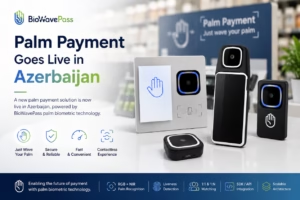
Palm Payment Goes Live in Azerbaijan: From Biometric Technology to Real-World Payment
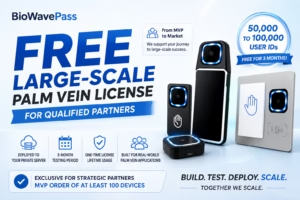
From MVP to Market: Scaling Palm Vein Technology with BioWavePass
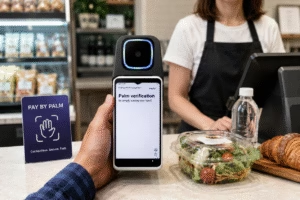
Palm Vein Payment: How Biometric Payments Work Without Cards or Phones
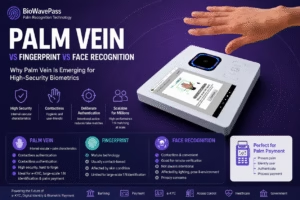
Palm Vein vs Fingerprint vs Face Recognition: Why Palm Vein Is Emerging for High-Security Biometrics
BioWavePass Palm Vein Scanner Products Receive Design Patent Certification
Palm Vein Authentication: The Future of Secure Digital Identity and Payments
BioWavePass AirOne Portable Palm Vein Payment POS Terminal Receives Design Patent