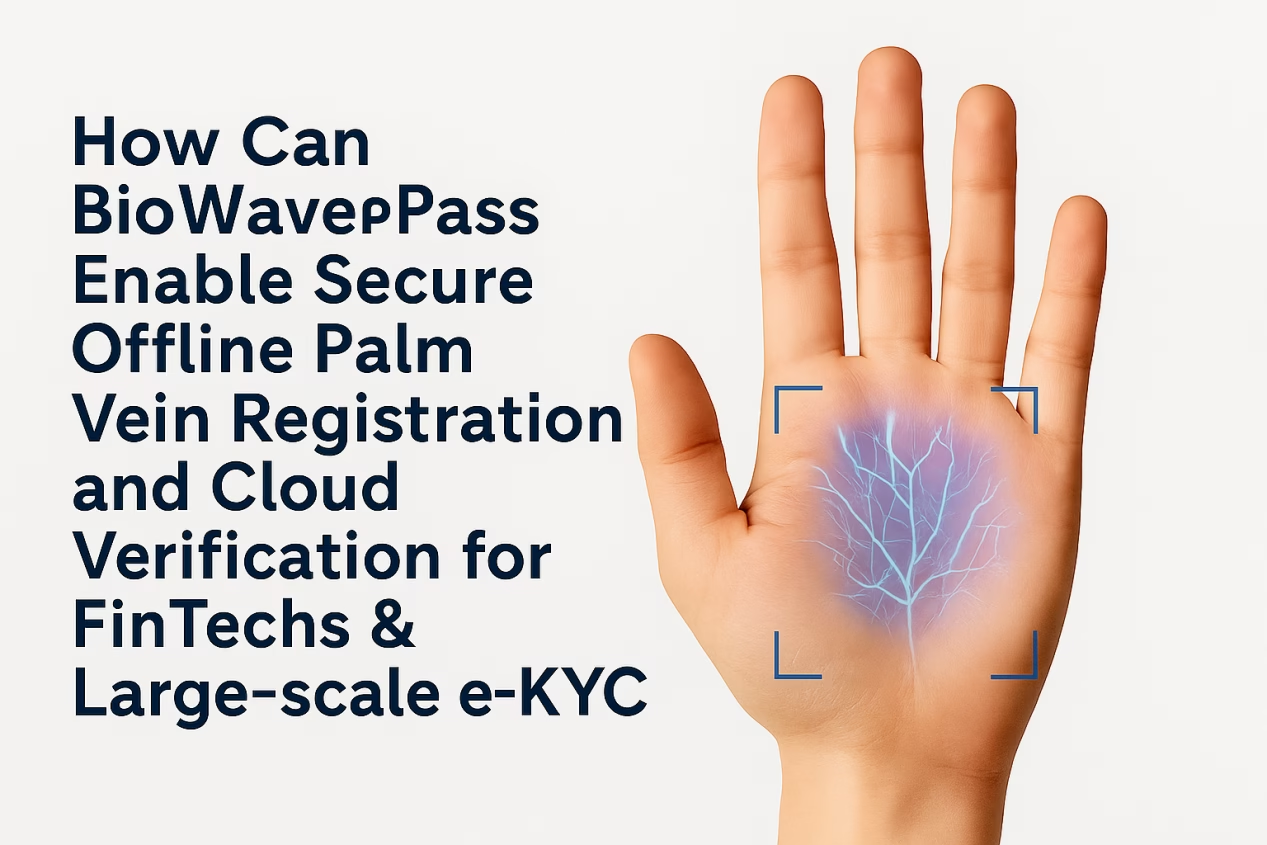
Como pode o BioWavePass permitir o registo seguro offline da veia da palma da mão e a verificação na nuvem para FinTechs e e-KYC em grande escala?
Introdução
In large-scale FinTech, e-KYC, and identity verification projects, maintaining secure and reliable biometric operations across both offline e online environments is critical.
Network interruptions are common in the field — yet financial institutions and event operators still need to register users, confirm enrolment success, and later synchronize those records securely to the cloud.
BioWavePass, developed by X-Telcom, delivers a hybrid Palm Vein Registration and Cloud Verification workflow, combining the flexibility of offline enrolment with the security and scalability of centralized cloud comparison.
1. The Challenge
FinTechs and system integrators often face three major pain points:
- Unstable connectivity: Field teams can’t rely on constant network access.
- Security & accuracy: Data integrity must be preserved during offline capture.
- Scalability: User records from multiple sites must synchronize to a unified, cloud-based database.
Clients need a system that allows offline registration and local verification, followed by secure cloud synchronization once connected.
2. BioWavePass Hybrid Workflow — Secure, Flexible, and Proven
Our technical team has validated that this hybrid approach is fully supported by the BioWavePass SDK and hardware.
Below are the three recommended steps to achieve offline registration with later cloud verification.
Step 1. Develop a Registration Capture Application
Clients can develop a registration capture app using the BioWavePass Palm Vein module.
This app should:
- Collect RGB + IR images of each user’s palm.
- Save each image with a unique user identifier (User ID).
- Use the BioWavePass SDK for image quality optimization and validation to ensure the data meets registration standards.
This ensures only valid and secure palm data are stored locally for synchronization later.
Step 2. Develop a Registration Submission Application
After data collection, clients can develop a registration submission app that:
- Uses the BioWavePass SDK to extract encrypted feature values from the optimized images.
- Uploads those encrypted templates to the central server for registration and management when a network connection is available.
This step transforms raw image data into secure, encrypted templates, enabling safe synchronization to the BioWavePass Cloud or a private on-prem environment.
Step 3. Choose Cloud-Compatible Devices
All registration and verification devices must be hardware models that support cloud-based comparison, as the final verification and matching process are performed in the cloud.
When network connectivity is restored:
- The registration device automatically uploads all encrypted templates.
- The cloud system performs centralized identity comparison.
- Verification results are synchronized to other connected terminals or systems.
This approach ensures both local autonomy e centralized accuracy, ideal for enterprise-scale deployments.
3. Why This Hybrid Model Works for FinTechs & e-KYC
| Challenge | BioWavePass Solution | Resultado |
|---|---|---|
| No stable network in field | Offline registration and local verification | Reliable enrolment in any environment |
| Need to centralize data later | Cloud synchronization and matching | Unified, accurate identity database |
| High security and compliance | AES-256 encryption + AI-based SDK | Financial-grade data protection |
| Multi-site scalability | Cross-device sync across locations | Fast rollout for large user bases |
4. Supported BioWavePass Hardware Models
XT-PalmVein 01 (USB Model)
Connects to Android, Windows, or Linux tablets and laptops.
Requires USB 5V / 1.5A output for stable operation.XT-WavePass500 (All-in-One Android Model)
Integrated palm vein + NFC device with DC power input.
Designed for fixed or semi-fixed verification stations.
Both models natively support the BioWavePass SDK, cloud algorithm integration, and are ideal for FinTech, e-KYC, and Palm Pay deployments.
5. Licensing & Scalability Options
| Package | User Scale | Descrição |
|---|---|---|
| MVP Testing Package | 10,000 users | Free for small-scale pilots |
| Standard License | 100,000 users | Suitable for enterprise rollout |
| Large-Scale License | 1,000,000 users | Ideal for national or event-level verification |
Licensing is one-time and based on total verified user count, with no per-device limitations.
For example, verifying 2 million users simply requires two 1M-user license packages.
6. Key Benefits at a Glance
- Hybrid Support: Register offline, verify online.
- Secure Encryption: AES-256 + SHA hashing for all templates.
- Cross-Platform: SDKs for Android, Windows, and Linux.
- Cloud Accuracy: Centralized matching with 99.9% success rate.
- Compliant & Scalable: Supports GDPR
Conclusão
BioWavePass provides FinTechs and KYC solution providers with a practical path to implement secure, scalable, and hybrid biometric workflows.
By following the three-step implementation — capture → extract → verify — clients can ensure reliable user registration even in offline conditions, while maintaining cloud-level accuracy and compliance once reconnected.
Whether deployed for financial onboarding, identity verification, or large-scale events, BioWavePass guarantees every palm vein record remains securely captured, encrypted, and verified with confidence.
If clients do not have their own software development team to build applications based on the BioWavePass Palm Vein SDK, our U.K. and India development teams can provide a complete end-to-end solution, from design to deployment, ensuring seamless implementation and technical support.
Learn More: https://biowavepass.com/palm-payment-technology/
Partilhar este artigo
Sobre o autor

Também pode gostar
Which Is the Best EMV & PCI Certified Palm Vein POS Terminal?
Will Palm Vein POS Support Existing EMV, NFC, and QR Payment Ecosystem?

Why Palm Vein Technology Is Emerging as a Payment-Grade Biometric Standard
Where Is Palm Vein Biometric Data Stored and How Is It Secured?
How Do You Choose the Best Palm Vein Technology for Real Projects?
How to Solve Power Issues in Palm Vein Scanner Projects?
What Is Palm Scanning Technology?
How Palm Vein Biometrics Can Be Integrated Into Mobile Payment Systems: A BioWavePass Implementation Guide
How to setup Palm Payment? Designing a Seamless Palm Payment Flow for Fintech and Payment Platforms