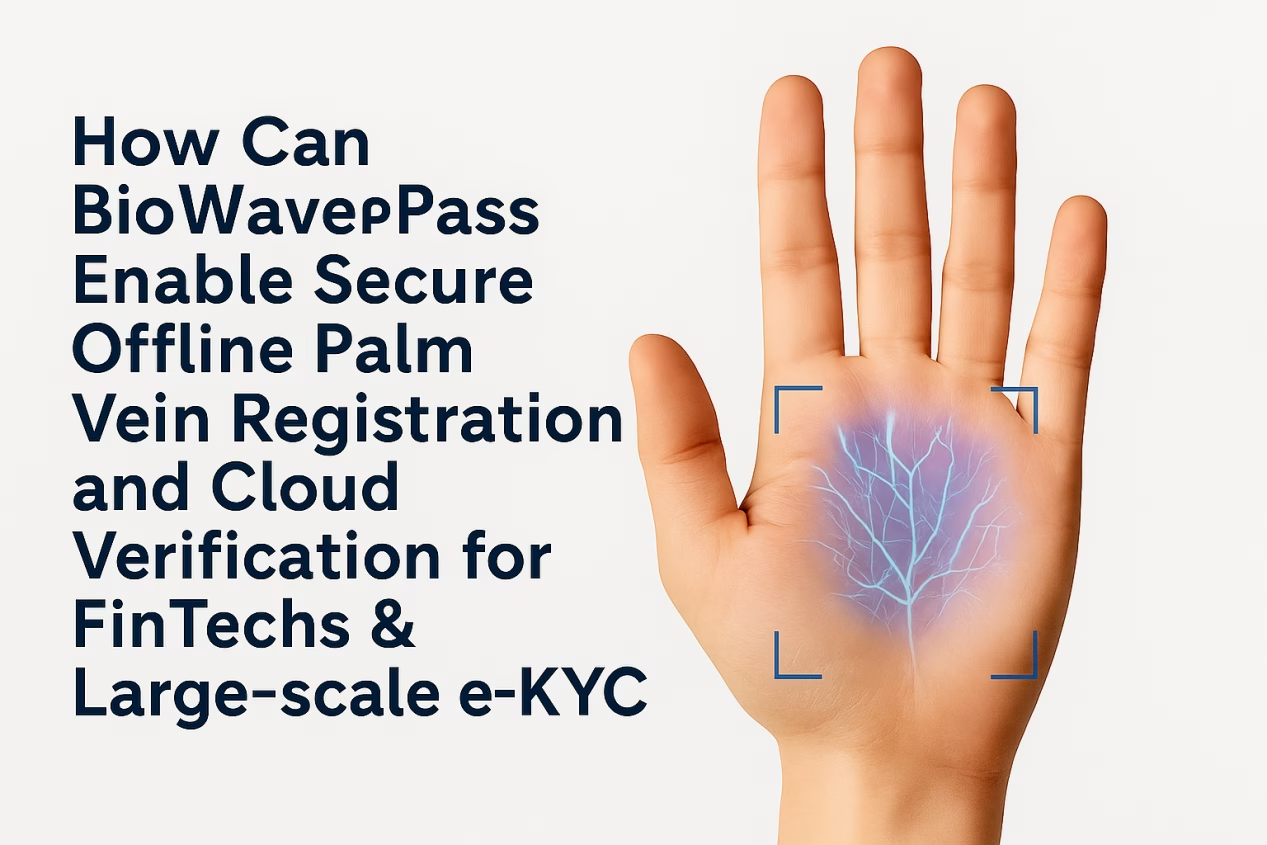
Comment BioWavePass peut-il permettre l'enregistrement sécurisé de la veine palmaire hors ligne et la vérification dans le nuage pour les FinTechs et l'e-KYC à grande échelle ?
Introduction
Dans les projets FinTech, e-KYC et de vérification d'identité à grande échelle, le maintien d'opérations biométriques sécurisées et fiables à la fois dans le cadre des projets FinTech, e-KYC et de vérification d'identité. hors ligne et en ligne est essentielle.
Les interruptions de réseau sont fréquentes sur le terrain, mais les institutions financières et les organisateurs d'événements ont toujours besoin d'enregistrer les utilisateurs, de confirmer le succès de l'inscription et de synchroniser ensuite ces enregistrements en toute sécurité vers le nuage.
BioWavePass, développé par X-Telcom, offre un service d'information et de conseil en matière de sécurité. Processus hybride d'enregistrement des veines de la main et de vérification dans le nuage, qui combine la flexibilité de l'inscription hors ligne avec la sécurité et l'évolutivité de la comparaison centralisée dans le nuage.
1. Le défi
Les FinTechs et les intégrateurs de systèmes sont souvent confrontés à trois points de douleur majeurs :
- Connectivité instable : Les équipes sur le terrain ne peuvent pas compter sur un accès permanent au réseau.
- Sécurité et précision : L'intégrité des données doit être préservée pendant la capture hors ligne.
- Évolutivité : Les enregistrements des utilisateurs de plusieurs sites doivent être synchronisés avec une base de données unifiée, basée sur le cloud.
Les clients ont besoin d'un système qui leur permette enregistrement hors ligne et vérification locale, suivi de synchronisation sécurisée dans le nuage une fois connecté.
2. Flux de travail hybride BioWavePass - Sûr, flexible et éprouvé
Notre équipe technique a validé que cette approche hybride est entièrement pris en charge par le SDK et le matériel BioWavePass.
Vous trouverez ci-dessous les trois étapes recommandées pour réaliser un enregistrement hors ligne avec une vérification ultérieure dans le nuage.
Étape 1. Développer une application de capture des enregistrements
Les clients peuvent élaborer un application de capture d'enregistrement en utilisant le Module BioWavePass Palm Vein.
Cette application devrait :
- Collecter Images RVB + IR de la paume de chaque utilisateur.
- Enregistrer chaque image avec un l'identifiant unique de l'utilisateur (User ID).
- Utiliser le SDK BioWavePass pour optimisation et validation de la qualité de l'image to ensure the data meets registration standards.
This ensures only valid and secure palm data are stored locally for synchronization later.
Étape 2. Élaborer une demande d'enregistrement
After data collection, clients can develop a registration submission app that:
- Uses the SDK BioWavePass to extract encrypted feature values from the optimized images.
- Uploads those encrypted templates to the central server for registration and management when a network connection is available.
This step transforms raw image data into secure, encrypted templates, enabling safe synchronization to the BioWavePass Cloud or a private on-prem environment.
Étape 3. Choisir des appareils compatibles avec le cloud
All registration and verification devices must be hardware models that support cloud-based comparison, as the final verification and matching process are performed in the cloud.
When network connectivity is restored:
- The registration device automatically uploads all encrypted templates.
- The cloud system performs centralized identity comparison.
- Verification results are synchronized to other connected terminals or systems.
This approach ensures both local autonomy et centralized accuracy, ideal for enterprise-scale deployments.
3. Pourquoi ce modèle hybride fonctionne-t-il pour les FinTechs et l'e-KYC ?
| Challenge | BioWavePass Solution | Result |
|---|---|---|
| No stable network in field | Offline registration and local verification | Reliable enrolment in any environment |
| Need to centralize data later | Cloud synchronization and matching | Unified, accurate identity database |
| High security and compliance | AES-256 encryption + AI-based SDK | Financial-grade data protection |
| Multi-site scalability | Cross-device sync across locations | Fast rollout for large user bases |
4. Modèles de matériel BioWavePass pris en charge
-
XT-PalmVein 01 (USB Model)
Connects to Android, Windows, or Linux tablets and laptops.
Requires USB 5V / 1.5A output for stable operation. -
XT-WavePass500 (All-in-One Android Model)
Integrated palm vein + NFC device with DC power input.
Designed for fixed or semi-fixed verification stations.
Both models natively support the BioWavePass SDK, cloud algorithm integration, and are ideal for FinTech, e-KYC, and Palm Pay deployments.
5. Options de licence et d'évolutivité
| Package | User Scale | Description |
|---|---|---|
| MVP Testing Package | 10,000 users | Free for small-scale pilots |
| Standard License | 100,000 users | Suitable for enterprise rollout |
| Large-Scale License | 1,000,000 users | Ideal for national or event-level verification |
Licensing is one-time and based on total verified user count, with no per-device limitations.
For example, verifying 2 million users simply requires two 1M-user license packages.
6. Aperçu des principaux avantages
- Hybrid Support: Register offline, verify online.
- Secure Encryption: AES-256 + SHA hashing for all templates.
- Cross-Platform: SDKs for Android, Windows, and Linux.
- Cloud Accuracy: Centralized matching with 99.9% success rate.
- Compliant & Scalable: Supports GDPR
Conclusion
BioWavePass provides FinTechs and KYC solution providers with a practical path to implement secure, scalable, and hybrid biometric workflows.
By following the three-step implementation — capture → extract → verify — clients can ensure reliable user registration even in offline conditions, while maintaining cloud-level accuracy and compliance once reconnected.
Whether deployed for financial onboarding, identity verification, or large-scale events, BioWavePass guarantees every palm vein record remains securely captured, encrypted, and verified with confidence.
If clients do not have their own software development team to build applications based on the BioWavePass Palm Vein SDK, our U.K. and India development teams can provide a complete end-to-end solution, from design to deployment, ensuring seamless implementation and technical support.
Learn More: https://biowavepass.com/palm-payment-technology/
Partager cet article
A propos de l'auteur

Vous pourriez aussi aimer
Scaling Palm Vein Payment: Single Server or Kubernetes Cluster?
Before You Scale Palm Vein POS: A Terminal Management Checklist
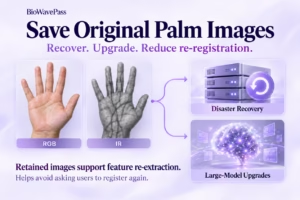
Why Saving Original Palm Images Matters for Biometric Recovery and Future Upgrades By BioWavePass
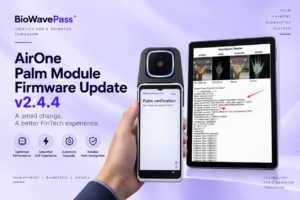
Optimizing Palm Payment Performance: AirOne Palm Module Firmware v2.4.4
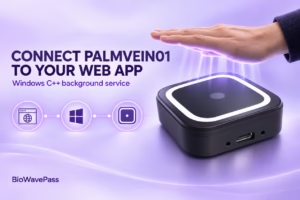
Bringing Palm Vein Scanning into a Web Workflow
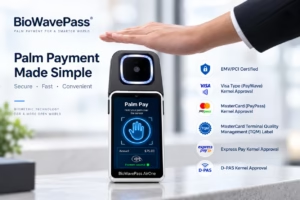
From Palm Payment MVP to Commercial Deployment: Building a Scalable Biometric Payment System
How to Integrate a USB Palm Vein Scanner with a POS Terminal
Palm Payment Goes Live in Azerbaijan: From Biometric Technology to Real-World Payment
From MVP to Market: Scaling Palm Vein Technology with BioWavePass