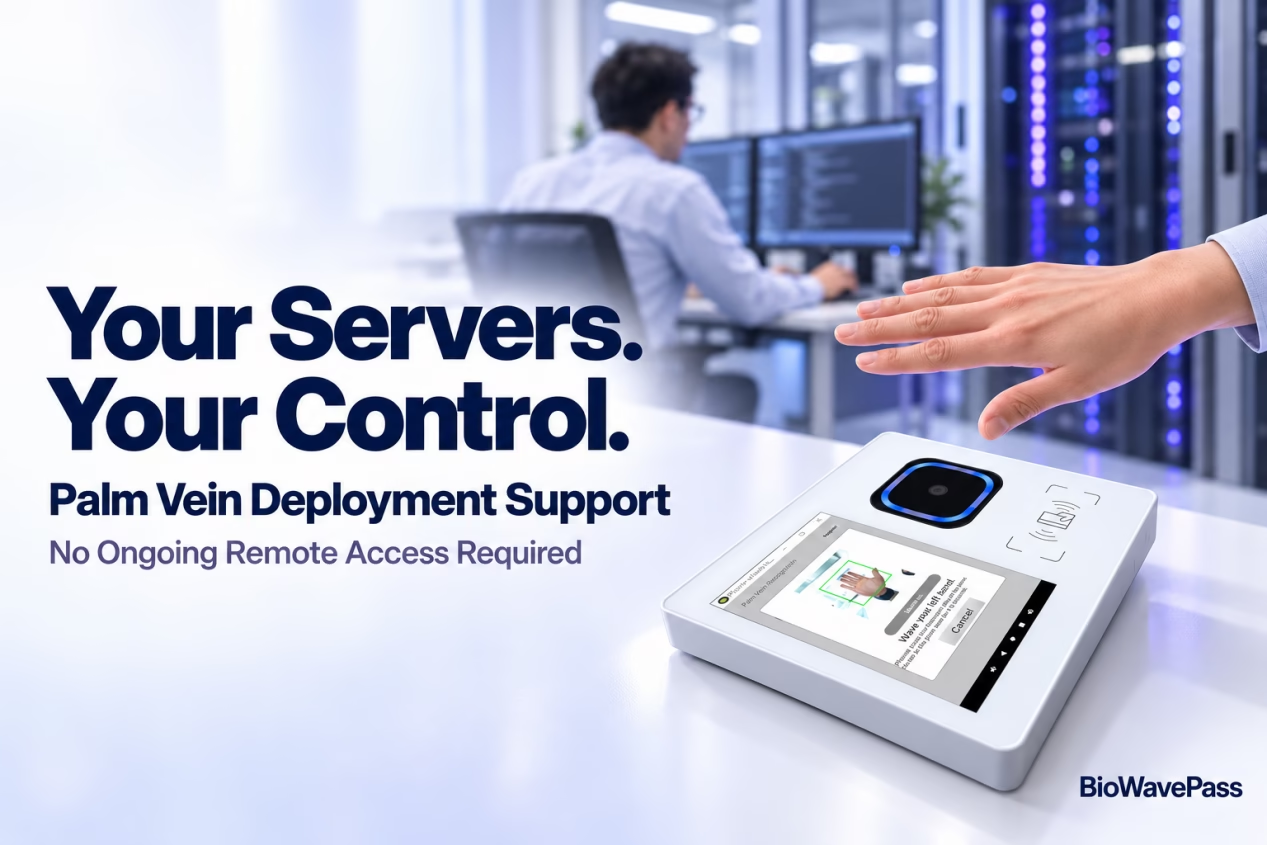
Palm Vein Deployment Support: Who Can Access Your Servers?
Before introducing palm vein authentication into a production environment, IT teams need to know who will access their servers, what permissions are required and whether that access will continue after installation.
These questions are especially relevant when a palm vein payment platform connects biometric terminals with customer accounts and payment workflows.
BioWavePass provides free remote deployment support for its large-model palm vein algorithm. The deployment is carried out on the customer’s infrastructure, with access arrangements agreed before work begins. Once deployment is complete, our team does not require continued remote access to the server environment.
The Concern: Temporary Support Becoming Permanent Access
A customer may welcome technical assistance during installation while still wanting its own team to control day-to-day operations.
Before deployment, both teams should establish:
- Which environment the deployment team will access.
- What permissions are needed.
- How long installation and configuration are expected to take.
- Who manages the system after handover.
- How future technical issues will be investigated.
Clear responsibilities help prevent unnecessary delays when a palm vein recognition project moves from testing to production.
What Access Is Required During Deployment?
For a Kubernetes deployment of the BioWavePass large-model algorithm, cluster-admin permissions are required.
These permissions support the environment configuration and service deployment work. The customer’s infrastructure team should review and approve the access method before the deployment session.
Cluster-admin is a Kubernetes permission. Any separate requirements for server login, operating-system administration or network configuration should be confirmed for the specific environment rather than assumed.
How Long Does Deployment Take?
Environment checks, configuration and large-model algorithm deployment are generally expected to take 2–3 days.
The schedule depends on the required infrastructure being ready. Missing resources, access restrictions or unresolved network settings can extend the work.
This estimate covers algorithm deployment. It does not represent the time required to develop an entire palm vein payment application, integrate a retail cashier system or redesign a customer’s backend.
| Activity | Scope |
|---|---|
| Environment review | Check the prepared infrastructure and deployment conditions |
| Configuration and installation | Configure and deploy the large-model algorithm services |
| Deployment validation | Confirm that the deployed services respond as expected |
| Business application integration | A separate development activity based on the customer’s requirements |
Does BioWavePass Need Access After Deployment?
No continued remote access is required after deployment is completed.
The customer operates the server environment, and the algorithm deployment has no external connections. BioWavePass does not need to keep logging in for routine biometric matching.
Your infrastructure team can close the temporary access arrangement after handover in accordance with its own procedures.
This allows a palm vein authentication service to run within the customer’s operational environment without making permanent supplier access part of normal operation.
How Are Technical Issues Investigated Later?
For case analysis, the customer provides the relevant case images and error information.
This gives the support team material to investigate a recognition issue without routinely entering the customer’s production servers. Any transfer of biometric images should follow the customer’s approved data-handling process.
A useful support report should explain:
- What the user was trying to do.
- Whether the issue occurred during registration or matching.
- The error code or message returned.
- The device and software versions involved.
- The relevant case images, where required for analysis.
Providing a specific case helps distinguish an image-capture issue from an integration, configuration or application problem.
Algorithm Deployment and Payment Development Have Different Responsibilities
In a palm vein payment solution, the biometric service supplies a matching result. The customer’s application and backend use that result within their own account and payment logic.
Deploying the algorithm does not automatically include developing:
- The terminal’s customer-facing application.
- User registration and account-binding workflows.
- Retail POS or cashier-system connections.
- Payment gateway integration.
- Business dashboards and operational tools.
If your team needs additional development support, BioWavePass can review the requested functions and expected deliverables separately. A clear scope is needed before estimating implementation time and commercial terms.
Prepare for a Clear Handover
Before scheduling remote deployment, identify the people responsible for infrastructure, application integration and ongoing operations.
Your team should also confirm the proposed server configuration, network access arrangements and deployment architecture. For Kubernetes environments, approval for the required cluster permissions should be arranged in advance.
After installation, agree on the handover point and the information needed for future support. This gives both teams a practical way to work together while keeping operational ownership clear.
Start With a Defined Deployment Scope
Remote support can help accelerate a large-model palm vein recognition deployment when the environment and responsibilities are prepared.
BioWavePass’s approach is straightforward: assist with deployment, complete validation and hand the environment over to the customer. Continued supplier access is not required for routine operation.
Partilhar este artigo
Sobre o autor

Também pode gostar
Can a Palm Vein SDK Capture Data Without an Algorithm Server?

Palm Vein Image Encryption: Why AES-256-GCM Alone Does Not Guarantee Compatibility
Large-Scale Palm Vein Recognition: How to Test the SDK and Plan for Growth

Palm Vein Payment SDK: Direct Algorithm Server Integration or Your Own Backend?
Scaling Palm Vein Payment: Single Server or Kubernetes Cluster?

Before You Scale Palm Vein POS: A Terminal Management Checklist
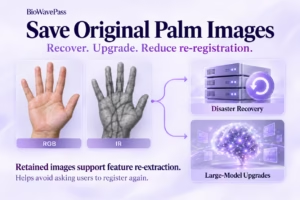
Why Saving Original Palm Images Matters for Biometric Recovery and Future Upgrades By BioWavePass
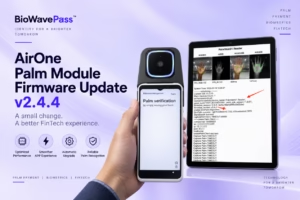
Optimizing Palm Payment Performance: AirOne Palm Module Firmware v2.4.4
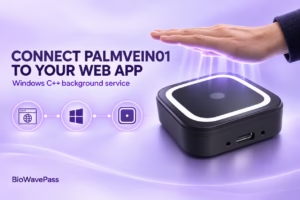
Bringing Palm Vein Scanning into a Web Workflow