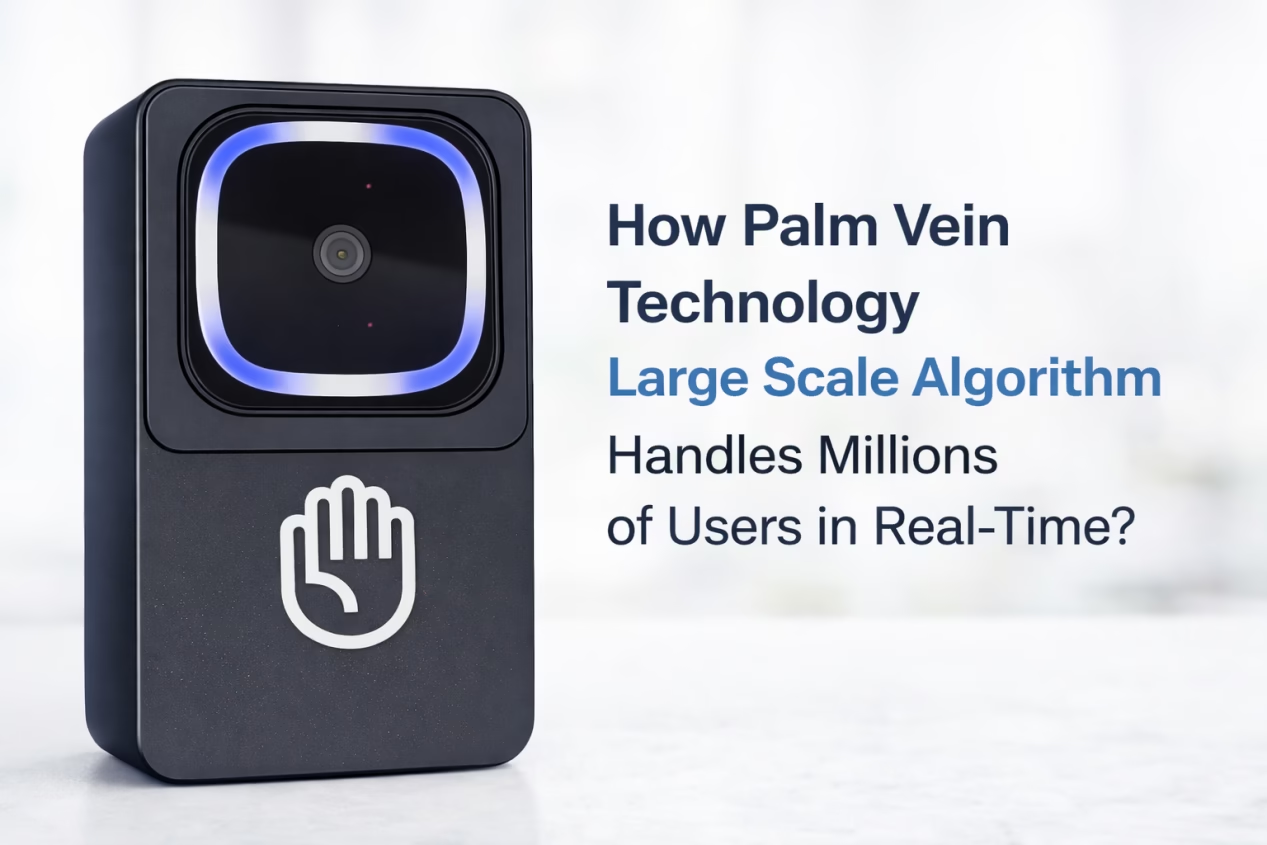
How Palm Vein Technology Large Scale Algorithm Handles Millions of Users in Real-Time?
مقدمة
As biometric systems move from small deployments to national-level platforms and global payment ecosystems, one challenge becomes critical:
How can a biometric system handle millions of users in real-time without sacrificing speed or accuracy?
This is exactly where palm vein technology large scale algorithm تبرز.
Unlike traditional biometric systems, palm vein solutions are designed not only for identity recognition, but for high-concurrency, real-time performance and system stability at scale.
The Challenge of Real-Time Systems at Scale
In the following scenarios:
- Digital payment platforms
- eKYC identity verification systems
- Government identity systems
- Transportation and ticketing systems
The system must handle:
- High concurrency (many users verifying simultaneously)
- Databases with millions or even tens of millions of users
- Sub-second response requirements
The bottlenecks of traditional systems include:
- Matching speed decreases as the database grows
- Limited feature dimensions reduce accuracy
- Increased latency under high load
Why Palm Vein Technology Is Naturally Scalable
Palm vein recognition has inherent advantages:
- اللقطات subdermal vein patterns, offering higher uniqueness
- Not affected by skin color, aging, or lighting conditions
- Provides richer feature dimensions
However, true scalability comes from its large scale algorithm architecture.
Core Technologies for Real-Time Processing
1. Dual-Mode Data Fusion (RGB + IR)
The system captures:
- RGB images → palm surface features
- IR images → internal vein structures
Advantages:
- Increased feature density
- Reduced false acceptance rates
- Maintains high accuracy even in large databases
2. GPU-Based Parallel Computing Architecture
Large-scale real-time processing relies on:
- GPU parallel computing
This enables:
- Simultaneous processing of multiple requests
- High-speed feature extraction
- Fast matching across massive datasets
Compared to traditional CPU-based sequential processing, GPU architecture significantly reduces response time.
3. Vector Database Support (Milvus)
Traditional relational databases cannot support large-scale biometric search.
The system uses Milvus vector database:
- Stores biometric feature vectors
- Enables high-speed similarity search
- Optimizes performance for million-level datasets
Results:
- Stable performance as data scales
- Millisecond-level query speed
4. Four-Factor Matching Mechanism
The large scale algorithm uses multi-layer verification:
- Device-side palm print features
- Device-side vein features
- Server-side palm print features (from RGB images)
- Server-side vein features (from IR images)
Advantages:
- Extremely low false acceptance rate
- More stable matching results
- Suitable for high-security scenarios
BioWavePass Algorithm Performance Testing (Internal Validation)
To verify the stability and performance of the large scale algorithm in real-world conditions,
BioWavePass conducted large-scale internal testing on its palm vein algorithm.
Test Environment
- Data scale: 5 million user database
- Concurrency test: 100,000 parallel operations per task (registration / deletion / query)
- Hardware: NVIDIA A10 GPU
- Architecture: GPU parallel computing + Milvus vector database
Test Results
1. Response Speed
- Average recognition time per query: approximately 300 milliseconds (0.3 seconds)
- Stable response maintained under high concurrency
👉 Meets real-time requirements for payments and eKYC
2. Large-Scale Stability
Under simultaneous operations:
- User registration (Enrollment)
- User deletion (Deletion)
- Real-time identification (Identification)
System performance:
- No noticeable performance degradation
- Stable query speed
- No system blocking or latency accumulation
3. Concurrency Capability
- Supports high concurrent request processing (high TPS/QPS)
- GPU configuration can scale based on business needs
- Supports horizontal scaling (multi-node deployment)
4. Accuracy Performance at Scale
In a 5 million user database test:
- Recognition success rate reaches ~99% level
- Significantly lower false acceptance compared to single-mode biometrics
Reasons:
- RGB + IR dual-mode fusion
- Multi-layer feature verification
- High-quality feature extraction and filtering
Performance Under High Concurrency
With proper architecture configuration, the system can achieve:
- Thousands of transactions per second (TPS)
- Average response time around 300ms
- Stable long-term operation under heavy load
Key factors:
- GPU capacity planning
- Concurrency scheduling
- Vector indexing optimization
Recommended Architecture for Million-Level Deployment
A complete system typically includes:
Device Layer
- Captures palm vein images
- Performs liveness detection
- Initial feature extraction
Algorithm Layer
- AI-based feature re-extraction
- High-speed matching
Data Layer
- Stores feature vectors in Milvus
- Enables fast retrieval
Orchestration Layer (Optional)
- Request routing
- موازنة التحميل
- Multi-node scaling
Why Real-Time Performance Matters
In real-world scenarios:
- Payments must be instant
- Authentication must be seamless
- Systems cannot become bottlenecks
The value of palm vein large scale algorithms lies in:
Maintaining both speed and accuracy, even as the system scales.
الخاتمة
Achieving real-time recognition at million-scale is not just about hardware upgrades,
but about upgrading the entire system architecture.
The core capabilities of palm vein technology large scale algorithm include:
- RGB + IR dual-mode fusion
- GPU parallel computing
- Vector database architecture
- Multi-layer verification mechanism
Combined with BioWavePass large-scale test results, it clearly shows:
👉 Palm vein technology is ready for real-world, large-scale commercial deployment
CTA
If you are building a large-scale real-time biometric system or payment platform,
palm vein technology offers a more stable and scalable solution.
👉 Learn more: https://biowavepass.com/biowavepass-palm-vein-scanner-products/
شارك هذه المقالة
نبذة عن الكاتب

قد يعجبك أيضاً

Scaling Palm Vein Payment: Single Server or Kubernetes Cluster?

Before You Scale Palm Vein POS: A Terminal Management Checklist

Why Saving Original Palm Images Matters for Biometric Recovery and Future Upgrades By BioWavePass

Optimizing Palm Payment Performance: AirOne Palm Module Firmware v2.4.4

Bringing Palm Vein Scanning into a Web Workflow

From Palm Payment MVP to Commercial Deployment: Building a Scalable Biometric Payment System

How to Integrate a USB Palm Vein Scanner with a POS Terminal

Palm Payment Goes Live in Azerbaijan: From Biometric Technology to Real-World Payment

From MVP to Market: Scaling Palm Vein Technology with BioWavePass
