Palm Vein Payment: How Biometric Payments Work Without Cards or Phones
Payments have evolved from cash and magnetic stripe cards to contactless cards, smartphones, QR codes and digital wallets.
The next step could be even simpler:
Your palm becomes your authentication method.
Palm vein payment allows a registered user to identify and authenticate themselves by presenting their palm, without needing to present a physical card or smartphone during the biometric interaction.
For banks, fintech companies, payment providers and digital wallet operators, this creates a new way to connect biometric identity with payment.
But how does palm payment actually work?
What Is Palm Vein Payment?
Palm vein payment is a biometric payment method that uses characteristics of a person’s palm as part of the process of identifying and authenticating a registered user.
BioWavePass technology combines:
- NIR palm vein recognition
- RGB palmprint recognition
- Palm detection
- Liveness detection
- Biometric matching
Once a user’s palm has been enrolled and securely linked with their identity and appropriate payment account, the palm can become part of the payment authentication process.
A simplified experience can look like:
Present Palm → Identify User → Authenticate → Connect Payment Account → Process Payment
The important difference is that the user does not necessarily need to present a card, smartphone or QR code during the palm authentication process.
How Does Palm Payment Work?
A complete palm payment system involves several layers.
1. User Enrolment
Before someone can pay using their palm, their biometric identity must first be registered.
The palm recognition device captures RGB palmprint and NIR palm vein information.
The biometric algorithm extracts the relevant features and creates the biometric data required for future matching.
The user’s biometric identity can then be associated with an account within the wider payment ecosystem.
2. Palm Capture
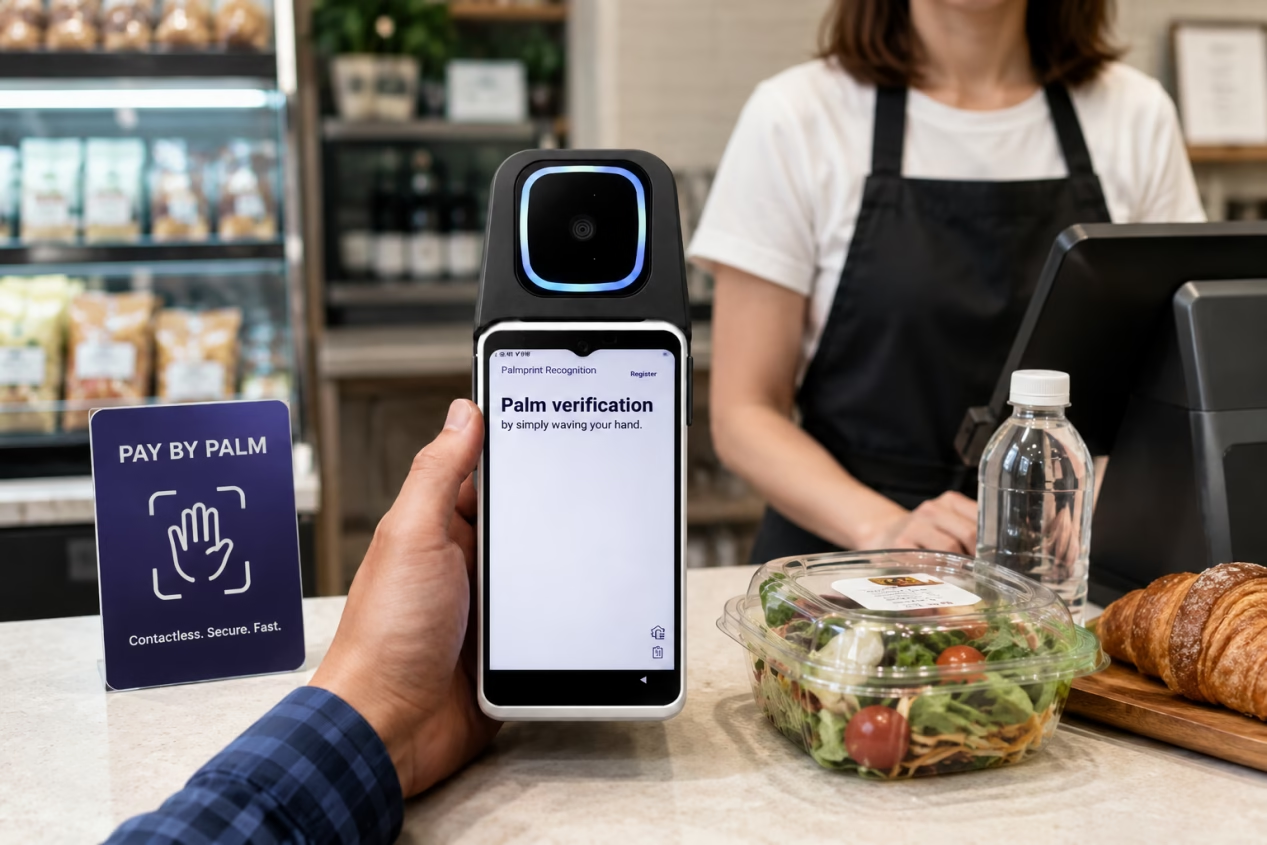
When the customer wants to authenticate, they present their palm above the scanner.
No physical contact with the biometric sensor is required.
The device captures the palm information required for recognition.
This provides a simple user experience:
Wave Your Palm → Authenticate
3. Liveness Detection
For payment applications, recognising a palm is only part of the security requirement.
The system also needs to determine whether the biometric presentation is genuine.
Liveness detection, also known as Presentation Attack Detection (PAD), helps identify attempted presentation attacks.
This is particularly important when biometric authentication is connected to financial transactions.
4. Biometric Identification
Once the palm has been captured, the biometric features can be compared against the enrolled user database.
For palm payment, 1:N biometric identification is particularly important.
Instead of asking:
"Does this palm belong to this specific account?"
the system can determine:
"Which registered user does this palm belong to?"
This allows the palm itself to become the mechanism for identifying the registered customer.
Why 1:N Matching Matters for Palm Payment
Traditional biometric authentication is often based on 1:1 verification.
For example, a smartphone already knows which user account is being authenticated. The biometric simply verifies that the person using the device is authorised.
Palm payment can work differently.
The customer may approach a payment terminal without first presenting a phone, card or customer ID.
The system therefore needs to identify the user from a potentially large biometric database.
1 Palm → Search Registered Database → Identify User
For a commercial payment ecosystem with hundreds of thousands or millions of registered users, this requires a scalable biometric matching architecture.
BioWavePass provides large-model biometric matching technology designed for these types of deployments.
From Palm Identity to Payment
Biometric identification alone does not move money.
This is an important distinction when discussing palm payment technology.
A complete ecosystem may include:
Palm Recognition + Digital Identity + User Account + Payment Gateway / Acquirer + Bank or Wallet + Payment Hardware
The palm recognition platform identifies and authenticates the user.
The financial transaction is then handled through the appropriate bank, acquirer, payment gateway, digital wallet or payment processor.
This means palm payment is not simply a hardware project.
It is an ecosystem project.
Why Palm Vein Is Well Suited to Contactless Payment
Several characteristics make palm vein recognition particularly interesting for payment applications.
Contactless Authentication
The customer does not need to touch the biometric sensor.
They simply present their palm within the recognition area.
Deliberate User Action
Palm authentication normally requires the customer to intentionally present their hand.
This creates a clear authentication action:
Present Palm → Confirm Identity → Continue Transaction
Biometric Characteristics Beneath the Skin
Palm vein recognition uses NIR imaging to capture information associated with vascular characteristics beneath the skin.
These characteristics are not normally visible without specialised imaging equipment.
Multimodal Recognition
BioWavePass combines:
RGB Palmprint + NIR Palm Vein
This allows different biometric information to be obtained from the same palm presentation.
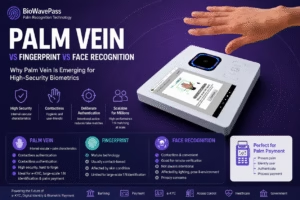
Palm Payment vs Face Payment
Both palm and face recognition can support contactless biometric experiences.
However, the interaction is different.
Facial recognition can potentially capture a person’s biometric characteristics simply because they are facing a camera.
Palm payment normally requires a more deliberate action.
The customer intentionally presents their palm to the recognition device.
For financial transactions, this can provide a clear distinction between simply being present and actively initiating an authentication interaction.
Palm Payment vs Fingerprint Payment
Fingerprint authentication is already widely used within smartphones and other payment devices.
However, in many of these applications the fingerprint is used to authenticate the owner of a device that already contains or accesses the payment credential.
Palm payment can provide a different experience.
Instead of:
Phone → Fingerprint → Wallet → Payment
a palm-based system can potentially provide:
Palm → Identify User → Payment Account → Payment
This creates the possibility of a biometric payment experience without requiring the customer to present their own device at the point of interaction.
Can Palm Payment Support Millions of Users?
Large-scale palm payment requires more than an accurate scanner.
The biometric matching architecture must also be capable of searching a large registered user database efficiently.
BioWavePass provides different algorithm models according to deployment scale.
For samples, MVP development and proof-of-concept projects, customers can begin with up to:
10,000 registered user IDs
For larger commercial deployments, BioWavePass provides a large-model architecture designed for databases ranging from hundreds of thousands to millions of registered users.
Server capacity and required QPS, or Queries Per Second, can then be configured according to the expected transaction volume.
What Technology Is Required for a Palm Payment Project?
A commercial palm payment project normally requires several technology partners.
These can include:
- Palm recognition technology provider
- Bank
- Acquirer
- Payment gateway
- Payment processor
- Digital wallet provider
- Fintech platform
- POS provider
- Local system integrator
This ecosystem is important because biometric technology provides the identity and authentication layer, while regulated payment infrastructure handles the financial transaction.
BioWavePass focuses on the palm biometric technology layer.
BioWavePass Palm Payment Technology
BioWavePass provides several hardware options for companies developing palm recognition and palm payment solutions.
These include palm recognition scanners for integration with existing systems and dedicated terminals for more complete deployments.
For payment-focused projects, the BioWavePass AirOne combines palm recognition capabilities with a mobile POS architecture.
Depending on the selected hardware and project architecture, BioWavePass can provide:
- Palm recognition hardware
- RGB + NIR biometric capture
- Liveness detection
- 1:1 and 1:N biometric matching
- Android SDK
- Linux SDK
- Windows SDK
- Flutter SDK/ API integration
- Private server deployment
- Large-scale biometric algorithm architecture
This allows partners to integrate palm authentication into their own payment, banking or digital identity ecosystem.
Is Palm Payment Secure?
Security depends on the complete system architecture, not simply the biometric modality.
A commercial palm payment solution should consider:
- Biometric matching accuracy
- Liveness detection
- Biometric template protection
- Encryption
- User enrolment security
- Account linking
- Server security
- Application security
- Payment certification
- Transaction authorisation
- Local financial regulations
The biometric system should therefore be treated as one security layer within the wider payment infrastructure.
Frequently Asked Questions About Palm Payment
What is palm payment?
Palm payment uses palm biometric recognition as part of the process for identifying and authenticating a registered customer before a payment transaction is processed.
Can you pay without a card or smartphone?
A properly integrated palm payment ecosystem can allow a registered customer to authenticate using their palm without presenting a physical card or smartphone during the biometric interaction.
Does palm payment use palmprint or palm vein recognition?
Different systems may use different technologies. BioWavePass combines RGB palmprint recognition and NIR palm vein recognition.
Does palm payment require physical contact?
No. BioWavePass palm recognition technology is designed for contactless palm capture.
Can palm payment identify a user from millions of people?
Large-scale palm payment can use 1:N biometric matching to identify a registered user within a large database. The required server and matching architecture depends on database size and transaction volume.
Does BioWavePass process the payment transaction?
BioWavePass focuses on the biometric hardware, palm recognition algorithms and integration technology. Payment processing should be integrated with the appropriate bank, acquirer, gateway, wallet or other payment infrastructure.
The Future of Palm Payment
The evolution of payment has progressively reduced the number of things customers need to carry.
Cash was replaced by cards.
Cards were increasingly supplemented by smartphones and digital wallets.
Palm recognition introduces another possibility:
The customer becomes the credential.
For banks, fintech companies and payment providers, the opportunity is not simply to replace a card with another authentication method.
It is to connect biometric identity, digital accounts and payment infrastructure into a faster and more natural customer experience.
BioWavePass provides the palm recognition technology required to build this biometric layer, from RGB and NIR palm capture to liveness detection, large-scale 1:N matching, SDK/API integration and payment-capable hardware.
شارك هذه المقالة
نبذة عن الكاتب

قد يعجبك أيضاً

Scaling Palm Vein Payment: Single Server or Kubernetes Cluster?

Before You Scale Palm Vein POS: A Terminal Management Checklist

Why Saving Original Palm Images Matters for Biometric Recovery and Future Upgrades By BioWavePass

Optimizing Palm Payment Performance: AirOne Palm Module Firmware v2.4.4

Bringing Palm Vein Scanning into a Web Workflow

From Palm Payment MVP to Commercial Deployment: Building a Scalable Biometric Payment System

How to Integrate a USB Palm Vein Scanner with a POS Terminal

Palm Payment Goes Live in Azerbaijan: From Biometric Technology to Real-World Payment

From MVP to Market: Scaling Palm Vein Technology with BioWavePass