Palm Vein vs Fingerprint vs Face Recognition: Why Palm Vein Is Emerging for High-Security Biometrics
Biometric authentication is becoming an essential part of e-KYC, digital identity, banking, access control and biometric payment systems.
Fingerprint and facial recognition are already widely used, but التعرف على وريد راحة اليد is gaining increasing attention for applications that require high security, contactless authentication and deliberate user interaction.
So what makes palm vein recognition different?
And why are banks, fintech companies, identity solution providers and system integrators increasingly exploring palm-based authentication?
What Is Palm Vein Recognition?
Palm vein recognition is a biometric authentication technology that uses near-infrared (NIR) imaging to capture vascular characteristics beneath the skin of a person’s palm.
Unlike fingerprints and facial characteristics, which are externally visible biometric features, palm vein authentication uses vascular information that requires specialised imaging technology to capture.
BioWavePass combines:
- NIR palm vein recognition
- RGB palmprint recognition
- Palm detection
- Liveness detection
- Biometric matching
A typical BioWavePass authentication process can include:
Palm Detection → Liveness Detection → Feature Extraction → Biometric Matching → Identity Verification
This makes palm recognition particularly relevant for applications such as e-KYC, digital identity, banking authentication and palm payment.
Why Is Palm Vein Recognition Different?
One of the main advantages of palm vein technology is the combination of contactless operation and biometric characteristics associated with vascular patterns beneath the skin.
Users simply present their palm within the recognition area.
There is no requirement to touch a fingerprint sensor or present a card, and authentication represents an intentional action by the user.
This creates several advantages for applications involving:
- Payment
- الأعمال المصرفية
- e-KYC
- الرعاية الصحية
- Government identity
- Enterprise authentication
- Access control
- Self-service terminals
Palm Vein vs Fingerprint vs Face Recognition
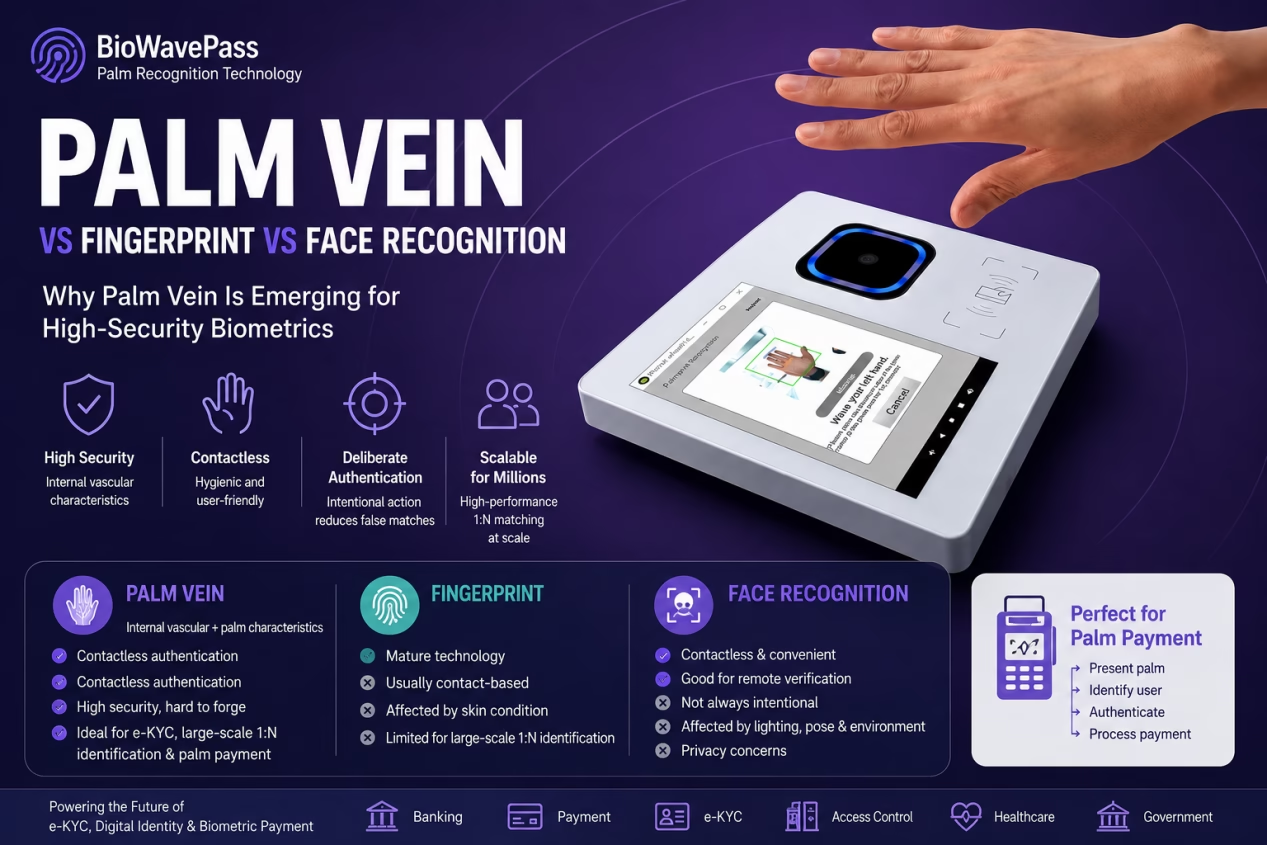
Each biometric technology has its own advantages, but palm vein recognition offers a distinctive combination of characteristics.
| Feature | وريد النخيل | Fingerprint | التعرف على الوجه |
|---|---|---|---|
| Biometric characteristic | Internal vascular + palm characteristics | External fingerprint | External facial characteristics |
| عدم التلامس | نعم | Usually no* | نعم |
| Intentional user action | نعم | نعم | Not always |
| Capture method | NIR + RGB | Fingerprint sensor | Camera |
| Suitable for e-KYC | High | متوسط | High |
| Suitable for contactless payment | High | Limited | متوسط |
| Suitable for high-security authentication | High | متوسط | متوسط |
| Suitable for large-scale 1:N identification | High with scalable matching architecture | Application-dependent | Application-dependent |
| Biometric visibility | Not normally visible | Visible | Highly visible |
*Contactless fingerprint technologies also exist, although conventional fingerprint readers commonly require physical contact.
The important difference is that palm vein recognition combines contactless capture, intentional authentication and internal biometric characteristics within a single user experience.
For large-scale applications, the biometric modality is only one part of the solution. Algorithm architecture, liveness detection, database capacity and matching performance also determine whether the technology is suitable for commercial deployment.
Palm Vein vs Fingerprint Recognition
Fingerprint recognition is mature and cost-effective, making it highly suitable for many conventional biometric applications.
However, traditional fingerprint scanners normally require physical contact. Fingerprint capture can also be influenced by wet, dry, dirty or damaged fingers.
Palm vein recognition provides a different approach.
The user presents their palm without touching the scanner, while NIR imaging captures vascular information beneath the skin.
For applications where minimum hardware cost is the main consideration, fingerprint recognition may remain appropriate.
For applications where security, contactless operation and user experience have greater importance, palm vein recognition becomes particularly attractive.
Palm Vein vs Face Recognition
Facial recognition offers excellent convenience and is particularly effective for remote identity verification because cameras are already widely available.
Palm vein recognition serves a different purpose.
A user normally makes a deliberate decision to authenticate by presenting their palm:
Present Palm → Verify Identity → Authorise Action
This intentional interaction is particularly valuable for applications such as payment, banking authentication and physical e-KYC.
There is also an important distinction in how biometric characteristics are presented.
A person’s face is naturally visible and can potentially be captured from a distance. Palm vascular information is beneath the skin and requires specialised imaging equipment to capture.
For remote onboarding, face recognition may therefore be highly practical.
For deliberate, repeated physical authentication, palm vein recognition provides a compelling alternative.
How Accurate Is BioWavePass Palm Recognition?
Accuracy should not simply be described as a single percentage.
Professional biometric systems should be evaluated using metrics such as FAR, FRR, TAR, detection accuracy and liveness performance.
BioWavePass large-scale algorithm testing produced the following results:
| Algorithm | Performance |
|---|---|
| Palm Detection | 99.64% Precision @ 99.96% Recall |
| Palm Liveness Detection | 98.69% TAR @ FAR 1×10⁻³ |
| Palm Matching | 97.8779% TAR @ FAR 1×10⁻⁸ |
The palm matching evaluation was conducted using a dataset at the scale of hundreds of millions of records.
A FAR of 1×10⁻⁸ represents approximately one false acceptance in 100 million comparisons under the stated test conditions.
This level of testing is particularly relevant when considering palm recognition for large-scale identity and financial applications.
Palm Vein Recognition and Liveness Detection
For high-security biometric applications, matching alone is not enough.
The system should also determine whether the presented palm originates from a genuine person rather than a presentation attack.
BioWavePass palm liveness testing included tens of millions of spoof attack samples, including:
- Printed paper fake hands
- Plastic fake hands
- Silicone fake hands
- Gloves
- Other presentation attack samples
The documented testing achieved:
98.69% TAR @ FAR 1×10⁻³
Liveness detection becomes particularly important when palm recognition is used for payment, banking, e-KYC and high-security identity authentication.
Why Palm Vein Recognition Is Well Suited to e-KYC
Palm vein technology can provide a strong biometric layer within an e-KYC or digital identity ecosystem.
A typical process may include:
User Enrolment → Palm Capture → Liveness Detection → Biometric Template → Identity Registration → Future Palm Authentication
Once enrolled, the user can subsequently authenticate using their palm without repeatedly presenting traditional credentials.
This can be particularly useful in:
- Banks
- Government service centres
- Healthcare facilities
- Self-service kiosks
- Retail environments
- Enterprise identity systems
Palm recognition can also complement other biometric technologies.
For example:
Face Recognition for Remote Enrolment + Palm Vein Recognition for Repeated Physical Authentication
Rather than replacing every biometric technology, palm vein can become the preferred authentication method at specific points within the identity journey.
Why Palm Vein Recognition Is Particularly Interesting for Payment
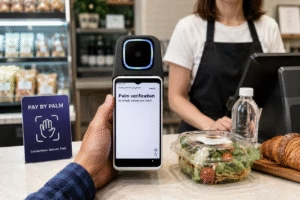
Palm payment is one of the most promising applications for palm recognition technology.
Once a user’s biometric identity is securely enrolled and connected to an appropriate payment account, presenting the palm can become part of the payment authentication process.
The user experience can become:
Present Palm → Identify User → Authenticate → Process Payment
This is an important distinction from many fingerprint payment applications, where the fingerprint is commonly used to authenticate the owner of a specific smartphone, card or other device.
Palm recognition can instead form part of a contactless biometric identification and payment experience.
A complete palm payment ecosystem may include:
Palm Recognition + Digital Identity + Payment Account + Payment Gateway / Acquirer + Certified Payment Hardware
Palm payment therefore requires much more than simply adding a biometric scanner to a POS terminal.
Successful deployment requires an ecosystem involving banks, acquirers, fintech companies, digital wallets, payment processors and biometric technology providers.
BioWavePass focuses on providing the palm recognition hardware, algorithms, SDK/API and integration technology required within this ecosystem.
Can Palm Vein Recognition Scale to Millions of Users?
Yes, but the biometric architecture needs to be designed according to the size of the database.
BioWavePass provides different algorithm models for different deployment scales.
For initial testing and proof-of-concept projects, the small-model algorithm supports up to:
10,000 registered user IDs
For commercial projects requiring significantly larger databases, the BioWavePass large-model architecture is designed for hundreds of thousands to tens of millions of users.
This is particularly important for applications requiring large-scale 1:N biometric identification, where a captured palm needs to be searched against a large registered user database.
Private server deployment is also supported for organisations that require greater control over their biometric infrastructure.
This scalability is particularly relevant for:
- Banks
- Payment platforms
- National identity projects
- Large enterprises
- Healthcare networks
- Government applications
When Should You Consider Palm Vein Recognition?
Palm vein recognition should be considered when your application requires a combination of:
- Contactless biometric authentication
- High-security identity verification
- Intentional user interaction
- Liveness detection
- Large-scale 1:N biometric matching
- e-KYC or digital identity
- Banking authentication
- Palm payment
Fingerprint may remain ideal for cost-sensitive applications, while facial recognition can be particularly effective for remote authentication.
Palm vein recognition occupies an increasingly important position where security, convenience and deliberate authentication need to work together.
Frequently Asked Questions About Palm Vein Recognition
Is palm vein recognition contactless?
Yes. The user presents their palm within the recognition area without needing to physically touch the scanner.
How does palm vein recognition differ from fingerprint recognition?
Fingerprint recognition analyses characteristics on the surface of the finger. Palm vein recognition uses NIR imaging to capture vascular characteristics beneath the skin and can operate contactlessly.
How does palm vein recognition differ from facial recognition?
Facial recognition captures externally visible facial characteristics and can operate at a distance. Palm vein authentication normally requires the user to intentionally present their palm close to a specialised scanner.
Can palm vein recognition be used for e-KYC?
Yes. Palm recognition can provide a biometric authentication layer within an e-KYC or digital identity ecosystem, particularly for repeated physical authentication after enrolment.
Can palm vein recognition be used for contactless payment?
Yes. Palm recognition can be connected to a user’s digital identity and payment account as part of a complete biometric payment ecosystem.
The user can intentionally present their palm for identification and authentication without needing to physically touch a biometric sensor.
Can palm vein recognition support large-scale 1:N identification?
Yes. The architecture of the biometric matching system is important for large-scale 1:N identification.
BioWavePass provides commercial large-model algorithm solutions designed for databases ranging from hundreds of thousands to tens of millions of registered users.
Why BioWavePass Is Focused on Palm Vein Technology
The future of biometric authentication will involve multiple technologies, but palm vein recognition offers a particularly compelling combination of contactless interaction, biometric security, scalability and user convenience.
BioWavePass is focused on developing palm recognition technology for the next generation of:
e-KYC | Digital Identity | Biometric Authentication | Palm Payment
Our technology includes palm recognition hardware, RGB and NIR biometric capture, liveness detection, large-scale 1:N matching algorithms, SDK/API integration and private deployment capabilities.
For organisations considering their next biometric project, the question is no longer simply whether palm vein recognition works.
The more important question is:
Where can palm vein recognition provide a better authentication experience than traditional biometrics?
شارك هذه المقالة
نبذة عن الكاتب

قد يعجبك أيضاً
Scaling Palm Vein Payment: Single Server or Kubernetes Cluster?

Before You Scale Palm Vein POS: A Terminal Management Checklist
Why Saving Original Palm Images Matters for Biometric Recovery and Future Upgrades By BioWavePass
Optimizing Palm Payment Performance: AirOne Palm Module Firmware v2.4.4
Bringing Palm Vein Scanning into a Web Workflow
From Palm Payment MVP to Commercial Deployment: Building a Scalable Biometric Payment System
How to Integrate a USB Palm Vein Scanner with a POS Terminal
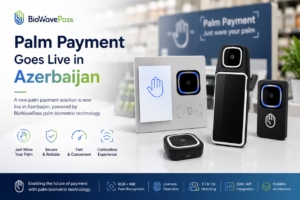
Palm Payment Goes Live in Azerbaijan: From Biometric Technology to Real-World Payment
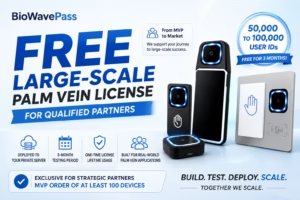
From MVP to Market: Scaling Palm Vein Technology with BioWavePass