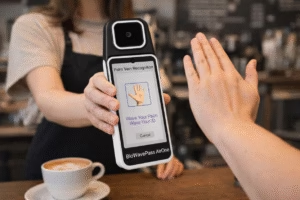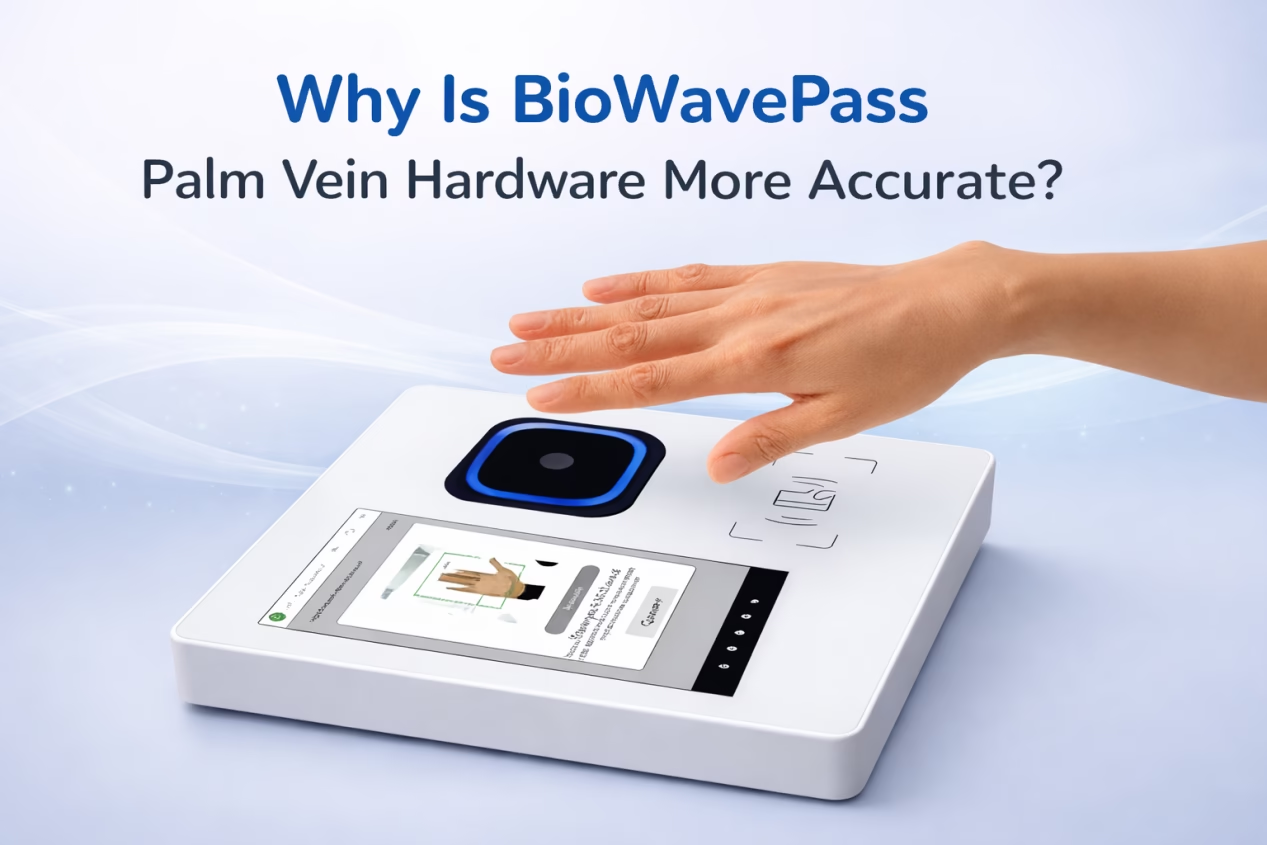
Why Is BioWavePass Palm Vein Hardware More Accurate?
Introducción
In biometric systems, accuracy is often attributed to algorithms.
But in real-world deployments, accuracy starts much earlier — at the moment of data capture.
En BioWavePass, accuracy is not treated as a single metric.
It is engineered through a full-stack approach, combining hardware design, capture control, and algorithm architecture.
Accuracy Starts with Data Quality
Palm vein recognition depends on extracting stable and complete biometric features.
This requires:
- Clear imaging
- Correct positioning
- Controlled lighting
If the input data is inconsistent, even the best algorithms will fail.
BioWavePass addresses this by ensuring that every scan begins with high-quality data.
Dual-Mode Capture: RGB + IR
BioWavePass devices are designed with:
- RGB imaging → captures palm surface features
- IR imaging → captures sub-dermal vein patterns
This dual-mode approach enables:
- Multi-dimensional identity verification
- Higher recognition accuracy
- Stronger resistance to spoofing
Unlike single-mode systems, BioWavePass ensures that identity is validated from both external and internal biometric layers.
PSensor: Controlling the Capture Process
A key innovation in BioWavePass hardware is the PSensor (distance detection module).
Core Capabilities:
- Real-time distance detection (0–2000 mm)
- Optimal capture range: 50–150 mm
- Prevention of invalid scans (too close or too far)
Why It Matters:
Palm vein recognition is highly sensitive to distance.
PSensor ensures:
- Consistent positioning
- Stable image acquisition
- Repeatable capture conditions
This shifts the system from:
user-dependent → hardware-controlled
Intelligent Lighting and Capture Synchronization
BioWavePass hardware integrates automatic coordination between:
- Lighting
- Capture timing
- RGB + IR data acquisition
When the palm enters the optimal range:
- White fill light is activated automatically
- Capture is triggered at the right moment
This ensures:
- High-quality images in any lighting condition
- Reduced noise and distortion
- Reliable feature extraction
Designed for Large-Scale Accuracy
Accuracy must remain stable not only in testing, but at scale.
BioWavePass systems support:
- Millions-level database comparison
- Recognition speed: ~0.3–0.35 seconds
- High success rate in large deployments
This is achieved through:
- Multi-feature fusion
- Optimized data pipelines
- Efficient matching architecture
Built for Real-World Environments
BioWavePass is designed for real applications such as:
- Palm vein payment systems
- eKYC and digital identity
- Banking and fintech
- Healthcare and public services
These environments are:
- Dynamic
- Uncontrolled
- High-frequency
By combining hardware control + intelligent capture + algorithm optimization, BioWavePass maintains consistent accuracy across all scenarios.
Conclusión
At BioWavePass, accuracy is not a feature — it is a system outcome.
It is achieved through:
- Dual-mode biometric capture (RGB + IR)
- PSensor-driven distance control
- Intelligent lighting and capture coordination
- AI-based large-scale recognition
Accuracy is not just calculated. It is engineered.
Más información
Discover how BioWavePass enables next-generation biometric systems:
👉 https://biowavepass.com/biowavepass-palm-vein-scanner-products/
Comparte este artículo
Sobre el autor

También le puede interesar
What is Palm Vein Algorithm License?
What is Palm Vein Technology Solution? And What Are the Costs?
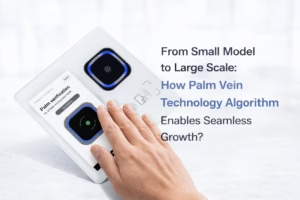
From Small Model to Large Scale: How Palm Vein Technology Algorithm Enables Seamless Growth?
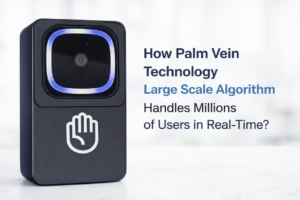
How Palm Vein Technology Large Scale Algorithm Handles Millions of Users in Real-Time?
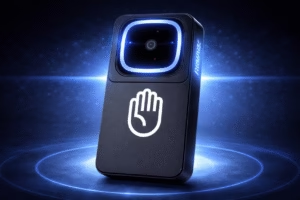
Why Capture Consistency Matters More Than Algorithms in Palm Vein Recognition?
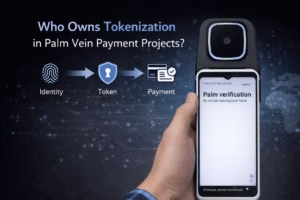
Who Owns Tokenization in Palm Vein Payment Projects?

How Does Tokenization Work in Palm Vein Payment Architecture?
Can Palm Registration and Payment Be Done in One Tap? A Practical View from BioWavePass
As a Developer, How Can We Upgrade from a Small Model to a Large Model Palm Vein Recognition Algorithm Without Re-Registering Users?