Beyond Palm Vein Payments: How Palm Vein Recognition Is Creating Better Public Health Experiences
For years, discussions around reconnaissance des veines de la paume have focused on technical specifications.
- How accurate is it?
- How fast is it?
- How secure is it?
These are all important questions. But as the technology matures, they are no longer the biggest challenge.
A recent public health initiative in Shenzhen, China, offers an important lesson for the entire biometric industry.
The future of palm vein recognition is no longer about proving the technology works.
It’s about helping people experience it.
A Real-World Example
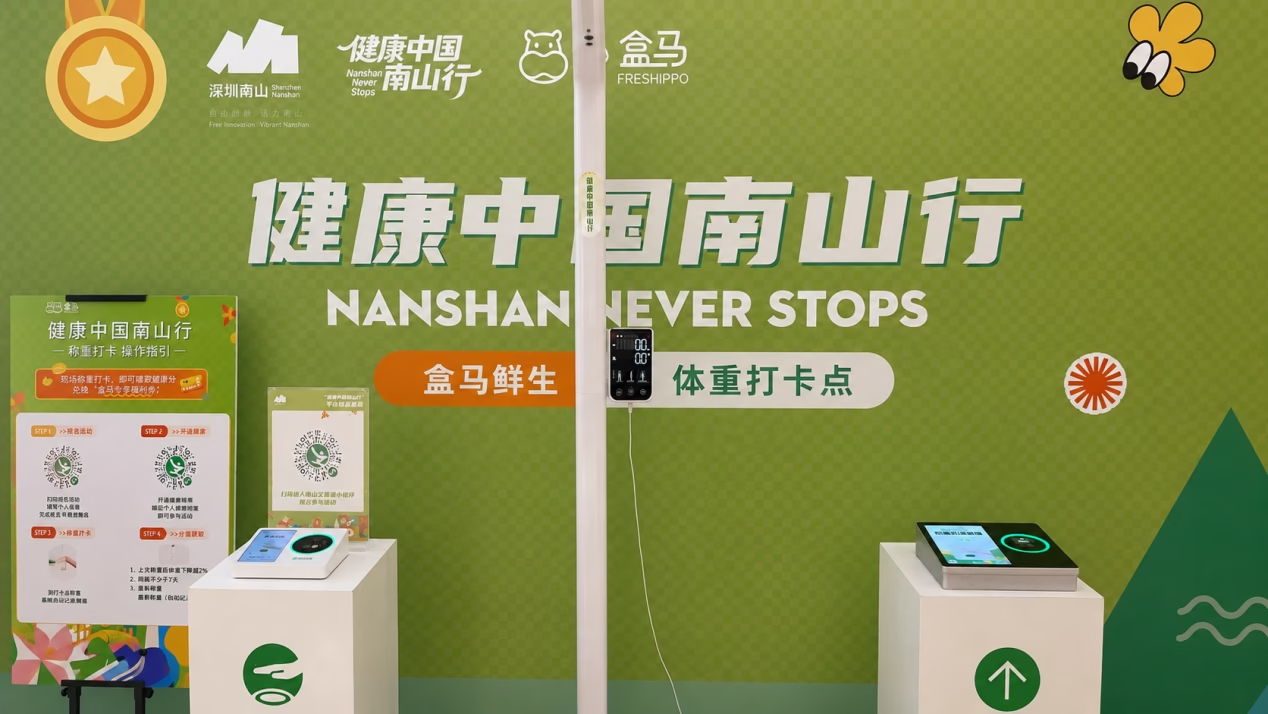
As part of "Healthy China, Nanshan Action," Shenzhen launched a city-wide weight management programme that combines digital healthcare with contactless biometric authentication.
The user journey is remarkably simple.
- Participants scan their palm to verify their identity.
- They step onto a smart body composition scale.
- Their weight is automatically linked to their personal account and uploaded to the platform.
- Progress is tracked over time, with participants earning health points for achieving weight-loss milestones.
- Points can be redeemed for sports vouchers, fitness experiences, healthy lifestyle rewards, and prize draw opportunities.
There are no forms to complete.
No cards to carry.
No QR codes to scan.
No manual data entry.
The technology quietly works in the background while users simply focus on their health goals.
The Real Innovation Is Removing Friction
Palm vein recognition itself is not the innovation.
The innovation is removing friction from the user journey.
Instead of asking people to remember another password, scan another QR code, or carry another membership card, the system simply recognises who they are and allows them to continue.
For most users, the questions are much simpler:
- Can I skip filling out another form?
- Can I avoid waiting in another queue?
- Can everything happen automatically?
People rarely think about biometric algorithms.
They simply appreciate an experience that feels effortless.
The best technology is often the technology users barely notice.
Great User Experiences Drive Adoption
One observation from initiatives like this is particularly interesting.
Once people experience palm vein recognition, many quickly prefer it over traditional methods such as QR codes, membership cards, or passwords.
Why?
Because the interaction feels natural.
You simply present your palm and continue.
There is nothing to remember.
Nothing to carry.
Nothing to scan.
The technology disappears into the experience.
That is exactly what good technology should do.
The Industry’s Biggest Challenge Isn’t Accuracy
Despite the maturity of today’s biometric solutions, millions of people have still never experienced palm vein recognition.
This isn’t because the technology isn’t ready.
It’s because they have never been introduced to it.
Technology adoption requires education.
Every new technology needs someone to demonstrate it, explain it, and encourage first-time users.
Without that first interaction, even the most advanced solution remains invisible.
Deployment alone is not enough.
Real success comes when people actively choose to use the technology because it genuinely improves their daily lives.
Beyond Payments
Palm vein recognition is widely recognised for its role in secure payments.
But the Shenzhen initiative demonstrates that its potential extends much further.
Public health programmes.
Community wellness initiatives.
Healthcare.
Membership management.
Government services.
Smart cities.
Anywhere identity needs to be verified quickly, securely, and effortlessly, contactless palm vein recognition can create a better user experience.
The BioWavePass Perspective
At BioWavePass, we believe the future of palm vein recognition will not be defined by another small improvement in algorithm accuracy.
The technology is already capable.
The next stage of growth belongs to organisations that focus on user experience.
The companies that succeed will be those that remove friction, educate users, and design services around people rather than technology.
The question is no longer:
Can palm vein recognition work?
The better question is:
How can palm vein recognition make everyday life easier?
When people experience that answer for themselves, adoption follows naturally.
And that is when biometric technology begins to deliver its true value.
About BioWavePass
BioWavePass develops next-generation palm vein recognition solutions for payments, healthcare, digital identity, smart cities, and enterprise applications.
Our mission is simple:
Transform biometric authentication from a security feature into a seamless everyday experience.
Learn more from: https://biowavepass.com/biowavepass-palm-vein-scanner-products/
Partager cet article
A propos de l'auteur

Vous pourriez aussi aimer
Scaling Palm Vein Payment: Single Server or Kubernetes Cluster?
Before You Scale Palm Vein POS: A Terminal Management Checklist
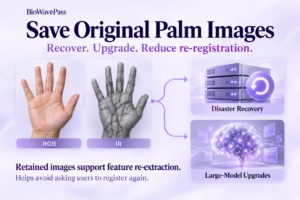
Why Saving Original Palm Images Matters for Biometric Recovery and Future Upgrades By BioWavePass
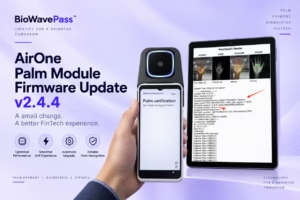
Optimizing Palm Payment Performance: AirOne Palm Module Firmware v2.4.4
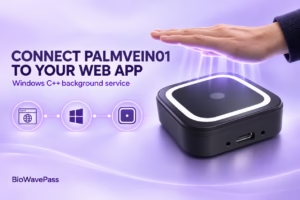
Bringing Palm Vein Scanning into a Web Workflow
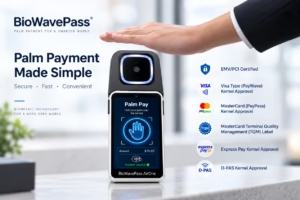
From Palm Payment MVP to Commercial Deployment: Building a Scalable Biometric Payment System
How to Integrate a USB Palm Vein Scanner with a POS Terminal
Palm Payment Goes Live in Azerbaijan: From Biometric Technology to Real-World Payment
From MVP to Market: Scaling Palm Vein Technology with BioWavePass