BioWavePass Blogs
Insights & Innovations in Palm Vein Technology
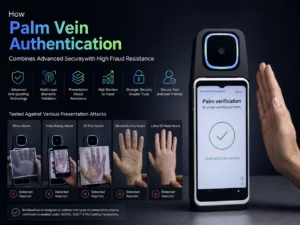
How Palm Vein Authentication Combines Advanced Security with High Fraud Resistance
As organisations increasingly adopt biometric authentication for payments, digital identity, access control, healthcare, and public services, security remains one of the most important considerations. A common question asked by decision-makers is: How resistant is a biometric system to fraud and spoofing attacks? While no security technology can guarantee absolute immunity from attack, the most effective solutions combine advanced anti-spoofing technologies...
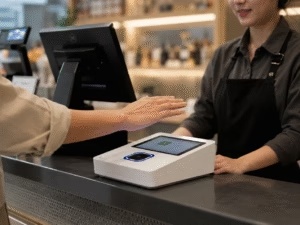
How to Choose the Right Palm Payment Hardware Platform for Your Fintech or Banking Project
As Palm Pay continues to gain momentum across banking, digital wallets, government services, and fintech ecosystems, selecting the right hardware platform has become one of the most important decisions in any deployment. Many organizations focus primarily on biometric accuracy, but successful Palm Pay projects require much more than a scanner. The hardware platform must support integration, scalability, security, and future...
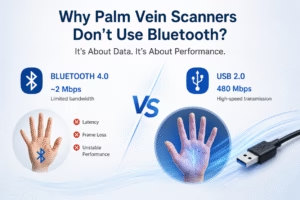
Why Palm Vein Scanners Don't Use Bluetooth Communication Way?
One of the most common questions we receive is: "Why can fingerprint scanners use Bluetooth, but Palm Vein Scanners cannot?" The answer comes down to one key factor: data transmission requirements. Fingerprint Scanners Transmit Small Amounts of Data Most fingerprint scanners capture the fingerprint image internally, extract the biometric features, and generate a small template. Only this template is transmitted...
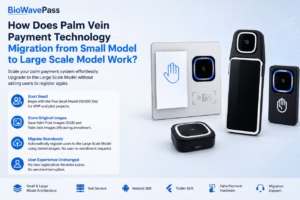
How Does Palm Vein Payment Technology Migration from Small Model to Large Scale Model Work?
As fintech platforms, digital wallets, and banking projects grow, one question frequently arises: "If we start with the free Small Model and later upgrade to the Large Scale Model, will all existing users need to register again?" The answer is: No. A properly designed palm vein payment architecture should allow future expansion without forcing users to repeat the enrollment process....
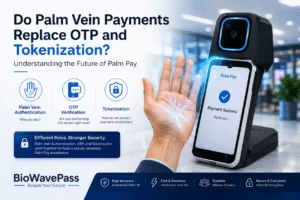
Do Palm Vein Payments Replace OTP and Tokenization? Understanding the Future of Palm Pay
Introduction As Palm Pay solutions gain popularity around the world, many fintech companies, banks, and payment platforms are asking the same question: If a customer can pay with their palm vein, do we still need OTP verification or tokenization? The short answer is: Palm Vein Authentication, OTP, and Tokenization solve different security challenges. Understanding the difference is essential for anyone...
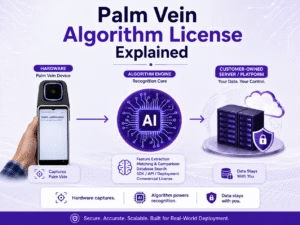
Why Is There a License Fee for Palm Vein Recognition Algorithms?
FAQ Guide by BioWavePass Palm vein recognition is becoming an important biometric technology for payment, identity verification, access control, attendance, fintech platforms, healthcare systems, and large-scale user authentication. However, some customers may ask a very reasonable question: “If the palm vein data is stored on our own server, why do we still need to pay for an algorithm license?” This...
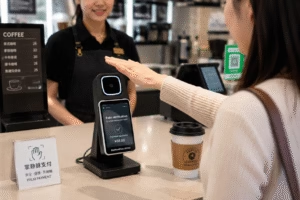
What is Palm Payment China?
What is Palm Payment China? Palm Payment China refers to a new generation of biometric payment technology that allows users to complete payment by scanning their palm. Instead of using a bank card, mobile phone, QR code, or password, the user only needs to place or wave their palm above a palm vein recognition device. The system verifies the user’s...
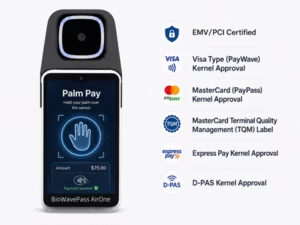
What Makes Palm Vein POS AirOne Different from Traditional POS Devices?
Introduction Traditional POS devices were designed mainly for: card payment QR payment transaction processing However, the next generation of payment infrastructure is changing. Today, fintech companies, digital banks, and payment platforms are increasingly exploring: 👉 Palm payment technology 👉 Biometric authentication 👉 Passwordless payment experiences This is where the BioWavePass AirOne Palm Vein POS becomes different from traditional POS devices....
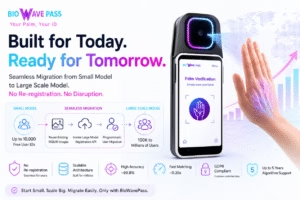
Why BioWavePass Palm Vein Systems Are Built for Seamless Large-Scale Expansion
Introduction Many biometric projects begin with a simple goal: launch an MVP validate the business model test real-world deployment However, as the project grows, a major concern appears: 👉 How can the system scale to millions of users without disrupting existing customers? BioWavePass was designed with this challenge in mind from the beginning. Its palm vein architecture supports a smooth...
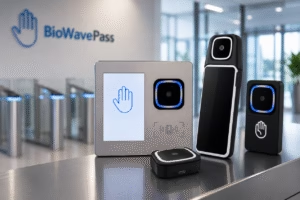
How Palm Vein Technology Scales to Millions of Users Without Losing Accuracy
Introduction One of the biggest challenges in biometric systems is simple: 👉 How do you scale from thousands to millions of users without losing accuracy? Most biometric technologies struggle as databases grow. Matching becomes slower, accuracy drops, and system complexity increases. BioWavePass addresses this challenge with a dual-model architecture: Small Model for fast deployment Large Scale Model for high-accuracy, large...