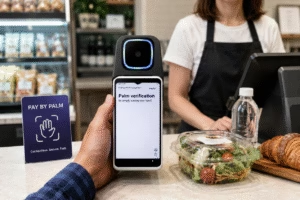
What Makes Palm Vein POS AirOne Different from Traditional POS Devices?
Introduction
Traditional POS devices were designed mainly for:
- card payment
- QR payment
- transaction processing
However, the next generation of payment infrastructure is changing.
Today, fintech companies, digital banks, and payment platforms are increasingly exploring:
👉 Palm payment technology
👉 Biometric authentication
👉 Passwordless payment experiences
This is where the BioWavePass AirOne Palm Vein POS becomes different from traditional POS devices.
AirOne is not simply a payment terminal.
It is a biometric payment infrastructure platform designed for scalable fintech integration.
Traditional POS Devices Focus Mainly on Transactions
Most traditional POS terminals are designed only to:
- read bank cards
- process NFC payments
- print receipts
- connect to payment networks
They usually do not include:
- biometric authentication
- scalable identity infrastructure
- palm recognition algorithms
- biometric SDK/API architecture
As a result, they are limited when fintech platforms want to build:
- palm payment systems
- biometric wallets
- digital identity payment ecosystems
AirOne Combines Payment + Biometrics
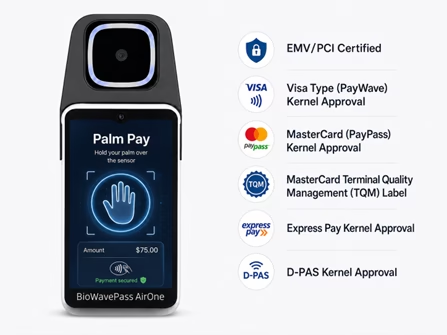
The BioWavePass AirOne Palm Vein POS combines:
✅ Palm biometric authentication
✅ EMV payment infrastructure
✅ SDK/API integration
✅ Large-scale biometric architecture
inside one commercial-grade device.
More Than a Palm Scanner
Many biometric devices on the market are demonstration scanners only.
AirOne is different because it is built on top of a real payment terminal architecture.
It supports:
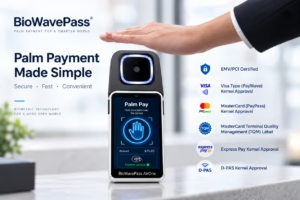
- EMV Level 1 & 2
- PCI-approved architecture
- Visa PayWave kernel
- Mastercard PayPass kernel
- Mastercard TQM
- American Express kernel
- D-PAS kernel
This makes AirOne suitable for:
- fintech integration
- banking environments
- commercial payment deployment
Designed for Fintech SDK/API Integration
Traditional POS devices are usually closed systems.
AirOne is designed to support fintech development teams.
Supported Integration Architecture
- Android Java SDK
- Android Flutter SDK
- RESTful API
- Cloud verification architecture
- Private server deployment
Secure Data Transmission
AirOne supports:
- HTTP + SSL encrypted transmission
- AES-256 CBC cloud storage encryption
- Cryptage lors de l'écriture
- Décrypté à la lecture
This helps fintech companies build secure biometric payment systems while maintaining customer-controlled deployment architecture.
Palm Vein Technology Instead of Passwords
Traditional POS systems rely on:
- PIN codes
- passwords
- cards
- mobile phones
AirOne introduces:
👉 Palm vein biometric authentication.
This allows users to authenticate using:
- palm vein features (IR)
- palm print features (RGB)
without requiring passwords or physical cards.
Built for Scalability
Traditional POS devices are not designed for biometric database scaling.
AirOne supports:
✅ Small Model architecture
✅ Large Scale Model architecture
allowing fintech platforms to start with MVP deployment and later scale to million-level user databases.
Small Model for MVP Deployment
The Small Model supports:
✅ Up to 10,000 Free User IDs
The system uses:
- End-side Palm Print Feature (RGB)
- End-side Palm Vein Feature (IR)
Only feature vectors are uploaded for matching.
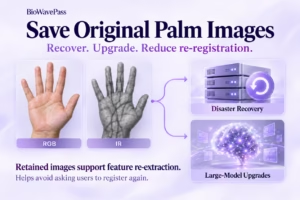
RGB + IR images are stored as backup.
Large Scale Model for Enterprise Deployment
The Large Model introduces:
👉 Server-side feature re-extraction from stored RGB + IR images.
The system uses four verification elements:
- End-side palm print feature
- End-side palm vein feature
- Server-side palm print feature
- Server-side palm vein feature
This supports:
- ~0.35s matching speed
- ~99.8% accuracy
- million-level biometric databases
Seamless Migration Without Re-Registration
One major difference from traditional systems is scalability architecture.
AirOne allows migration from Small Model to Large Scale Model without requiring users to re-register.
If RGB + IR registration images are stored properly:
✅ Existing users can be migrated programmatically
✅ No new registration images are required
✅ No disruption to end users
Built for Real Commercial Deployment
AirOne also includes enterprise deployment features:
- TMS management
- OTA support
- Remote diagnostics
- Android kiosk mode
- Fleet management
This allows large-scale commercial operation across distributed payment environments.
Customer-Controlled Infrastructure
BioWavePass does not manage customer biometric databases.
All systems support:
✅ Customer-owned server deployment
✅ GDPR-compliant architecture
✅ Private biometric infrastructure
This is critical for fintech and banking compliance environments.
Conclusion
Traditional POS devices were designed only for payments.
The BioWavePass AirOne Palm Vein POS is designed for:
- biometric payment ecosystems
- scalable fintech infrastructure
- secure identity authentication
- future payment architecture
Final Thought
AirOne is not just a POS terminal.
It is a scalable biometric payment infrastructure platform for the next generation of fintech systems.
CTA
Learn more about BioWavePass Palm Vein Technology:
Partager cet article
A propos de l'auteur

Vous pourriez aussi aimer
Scaling Palm Vein Payment: Single Server or Kubernetes Cluster?
Before You Scale Palm Vein POS: A Terminal Management Checklist
Why Saving Original Palm Images Matters for Biometric Recovery and Future Upgrades By BioWavePass
Optimizing Palm Payment Performance: AirOne Palm Module Firmware v2.4.4
Bringing Palm Vein Scanning into a Web Workflow
From Palm Payment MVP to Commercial Deployment: Building a Scalable Biometric Payment System
How to Integrate a USB Palm Vein Scanner with a POS Terminal
Palm Payment Goes Live in Azerbaijan: From Biometric Technology to Real-World Payment
From MVP to Market: Scaling Palm Vein Technology with BioWavePass