How BioWavePass Enhances Payment Security with Cloud Driven Palm Vein Authentication?
Introduction
As payment systems evolve, fintech companies are prioritizing authentication technologies that minimize fraud, reduce user friction, and deliver consistent performance across multiple devices. BioWavePass offers a secure, cloud aligned palm vein authentication model that elevates both the security and usability of modern payment environments.
Palm vein identification is inherently private and extremely difficult to replicate. With internal vascular patterns and encrypted template handling, BioWavePass enables fintech platforms to build a trusted identity layer that works seamlessly with existing cloud driven architectures.
Security Challenges in Modern Payment Workflows
Many financial services rely on surface level biometrics or passcodes that can be observed, copied, or manipulated. These methods often fall short in real world environments, where lighting, device placement, and user behavior vary widely.
BioWavePass solves several industry challenges:
- reducing identity spoofing through subdermal pattern verification
- preventing unauthorized access through secure template transmission
- eliminating the risks associated with shared passwords or static PIN codes
- improving user experience without compromising safety
The technology strengthens the core identity layer of any payment system by providing an authentication method that is both reliable and privacy friendly.
Cloud Ready Palm Vein Architecture for Fintech Developers
BioWavePass supports cloud based Identity and Payments ecosystems without requiring custom hardware modifications. Merchants and developers can integrate palm vein verification directly into their existing workflow using:
- PalmVein01 USB scanners
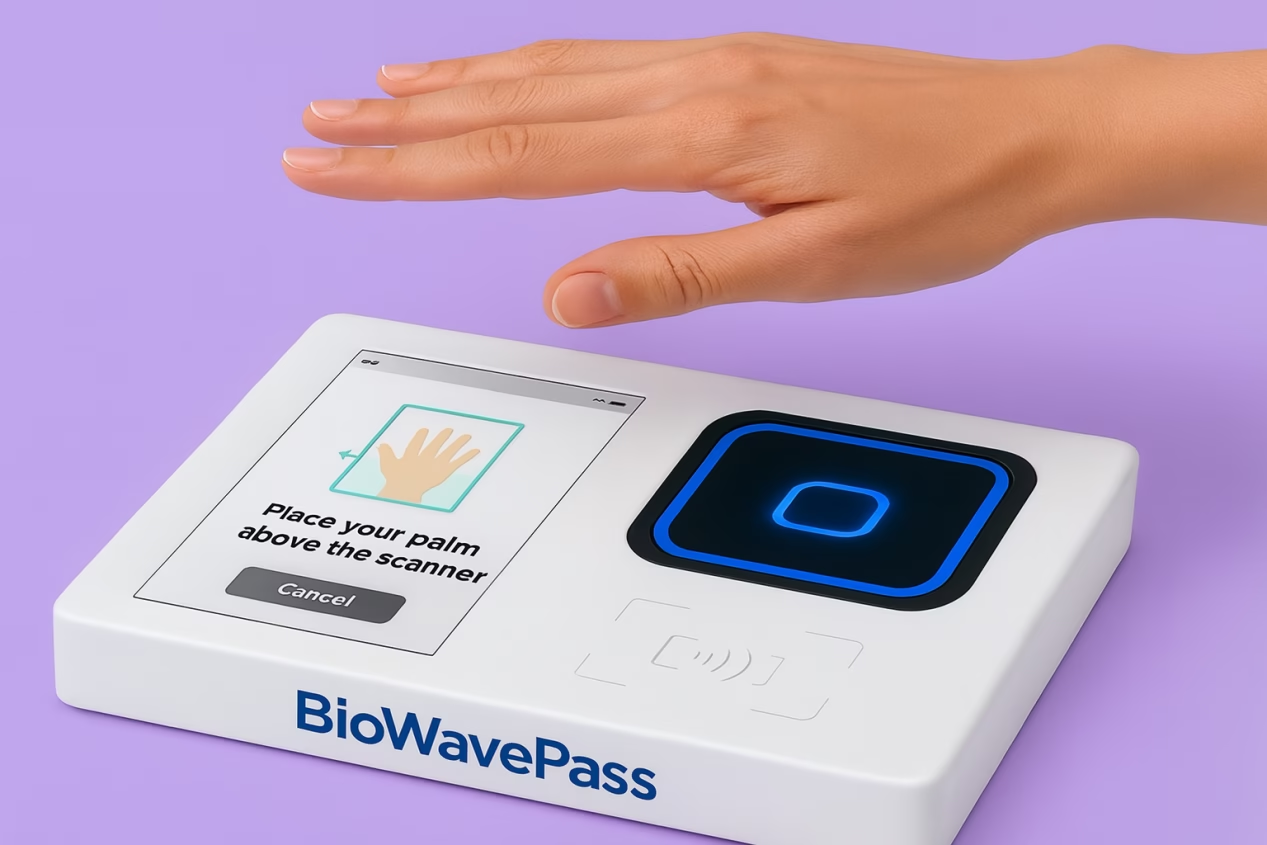
- WavePass500 Android biometric terminals
- lightweight SDK tools for Android, Linux, and Windows
The system is designed so that the palm vein image is captured locally, converted into an encrypted template, and transmitted securely to the cloud for matching. This ensures that the verification logic remains centralized, consistent, and scalable.
Why BioWavePass Strengthens Payment Authentication
Palm vein authentication provides several advantages for safeguarding financial transactions.
1. Internal biological patterns cannot be forged
Unlike fingerprints or facial features, palm veins cannot be photographed or lifted, creating a strong anti spoofing barrier.
2. Encrypted template handling ensures data integrity
All palm vein templates are encrypted before transmission, protecting the identity pipeline end to end.
3. Stable recognition across environments
Dual mode RGB plus IR imaging delivers accurate results in varied lighting conditions, making it suitable for high traffic retail and service environments.
4. Fast verification improves throughput
With a matching time of approximately 0.35 seconds, BioWavePass supports quick service lines and uninterrupted checkout flows.
Simple Deployment Through USB plus WiFi Architecture
BioWavePass uses a practical communication model that fintech teams can deploy quickly.
- USB supports high quality imaging and stable power delivery
- WiFi connects the Android terminal to cloud identity servers
- No reliance on Bluetooth pairing or OTG converters
- No firmware adjustments to merchant POS devices
This design allows merchants to retain their existing POS or billing environment while adding biometric authentication as an additional security layer.
Ideal for Scalable Payment Ecosystems
Whether used for subscription billing, retail transactions, or financial service authentication, BioWavePass is built for long term expansion.
Key advantages:
- supports small pilot tests and large merchant rollouts
- maintains accuracy even with growing user databases
- integrates with multiple endpoints through a unified identity model
- provides consistent authentication logic across Android terminals, kiosks, and payment devices
This makes BioWavePass an ideal choice for fintech companies looking to upgrade their security framework without disrupting current operations.
Conclusion
BioWavePass enhances the security foundation of modern payment systems by offering a cloud aligned, high precision biometric authentication method. With palm vein recognition, encrypted template communication, and simple USB plus WiFi integration, fintech developers gain a scalable solution that reduces fraud, protects user data, and improves the overall reliability of payment workflows.
BioWavePass delivers a future ready identity layer that strengthens trust in every transaction.
Partager cet article
A propos de l'auteur

Vous pourriez aussi aimer
Scaling Palm Vein Payment: Single Server or Kubernetes Cluster?
Before You Scale Palm Vein POS: A Terminal Management Checklist
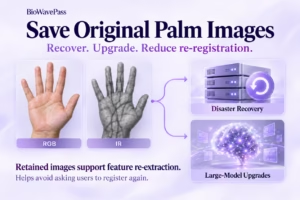
Why Saving Original Palm Images Matters for Biometric Recovery and Future Upgrades By BioWavePass
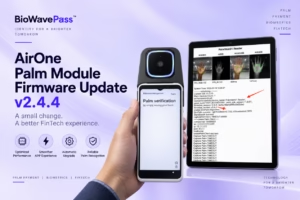
Optimizing Palm Payment Performance: AirOne Palm Module Firmware v2.4.4
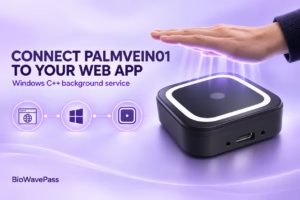
Bringing Palm Vein Scanning into a Web Workflow
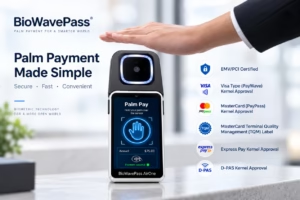
From Palm Payment MVP to Commercial Deployment: Building a Scalable Biometric Payment System
How to Integrate a USB Palm Vein Scanner with a POS Terminal
Palm Payment Goes Live in Azerbaijan: From Biometric Technology to Real-World Payment
From MVP to Market: Scaling Palm Vein Technology with BioWavePass