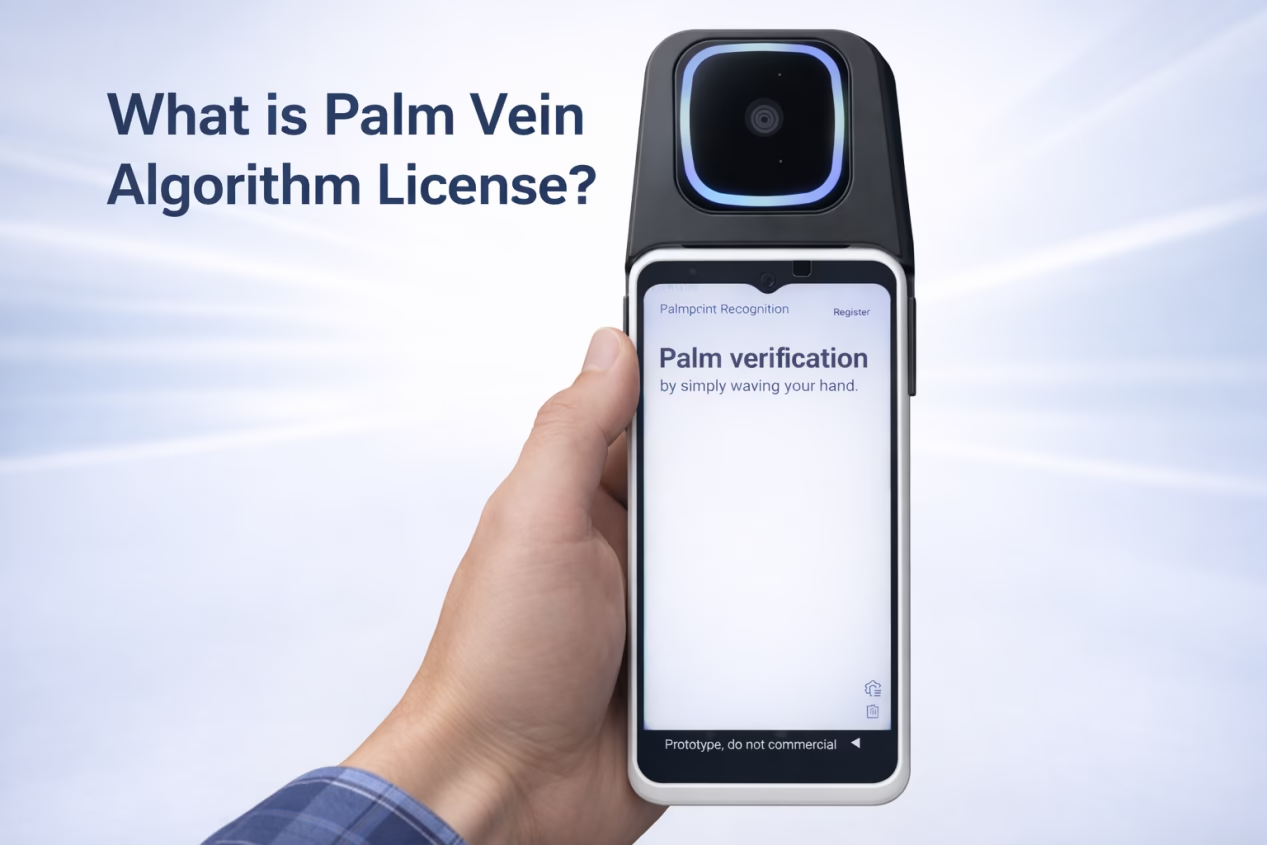
What is Palm Vein Algorithm License?
Introduction
As palm vein technology moves from pilot projects to real-world deployment,
one concept becomes critical for every business to understand:
What is a palm vein algorithm license?
Unlike traditional software licensing models, palm vein systems are built on a
user ID-based licensing architecture, which directly impacts system scalability, cost, and long-term performance.
What Is a Palm Vein Algorithm License?
A palm vein algorithm license is the authorization to use the biometric recognition engine,
including:
- Palm vein feature extraction
- Identity matching algorithms
- Large-scale database comparison capability
More importantly, it defines:
👉 How many users your system can support
The Core Concept: ID-Based Licensing
In BioWavePass palm vein systems, licensing is not based on:
- Number of devices
- Number of transactions
- API calls
Instead, it is based on:
👉 Number of registered users (User IDs)
How It Works
- Each user registered = 1 ID
- The total license determines maximum capacity
- Deleting a user frees up that ID
This creates a clear and predictable scaling model.
Why License Is Not Just “Software”
A palm vein algorithm license is tightly connected to:
- Recognition accuracy
- Matching speed
- System scalability
Because behind the license is:
- AI algorithm capability
- Computing resource allocation
- Database architecture
👉 The license is essentially the capacity of your biometric system
Small Model vs Large Scale License
Small Model (MVP Stage)
- Supports up to 10,000 users
- Designed for testing, integration, and pilot deployment
✅ BioWavePass provides up to 10,000 free ID licenses
This allows customers to:
- Start without algorithm cost
- Quickly validate business scenarios
- Reduce initial investment risk
Large Scale Model (Production Stage)
When your system grows:
👉 More than 10,000 users requires additional license purchase
Capabilities include:
- 100,000 to millions of users
- High-speed matching (~0.3 seconds)
- Stable performance in large databases
Why License Scaling Is Critical
As user volume increases, system complexity grows exponentially:
- More comparisons per request
- Higher concurrency
- Greater demand on infrastructure
BioWavePass algorithm is designed to handle this through:
- GPU-based parallel computing
- Vector database architecture
- Multi-feature matching (RGB + IR)
👉 License ensures the system maintains high accuracy and speed at scale
Real System Performance
In internal large-scale testing:
- Database size: 5 million users
- Recognition success rate: up to 99%
- Matching speed: as fast as 0.35 seconds
This demonstrates that the algorithm license is not just capacity,
but also performance assurance under scale.
One-Time License Model
BioWavePass licensing follows a simple principle:
- One-time purchase (lifetime use)
- No per-transaction fees
- No recurring algorithm cost
This means:
👉 You pay once, and scale based on user growth
Why This Model Matters for Business
Compared to traditional models:
| Traditional Systems | BioWavePass Model |
|---|---|
| Pay per transaction | No transaction cost |
| Pay per API usage | No API cost |
| Hidden scaling cost | Transparent ID-based scaling |
Long-Term Value of Algorithm License
The license model enables:
- Predictable budgeting
- Scalable infrastructure planning
- Faster ROI
Combined with:
- No consumables
- No card replacement
- Lower fraud risk
👉 It becomes a high-efficiency biometric investment
Conclusion
A palm vein algorithm license is not just a technical requirement.
It is the foundation of your system’s scalability and performance.
Final Thought
In palm vein systems,
the algorithm defines accuracy —
but the license defines scale.
CTA
If you are planning to build or scale a palm vein solution,
understanding the licensing model is the first step.
👉 Learn more: https://biowavepass.com/biowavepass-palm-vein-scanner-products/
Partager cet article
A propos de l'auteur

Vous pourriez aussi aimer

Scaling Palm Vein Payment: Single Server or Kubernetes Cluster?

Before You Scale Palm Vein POS: A Terminal Management Checklist

Why Saving Original Palm Images Matters for Biometric Recovery and Future Upgrades By BioWavePass

Optimizing Palm Payment Performance: AirOne Palm Module Firmware v2.4.4

Bringing Palm Vein Scanning into a Web Workflow

From Palm Payment MVP to Commercial Deployment: Building a Scalable Biometric Payment System

How to Integrate a USB Palm Vein Scanner with a POS Terminal

Palm Payment Goes Live in Azerbaijan: From Biometric Technology to Real-World Payment

From MVP to Market: Scaling Palm Vein Technology with BioWavePass
