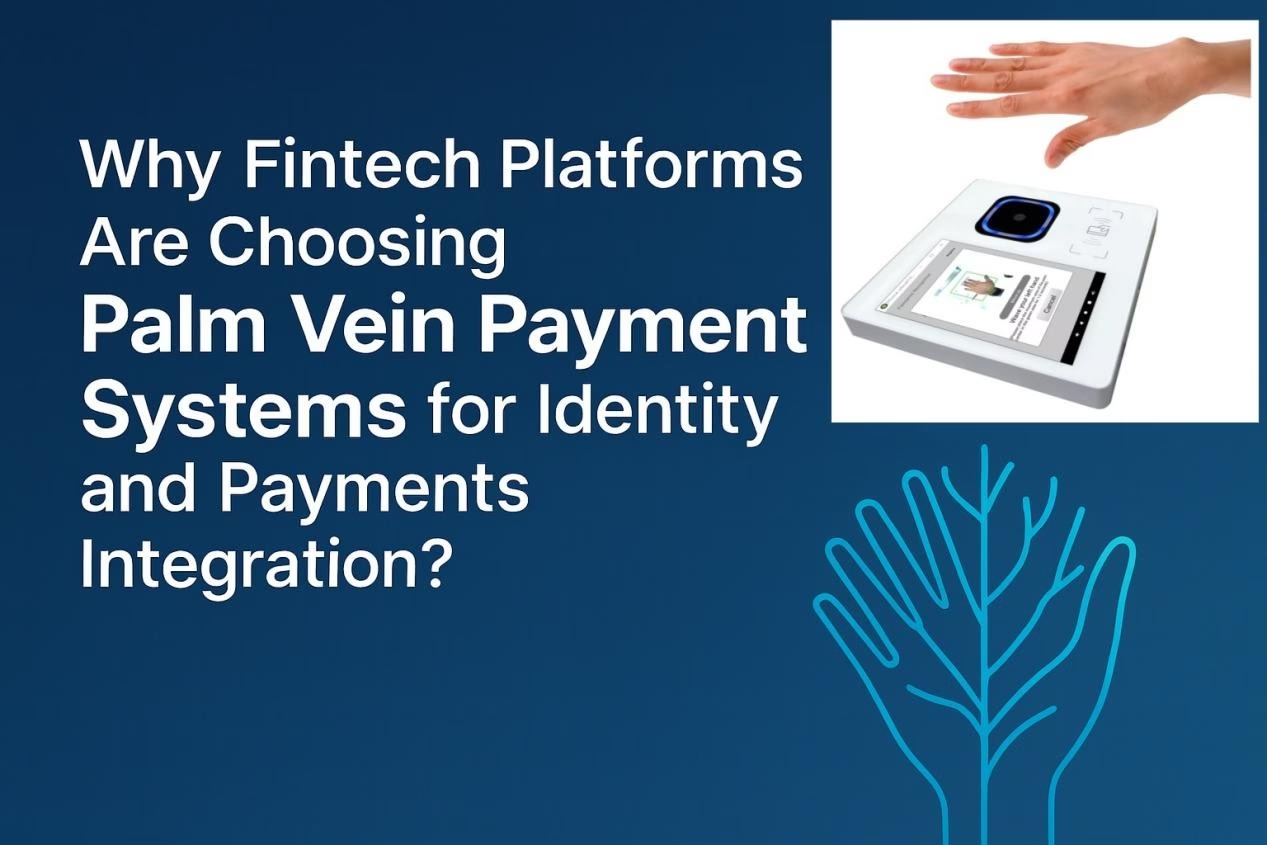
Why Fintech Platforms Are Choosing Palm Vein Payment Systems for Identity and Payments Integration?
Introduction
Fintech platforms are accelerating their search for stronger and more efficient authentication methods in physical payment environments. As transaction volume increases and compliance standards strengthen, traditional biometrics such as face and fingerprint recognition are no longer sufficient. Palm vein technology, with its internal vascular patterns that cannot be seen or replicated, has emerged as one of the most secure and reliable authentication methods.
The BioWavePass Palm Vein Payment System offers a fast to deploy, cloud friendly, and highly compatible biometric solution. It enables businesses to integrate palm vein authentication directly into their existing payment and billing ecosystems without hardware redesign.
A Unified Approach: Identity plus Payments API Integration
Modern payment systems rely on cloud based orchestration instead of isolated device logic. With this architecture, businesses use
- an Identity API for account management, authentication, and authorization
- a Payments API for transaction initialization and settlement
The BioWavePass Palm Vein Payment System integrates directly with this structure. Billing software and the Android palm vein scanner authenticate through a unified PairID, creating a centralized and consistent identity flow. This improves transparency, reduces integration complexity, and removes the need for additional hardware layers.
Why Palm Vein Technology Fits Modern Fintech Needs
Palm vein recognition offers several advantages that make it ideal for payment authentication.
1. Internal biometric characteristics that cannot be observed or copied
The vein pattern lies beneath the skin and can only be captured with near infrared imaging, providing strong anti spoof protection.
2. More stable performance in real environments
BioWavePass uses RGB plus IR dual mode imaging to ensure accuracy even in challenging lighting and movement conditions.
3. High speed recognition
Palm vein matching can be completed in as little as 0.35 seconds, supporting high frequency transactions and fast checkout lanes.
4. Privacy friendly
Palm vein patterns cannot be captured from a distance and do not leave latent traces, offering a higher level of privacy than face or fingerprint recognition.
Seamless Hardware Integration with Existing Devices
The greatest concern for many fintech teams is not the technology itself, but the integration cost and deployment effort. BioWavePass was designed for efficient implementation.
- PalmVein01 USB Scanner supports plug and play integration
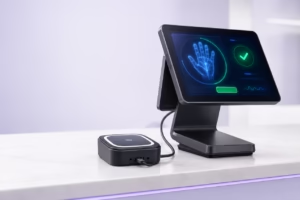
- WavePass500 Android Palm Vein Payment Terminal interfaces directly with billing software
- No POS hardware redesign is required
- No custom motherboard or firmware modifications
USB provides a stable power and data channel, while the Android device communicates with the cloud through WiFi. This creates a flexible, low friction integration pathway suitable for both pilot deployments and large scale rollouts.
Why Fintech Platforms Prefer USB plus WiFi Architecture
Palm vein recognition demands stable and rapid data transmission. USB offers
- reliable power delivery
- fast data transfer
- low latency communication
WiFi provides
- flexible cloud connectivity
- easy integration with Identity and Payments APIs
- lower deployment cost
Compared with Bluetooth, RS232, or OTG converters, this architecture eliminates pairing issues, compatibility concerns, and firmware adjustments across multiple hardware models.
Scalability for Large Merchant Networks
The Palm Vein Payment System is ideal for fintech companies planning wide scale expansion.
- Initial pilots typically begin with small batches
- The architecture supports growth into hundreds or thousands of merchant devices
- SDKs for Android, Windows, and Linux streamline development
- AI driven algorithm design maintains high accuracy even in large databases
This approach can be replicated across retail, billing, and payment scenarios, making it suitable for long term ecosystem growth.
Conclusion
As payment environments evolve, fintech platforms need stronger identity verification methods to improve security and user trust. The BioWavePass Palm Vein Payment System delivers exactly that. With high accuracy, high speed recognition, easy integration, and seamless compatibility with cloud Identity plus Payments APIs, it enables businesses to build a complete biometric payment ecosystem in a shorter time frame and with significantly lower deployment cost.
Learn more from: https://biowavepass.com/palm-vein-payment-solutions/
Partager cet article
A propos de l'auteur

Vous pourriez aussi aimer
Scaling Palm Vein Payment: Single Server or Kubernetes Cluster?
Before You Scale Palm Vein POS: A Terminal Management Checklist
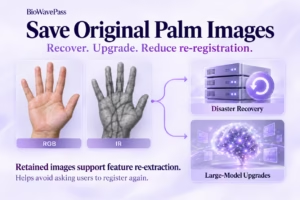
Why Saving Original Palm Images Matters for Biometric Recovery and Future Upgrades By BioWavePass
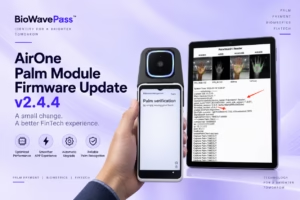
Optimizing Palm Payment Performance: AirOne Palm Module Firmware v2.4.4
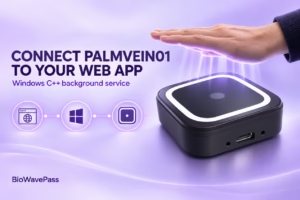
Bringing Palm Vein Scanning into a Web Workflow
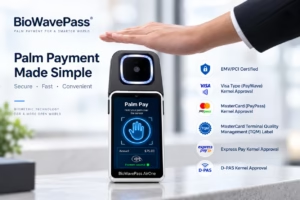
From Palm Payment MVP to Commercial Deployment: Building a Scalable Biometric Payment System
How to Integrate a USB Palm Vein Scanner with a POS Terminal
Palm Payment Goes Live in Azerbaijan: From Biometric Technology to Real-World Payment
From MVP to Market: Scaling Palm Vein Technology with BioWavePass