How Secure Is Palm Vein Technology Against Spoofing Attacks?
Biometric authentication is rapidly becoming a core technology in payments, identity verification, and access control. Among the emerging biometric methods, Palm Vein recognition has gained strong attention due to its high accuracy, contactless user experience, and strong resistance to spoofing attacks.
However, a common question raised by banks, fintech companies, and system integrators is:
How secure is Palm Vein technology against spoofing attempts?
This article explains the most common biometric attack methods and how BioWavePass Palm Vein technology is designed to defend against them.
Understanding Biometric Spoofing Attacks
A spoofing attack occurs when an attacker attempts to imitate or replicate a legitimate user’s biometric features in order to bypass authentication systems.
In biometric payment systems, attackers typically try to reproduce biometric data using printed images, artificial models, or digital replay techniques.
The table below summarizes several common spoofing approaches and why they fail against modern Palm Vein systems.
| Attack Method | Attack Cost | Risk Level | Why It Fails |
|---|---|---|---|
| Printed Palm Image | Baixa | Very Low | Only RGB palm image. No vein structure detected under infrared scanning. |
| Printed Vein Image | Baixa | Very Low | Lacks the palmprint layer. Systems verify both palmprint and vein simultaneously. |
| Screen Replay Attack | Baixa | Very Low | Phone screens emit visible light, not near-infrared required for vein imaging. |
| Paper + Real Hand Hybrid | Low–Medium | Baixa | Mixed biometric signals create inconsistent RGB/IR patterns detectable by AI. |
| Glove Attack | Médio | Baixa | Synthetic materials create abnormal skin texture and infrared response. |
| 3D Printed Palm Model | Elevado | Médio | Silicone or printed models lack dynamic blood flow and real skin characteristics. |
| Feature Reconstruction (AI) | Elevado | Baixa | Biometric feature templates are encrypted and mathematically irreversible. |
| Animal Skin Spoof | Very High | Baixa | Biological differences and absence of real vascular dynamics are detectable. |
As shown above, most low-cost spoofing attempts fail because Palm Vein recognition analyzes internal biological structures rather than external features alone.
Why Palm Vein Authentication Is Highly Secure
Unlike facial recognition or fingerprint scanning that rely primarily on surface features, Palm Vein technology captures vein patterns beneath the skin using near-infrared (IR) imaging.
These vein patterns are extremely difficult to replicate because they are:
- Unique to each individual
- Located beneath the skin
- Invisible under normal lighting
- Linked to real biological tissue
This makes Palm Vein authentication inherently more resistant to spoofing attacks.
Multi-Layer Security in BioWavePass Palm Vein Systems
BioWavePass devices developed by X-Telcom combine multiple biometric verification layers to ensure high security.
Dual Biometric Recognition
The system captures both:
- RGB palmprint features
- Infrared palm vein patterns
Both data sets must match simultaneously during authentication.
AI Liveness Detection
Advanced AI models analyze biometric images to detect signs of spoofing, including:
- Abnormal skin texture
- Material reflection differences
- Inconsistent vein imaging patterns
This allows the system to detect fake hands, gloves, printed images, or synthetic materials.
Secure Biometric Data Architecture
All palm vein data and images are encrypted using AES-256 encryption.
Importantly:
- BioWavePass devices do not store biometric data locally
- All biometric data is stored only on the customer’s own server or cloud infrastructure
- BioWavePass and X-Telcom do not manage or control user biometric databases
This ensures strong privacy protection and data sovereignty.
Enrollment Quality Verification
During registration, the system performs strict image quality checks to ensure:
- Clear vein visibility
- Accurate palm positioning
- Valid biometric features
Even if a spoofing attempt passes basic liveness detection, it is unlikely to pass registration quality verification.
Real-World Security Advantages
For financial institutions and payment providers, Palm Vein authentication offers several important benefits.
Contactless Authentication
Users authenticate simply by presenting their palm above the scanner, enabling a fast and hygienic user experience.
Strong Anti-Spoofing Capability
Because the system reads subcutaneous vein structures, fake biometric artifacts are extremely difficult to replicate.
High Speed Authentication
Typical verification times can reach around 0.35 seconds, even in large-scale deployments.
Large-Scale Database Capability
BioWavePass algorithms capture RGB + IR feature points and upload both images and features into large-scale identity databases.
In internal testing, the algorithm achieves:
- 99% recognition success rate
- 0.35 second matching speed
- tested with databases up to 5 million identities
This architecture enables fast authentication even in national-scale or financial-scale biometric systems.
The Future of Secure Contactless Payments
As biometric payments expand globally, financial institutions are looking for technologies that provide both strong security and frictionless user experience.
Palm Vein recognition is emerging as one of the most promising biometric technologies because it combines:
- High security
- Fast authentication
- Contactless interaction
- Strong privacy architecture
BioWavePass Palm Vein technology is designed to support next-generation payment systems, digital identity platforms, healthcare authentication, and secure access control environments.
Learn more about BioWavePass Palm Vein solutions: https://choosepalmveinpay.com/
Partilhar este artigo
Sobre o autor

Também pode gostar
Bringing Palm Vein Scanning into a Web Workflow
From Palm Payment MVP to Commercial Deployment: Building a Scalable Biometric Payment System
How to Integrate a USB Palm Vein Scanner with a POS Terminal
Palm Payment Goes Live in Azerbaijan: From Biometric Technology to Real-World Payment
From MVP to Market: Scaling Palm Vein Technology with BioWavePass
Palm Vein Payment: How Biometric Payments Work Without Cards or Phones
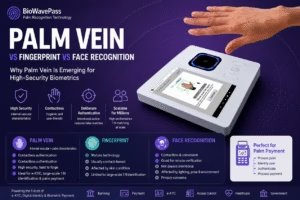
Palm Vein vs Fingerprint vs Face Recognition: Why Palm Vein Is Emerging for High-Security Biometrics
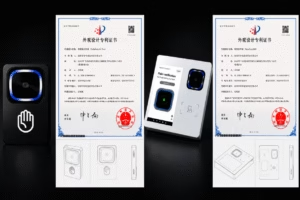
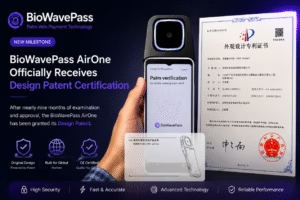
BioWavePass Palm Vein Scanner Products Receive Design Patent Certification
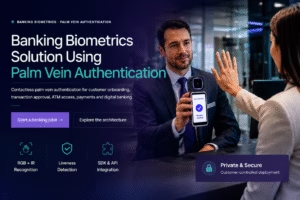
Palm Vein Authentication: The Future of Secure Digital Identity and Payments