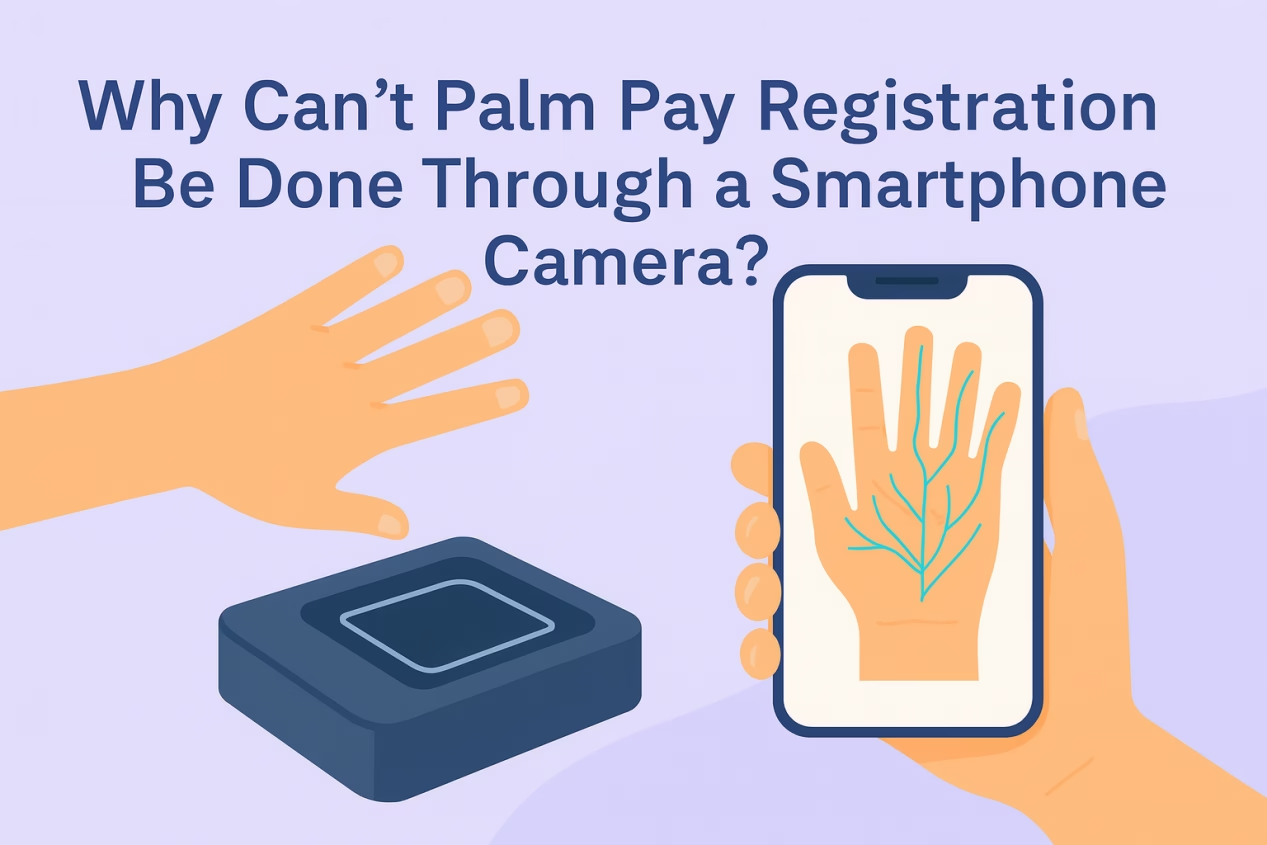
Why Can’t We Use a Smartphone Camera to Register Palm for WeChat Palm Pay?
Introduction
In China, Tencent WeChat Pay has become one of the world’s most advanced digital payment systems — and its Palm Pay technology shows where the future of biometrics is heading. Users can now complete payments simply by waving their palm over a scanner.
However, one question keeps coming up:
“If my phone has a high-resolution camera, why can’t I just use it to register my palm?”
The answer reveals an important truth about biometric security — and why global payment systems now rely on hardware-based Palm Vein Technology, like BioWavePass.
The WeChat Pay Palm Registration Process
Tencent’s official design clearly separates authorization from biometric collection:
-
Registration Starts in the WeChat App
- Users enter WeChat Pay → Biometrics → Palm to agree to the registration.
- The WeChat app is only an authorization portal, not a biometric collector.
-
Palm Data Captured on a Certified Device
- The user goes to a terminal or kiosk with a Palm Vein Scanner.
- The scanner captures both RGB and infrared (IR) images of the user’s palm veins.
- Encrypted data is uploaded to WeChat Pay’s backend, where a unique token links the palm ID to the user’s WeChat account and bank card.
-
No Data Stored Locally
- The device does not keep any biometric data.
- All data is encrypted and stored only on Tencent’s secure servers.
This ensures every registration is accurate, private, and compliant with industry biometric standards.
Why Phones Can’t Replace Palm Vein Devices
Tencent confirmed that it once tested mobile registration via phone cameras, but the feature was later shut down due to serious security and accuracy issues.
| Limitation | Reason |
|---|---|
| No Infrared Imaging | Palm vein recognition depends on IR light to detect blood vessel patterns — something phone cameras cannot see. |
| Lighting Variations | Inconsistent light and angles cause poor data capture and false matches. |
| No Encryption Hardware | Certified scanners encrypt data instantly; smartphones do not meet payment-grade security. |
This is why WeChat Palm Pay — like other major payment networks — mandates registration through dedicated Palm Vein Scanner devices.
BioWavePass: The Global Standard for Palm Vein Solutions
The similar palm vein payment technology is now available globally through BioWavePass Palm Vein Technology Solutions.
BioWavePass captures both RGB + IR images and extracts vein features from beneath the skin’s surface — a method that is:
- More secure – Each user’s vein pattern is unique and cannot be forged or copied.
- Highly accurate – Recognition speed reaches 0.35 seconds with up to 99% success rate in large databases.
- AI-driven – Real AI computation ensures stability and precision even under difficult lighting.
- Fully compliant – Supports secure encryption, SDK integration, and meets the demands of banking and fintech systems.
With its XT-WavePass500 Android terminal and XT-PalmVein01 USB module, BioWavePass enables payment providers, transit operators, and government systems to implement palm-based identity and payment seamlessly.
From China to the World
WeChat Pay’s success proves that Palm Vein Payment is more than a concept — it’s a global direction. As cashless economies expand across Asia, the Middle East, and Africa, BioWavePass offers the same trusted foundation:
- Local registration and verification through certified palm devices
- Secure cloud or local database binding
- SDK/API for integration with existing payment apps or e-wallets
Conclusion
A smartphone camera captures the surface. BioWavePass captures the truth beneath it.
Tencent WeChat Palm Pay demonstrated why mobile cameras are not enough — true biometric security depends on infrared-based palm vein capture.
With BioWavePass Palm Vein Technology, this proven model is now available to every country and fintech platform seeking a secure, touch-free future in biometric payments.
Learn more
Tags:
#BioWavePass #PalmVeinTechnology #WeChatPay #Tencent #Weixin #PalmPay #BiometricPayment #ContactlessPayment #Fintech #Security #Innovation
Share this article
About the Author

You might also like
Bringing Palm Vein Scanning into a Web Workflow
From Palm Payment MVP to Commercial Deployment: Building a Scalable Biometric Payment System
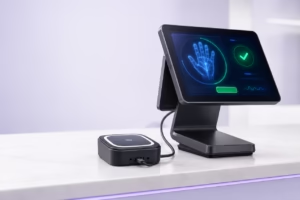
How to Integrate a USB Palm Vein Scanner with a POS Terminal
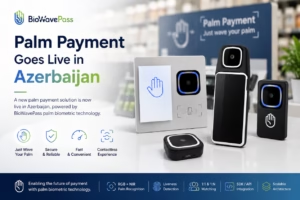
Palm Payment Goes Live in Azerbaijan: From Biometric Technology to Real-World Payment
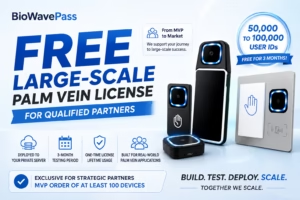
From MVP to Market: Scaling Palm Vein Technology with BioWavePass
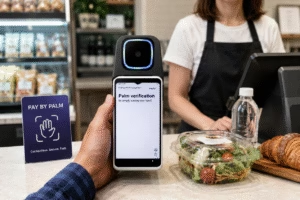
Palm Vein Payment: How Biometric Payments Work Without Cards or Phones
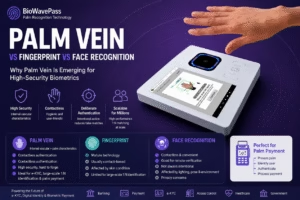
Palm Vein vs Fingerprint vs Face Recognition: Why Palm Vein Is Emerging for High-Security Biometrics
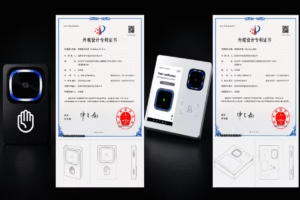
BioWavePass Palm Vein Scanner Products Receive Design Patent Certification
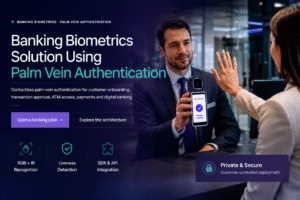
Palm Vein Authentication: The Future of Secure Digital Identity and Payments