Why Palm Vein Payment Is the Best? -BioWavePass Palm Vein Payment Solutions
Introduction
In today’s world of fast and digital payments, security, privacy, and user convenience define the next generation of payment experiences.
While fingerprints, facial recognition, and QR codes have been widely adopted, each still has weaknesses — from environmental sensitivity to security risks.
That’s where BioWavePass Palm Vein Payment stands out.
It delivers a truly contactless, card-free, and phone-free biometric payment experience — built on internal vein recognition, powered by advanced AI, and engineered for large-scale deployments.
1. 100% Contactless and Device-Free
BioWavePass enables users to make payments simply by hovering their hand over the reader — no phone, card, PIN, or signature needed.
This contactless approach ensures faster transactions, improved hygiene, and an effortless user experience in any environment.
2. Lifelong Biometric Stability
Palm vein patterns, located beneath the skin, are biologically stable for life once developed after age six.
Unlike fingerprints or faces that can change due to skin condition, aging, or lighting, palm veins remain consistent — offering unmatched reliability for financial, healthcare, and eKYC applications.
3. Dual-Spectrum Recognition (RGB + IR)
BioWavePass devices capture both RGB palm texture and infrared subdermal vein structures, combining them into a unique dual-layer biometric signature.
Technical advantages:
- Captures 5 million+ feature points per scan
- Delivers 99% matching accuracy across large databases
- Verifies in 0.35 seconds with AI-powered liveness detection
This multi-spectral method ensures every scan is genuine and secure — making it ideal for banks, governments, and enterprise authentication systems.
4. Maximum Security and Data Privacy
Palm vein recognition analyzes internal vein patterns that cannot be copied or photographed.
Because recognition depends on real-time blood flow, fake attempts or replicas fail instantly.
All BioWavePass devices encrypt biometric data into secure mathematical templates — never storing raw images — ensuring compliance with international security standards.
5. Maintenance-Free and Durable Hardware
Being completely contactless, BioWavePass scanners require no sensor cleaning or calibration.
They deliver long-term durability even in public or outdoor environments — reducing maintenance costs and downtime for operators.
6. Comparison Snapshot
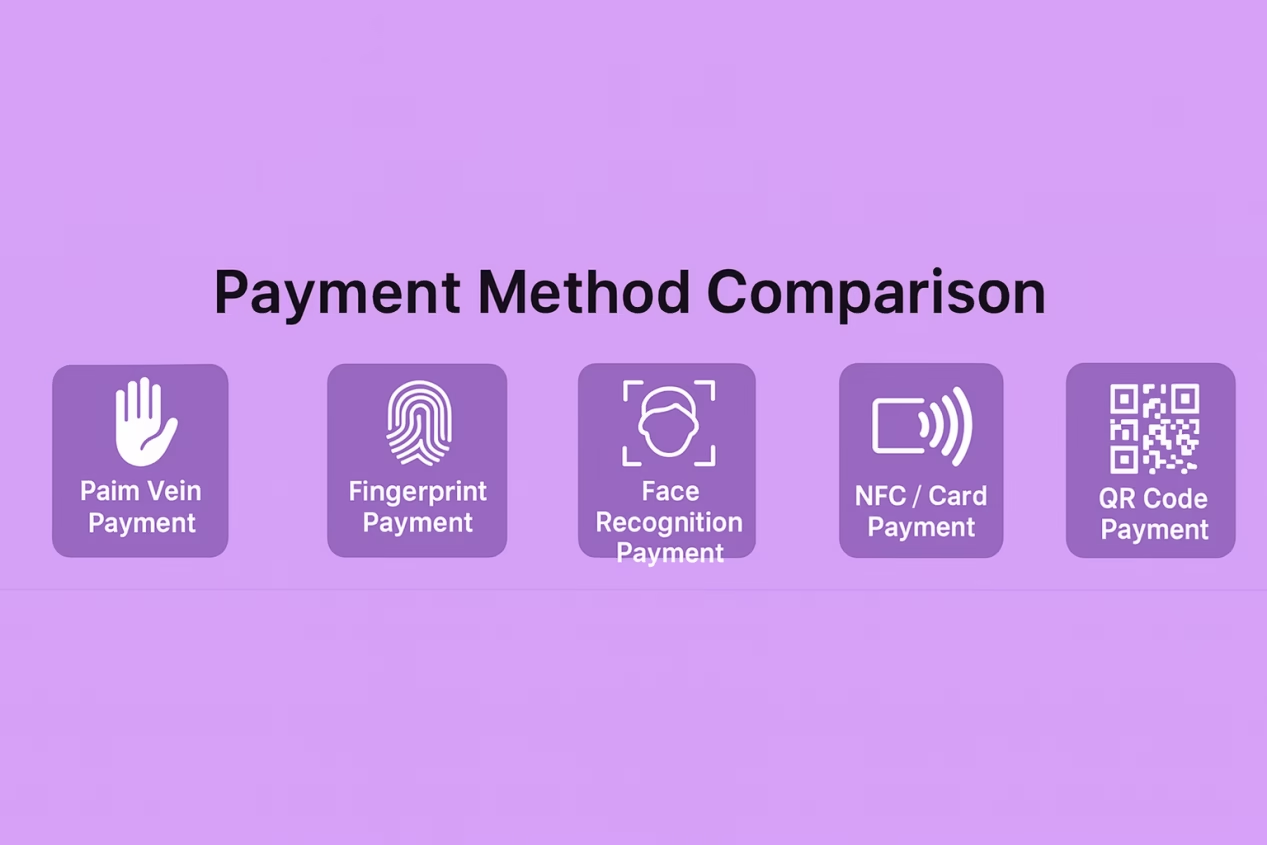
| Category | Palm Vein Payment | Fingerprint Payment | Face Recognition Payment | NFC / Card Payment | QR Code Payment |
|---|---|---|---|---|---|
| Biometric / Technology Type | Subcutaneous palm vein pattern (RGB + IR dual-mode) | Surface fingerprint ridge pattern | Facial geometric and texture features | Chip or contactless NFC module | 2D barcode (QR image) |
| Feature Extraction Principle | Extracts both IR vein patterns (subdermal blood vessel structure) and RGB palm texture — dual-layer biometric with 5M+ feature points | Extracts ridge endings and bifurcations (minutiae points), typically 40–80 points | Extracts distances and facial landmarks, typically 80–120 points | Reads chip or magnetic stripe data | Scans QR image linked to account |
| Need Phone, Card, PIN or Signature | ❌ No | ❌ No | ❌ No | ✅ Requires physical card, PIN or signature | ✅ Requires mobile phone |
| Contact Type | Fully contactless | Requires touch | Contactless (affected by lighting) | Contact or near-field tap | Scan printed or on-screen code |
| Anti-spoof Security | 🔒 Very high (internal veins, invisible and liveness-verified) | Medium (can be faked by printed or silicone fingerprint) | Low (photos or masks can spoof) | Medium (chip encryption) | Low (QR can be copied or intercepted) |
| Recognition Speed | ≈0.35 s | ≈0.5 s | ≈0.8 s | ≈1 s | 2–5 s |
| Environmental Impact | Not affected by light, humidity, or aging | Affected by skin dryness, cuts, dirt | Affected by lighting, angle, mask | Depends on terminal | Depends on network and brightness |
| Feature Stability | ✅ Stable after age 6; lifelong unchanged | ❌ Affected by skin condition, wear, and age | ❌ Changes with age, weight, or skin texture | ✅ Stable | ✅ Stable (depends on code generation) |
| Privacy Protection | Highest — internal biological data never exposed | Moderate | Low — external features easily captured | Moderate | Low |
| Maintenance Cost | Low (no contact, no wear) | High (sensor cleaning required) | Medium (camera calibration) | Medium | Low |
| Typical Applications | Banking, eKYC, healthcare, education, government | Mobile unlocking, access, attendance | Retail, public payment, gates | Bank payment, transport, retail | Mobile wallet, small vendors |
| Main Drawbacks | Higher hardware cost; SDK integration required | Hygiene issues, worn fingerprints | Unstable in poor lighting | Requires card handling | Requires smartphone and internet |
| Overall Evaluation | ✅ Most secure, contactless, and lifelong stable | 🔐 Mature but touch-based and wear-prone | ⚠️ Convenient but environment-sensitive | 💳 Traditional, widespread | 📱 Convenient but least secure |
Conclusion
BioWavePass combines advanced Palm Vein Recognition, AI-driven algorithms, and dual-spectrum imaging to deliver the safest and most frictionless payment experience on the market.
Our hardware and SDK solutions enable partners and developers to build next-generation Palm Vein Payment platforms that are secure, fast, and ready for global deployment.
👉 Learn more about Palm Vein Payment Hardware and Solutions at https://biowavepass.com/product/android-palm-vein-terminal/
Share this article
About the Author

You might also like
Bringing Palm Vein Scanning into a Web Workflow
From Palm Payment MVP to Commercial Deployment: Building a Scalable Biometric Payment System
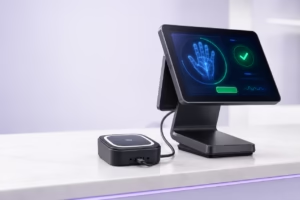
How to Integrate a USB Palm Vein Scanner with a POS Terminal
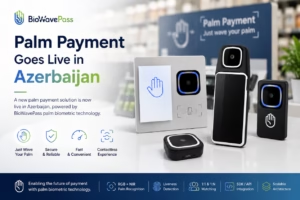
Palm Payment Goes Live in Azerbaijan: From Biometric Technology to Real-World Payment
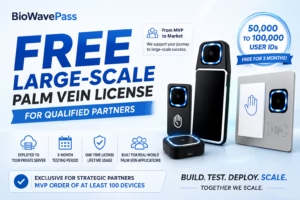
From MVP to Market: Scaling Palm Vein Technology with BioWavePass
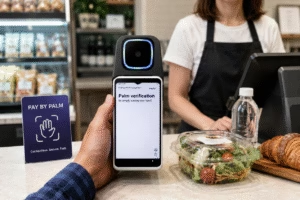
Palm Vein Payment: How Biometric Payments Work Without Cards or Phones
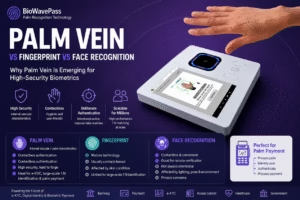
Palm Vein vs Fingerprint vs Face Recognition: Why Palm Vein Is Emerging for High-Security Biometrics
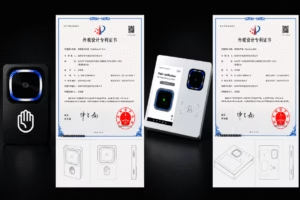
BioWavePass Palm Vein Scanner Products Receive Design Patent Certification
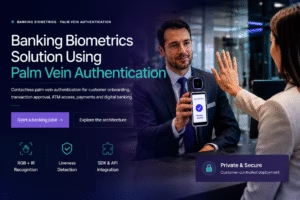
Palm Vein Authentication: The Future of Secure Digital Identity and Payments