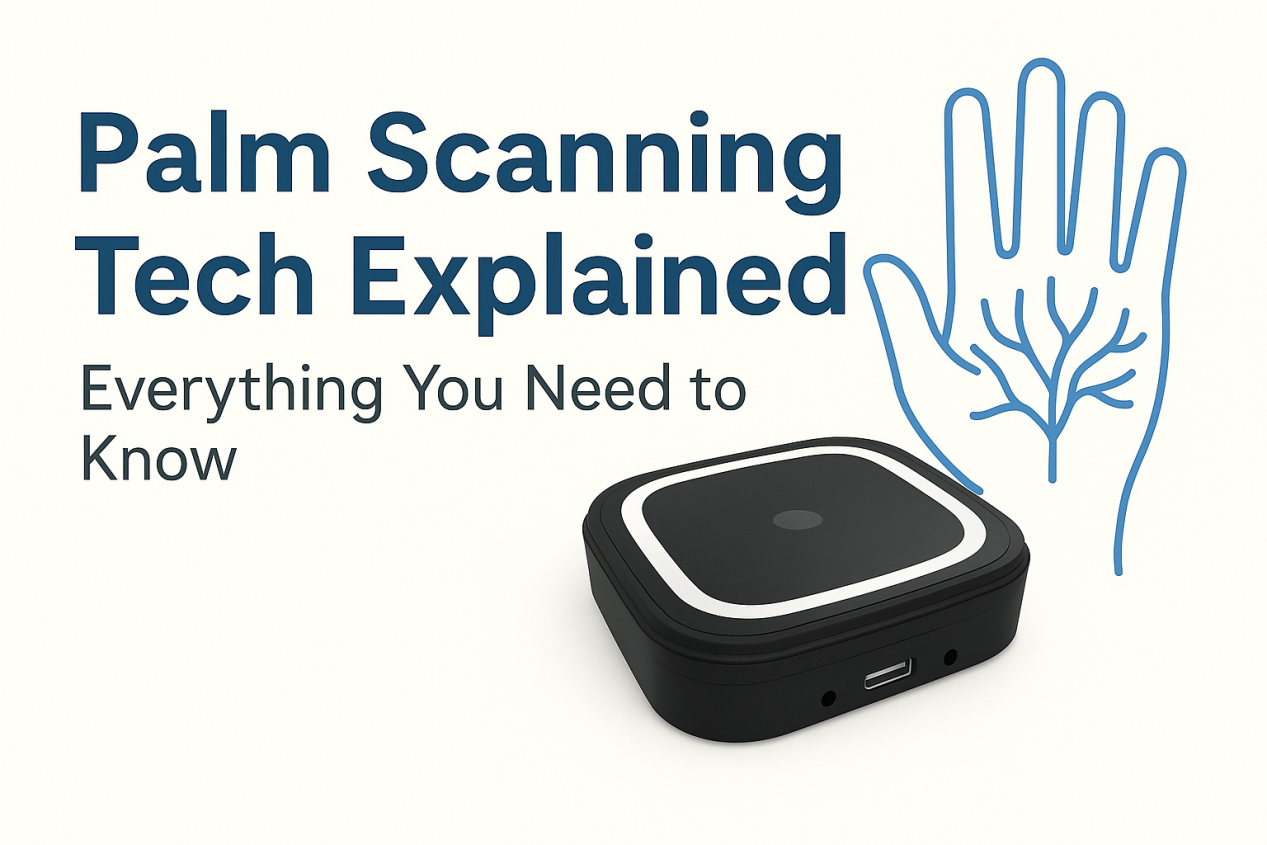
Palm Scanning Tech Explained: Everything You Need to Know
Your palm holds more than you think.
Beneath the surface lies a complex, unique pattern of veins—now powering the next generation of identity authentication and payments.
En BioWavePass, we develop cutting-edge Tecnología de reconocimiento de venas de la palma de la mano that captures both surface palm prints y subdermal vein data for precision-grade verification.
🖐 What Is Palm Scanning?
Palm scanning is a biometric method that verifies identity by capturing the internal vascular map of your palm using near-infrared (IR) y RGB sensors.
This internal map is then encrypted into a digital biometric signature, making it:
- Impossible to copy or lift like fingerprints
- Resistant to surface damage or manipulation
- Perfectly suited for contactless, privacy-first environments
🔬 How It Works: Dual Imaging = High Trust
Every BioWavePass device captures two types of biometric data in real time:
- RGB Sensor captures palm surface features (texture, ridges, creases)
- IR Sensor captures deep vein patterns invisible to the human eye
- AI engine extracts both features and fuses them into a biometric vector
- Identity is confirmed only when both layers match
This multi-modal matching reduces false acceptance to just 1 in 100 billion (1e-11) — ideal for high-security use cases.
🧠 Where Palm Scanning Is Already Changing the Game
- 💳 Palm-Based Payments in transit, retail, or banking
- 🏥 Patient ID & Hospital Entry
- 🚪 Secure Access Control in corporate/government buildings
- 🧾 eKYC & National ID Systems
- 🧑💼 Time Attendance & Workforce Identity
Palm scanning is fast, frictionless, and independent of external appearance, which makes it inclusive for all age groups and skin tones.
🌟 Why Choose BioWavePass
| Feature | BioWavePass Advantage |
|---|---|
| Dual RGB + IR Imaging | Combines internal and external biometrics for unmatched accuracy |
| Lightning-Fast Matching | ~0.35s even on databases with 5M+ users |
| SDK/API Support | Developer-ready tools for government, fintech, healthcare |
| USB + Android Options | From embedded modules to standalone terminals |
| QR Code Enabled (via RGB) | One device supports both ID y pago scenarios |
| Contactless & COVID-Safe | No touch required, no surface degradation risk |
| MDM & Geofencing | Optional enterprise controls for field deployment |
🤔 Addressing Common Questions
| Concern | Our Solution |
|---|---|
| High Entry Cost | USB-based models available for cost-sensitive applications |
| IR-Only Systems Inflexible | Our dual-mode architecture reduces errors and spoof attempts |
| Skin Conditions or Injuries | Internal vein patterns remain readable even when surface is compromised |
| Database Performance | Scalable across millions of IDs without speed or accuracy degradation |
✅ Resumen
Palm vein scanning is no longer a concept of the future—it’s now field-proven technology, already powering critical systems across payments, public services, and digital ID infrastructure.
En BioWavePass, we focus on delivering scalable, secure, and privacy-respecting palm biometrics built for modern deployment environments.
📩 Want to test your own palm authentication system?
We offer free SDK access, API docs, and remote test environments for developers.
Contact: [email protected]
WhatsApp: +86 198 6084 3404
PalmVein #PalmScanner #PalmAuthentication #BiometricSecurity #ContactlessID #eKYC #AIbiometrics #PalmPrint #BioWavePass #DigitalIdentity
Comparte este artículo
Sobre el autor

También le puede interesar
Bringing Palm Vein Scanning into a Web Workflow
From Palm Payment MVP to Commercial Deployment: Building a Scalable Biometric Payment System
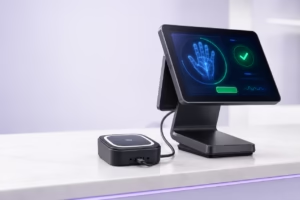
How to Integrate a USB Palm Vein Scanner with a POS Terminal
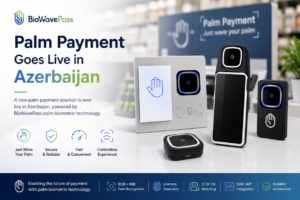
Palm Payment Goes Live in Azerbaijan: From Biometric Technology to Real-World Payment
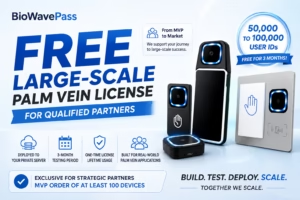
From MVP to Market: Scaling Palm Vein Technology with BioWavePass
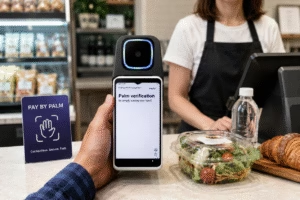
Palm Vein Payment: How Biometric Payments Work Without Cards or Phones
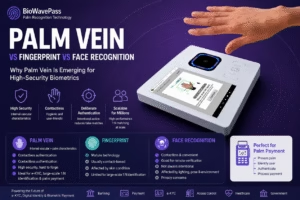
Palm Vein vs Fingerprint vs Face Recognition: Why Palm Vein Is Emerging for High-Security Biometrics
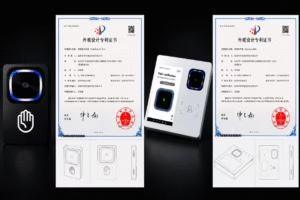
BioWavePass Palm Vein Scanner Products Receive Design Patent Certification
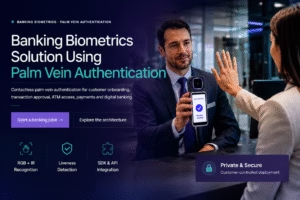
Palm Vein Authentication: The Future of Secure Digital Identity and Payments