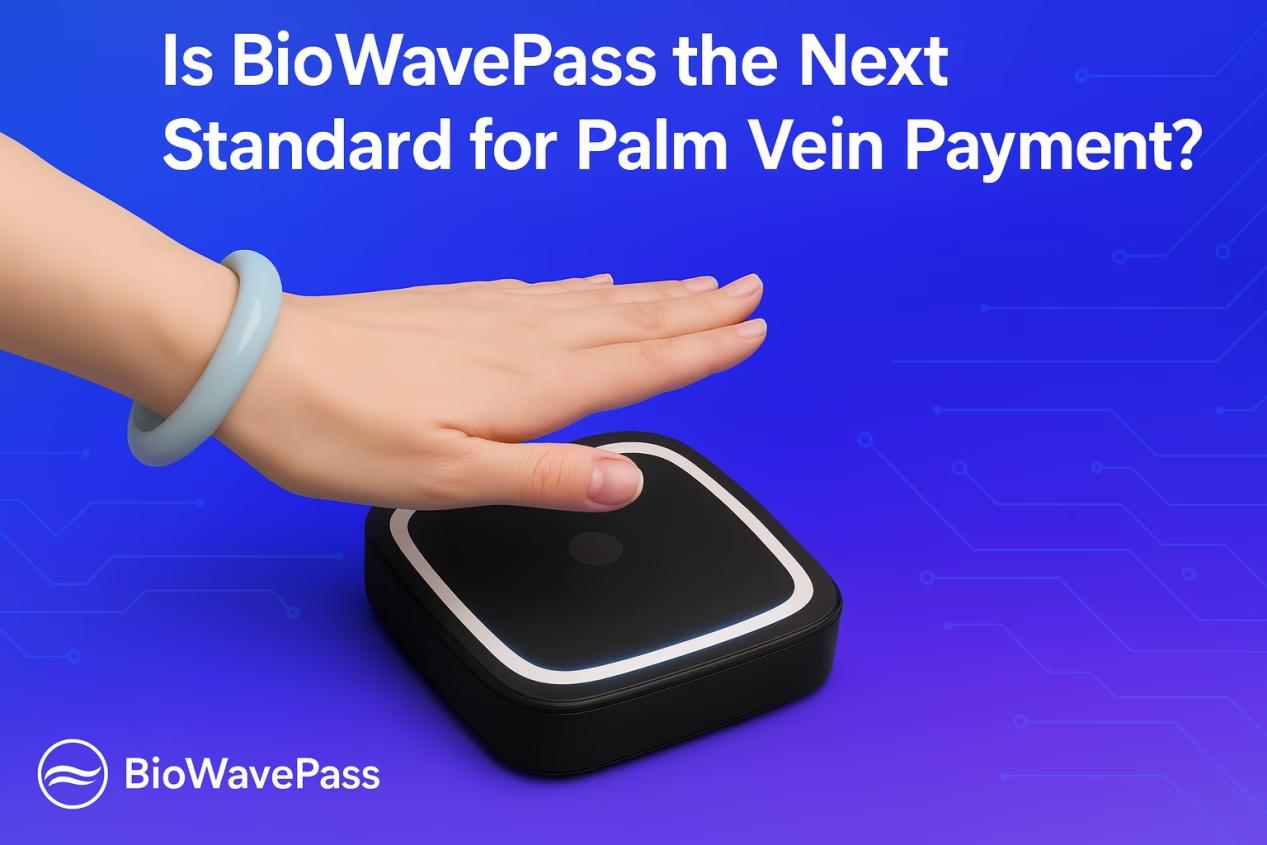
BioWavePass est-il la prochaine norme pour le paiement par Palm Vein ?
The global payment ecosystem is evolving faster than ever — from plastic cards to digital wallets, and now, to biometric identity verification.
As banks and fintechs seek to eliminate fraud and enhance user experience, one question defines the next era of innovation:
👉 Which biometric technology is truly ready for scalable, secure, and inclusive payments?
While fingerprint and face recognition have their place, both face persistent reliability and spoofing issues.
That’s where BioWavePass Palm Vein Technology sets a new benchmark for security, scalability, and usability.
🔐 Dual-Layer Security: RGB + IR for Fraud-Proof Authentication
Unlike single-spectrum biometric systems, BioWavePass integrates RGB + IR dual-modality imaging, combining palm print (RGB) et palm vein (infrared) data for unmatched precision.
| Modalité | FRR @ FAR=1e-6 | Key Feature |
|---|---|---|
| RVB | 1.002% | Surface palm print mode |
| NIR | 1.52% | Subcutaneous palm vein mode |
| Combined (RGB + IR) | 1e-11 | One in 100 billion match reliability |
This dual-layer algorithm ensures national-grade accuracy with near-zero false acceptance — making it ideal for fintech, eKYC, and banking-grade security applications.
In simple terms: Palm Vein Payment through BioWavePass can’t be forged, faked, or intercepted.
⚡ Built for Scale: Designed for Millions of Real-Time Users
BioWavePass isn’t just a biometric device — it’s an end-to-end identity verification infrastructure validated on a 5 million+ ID database.
- Average Matching Speed: ~315 ms per verification
- Recognition Accuracy: 99.9% under varying lighting and demographic conditions
- Évolutivité : Supports large-scale national ID, payment, and eKYC deployments
This ensures real-time authentication for high-volume fintech transactions — without compromising accuracy or latency.
🖥️ A Complete Hardware Ecosystem
BioWavePass offers a full hardware lineup to meet diverse deployment needs:
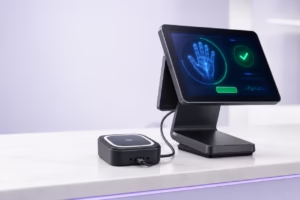
- PalmVein01 USB Reader — Compact, plug-and-play design compatible with Android, Linux, and Windows. Perfect for POS terminals, banking kiosks, and developer testing.
- WavePass500 Terminal — An Android-based biometric payment device supporting NFC, IC cards, QR scanning, and national ID integrations.
Both devices are EMV/PCI-ready and support custom branding or integration for financial institutions, government ID programs, and enterprise-level rollouts.
🛠️ Seamless Software Integration with SDK & API
Le SDK BioWavePass simplifies development for fintechs, government projects, and system integrators through stable APIs and modular architecture.
Software Highlights:
- Developer SDKs for Android, Linux, and Windows
- Flutter Plugin SDK for faster cross-platform app deployment
- API hooks for S'inscrire, Correspondance, Mise à jour, et Révoquer operations
- Full MVP-to-commercial scaling support, including sandbox and live environments
- Comes with 10,000 free cloud ID matches for pilot validation
This enables developers to integrate Palm Vein Authentication into existing banking apps, eKYC systems, and digital wallets — in under an hour.
🔒 Why Palm Vein Payment Outperforms Other Biometrics
| Biometric Type | Key Weakness | BioWavePass Advantage |
|---|---|---|
| Fingerprint | Spoofable from lifted prints | Internal vein structure impossible to copy |
| Facial Recognition | Affected by lighting, demographics, and masks | Independent of lighting and appearance |
| Iris Scanning | High cost and user discomfort | Contactless and easy for public use |
| Palm Vein | None significant | Dual-spectrum, fast, and fraud-proof |
The result: a biometric identity layer that’s both secure and user-friendly, ready for mass adoption across retail, fintech, and public sector systems.
🌍 Industry Applications
BioWavePass Palm Vein Technology is already driving digital transformation in multiple industries:
- 🏦 Banking & Fintech: Secure authentication for cardless ATMs and Palm Pay systems
- 💰 Government eKYC: Reliable identity verification for subsidy and citizen services
- 🏥 Healthcare: Hygienic, contactless patient identification
- 🛒 Retail Payments: Fast checkout without cash, cards, or phones
- 🧾 Smart City Infrastructure: Unified biometric access and payment systems
✨ Conclusion: The Future of Payments Is Palm-Based
The payment revolution isn’t about removing cards — it’s about replacing friction with identity.
BioWavePass combines advanced Palm Vein Technology, dual-layer RGB+IR biometrics, et enterprise-grade SDK tools to deliver what the industry has been waiting for:
a secure, scalable, and touchless standard for next-generation payments.
Banks, fintechs, and government agencies are now embracing Palm Vein Payment — not as a trend, but as the future standard for authentication and trust.
Check more about the Palm Vein Scanner Payment: https://biowavepass.com/palm-payment-technology/
Partager cet article
A propos de l'auteur

Vous pourriez aussi aimer
Scaling Palm Vein Payment: Single Server or Kubernetes Cluster?
Before You Scale Palm Vein POS: A Terminal Management Checklist
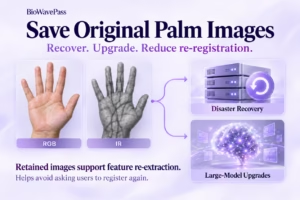
Why Saving Original Palm Images Matters for Biometric Recovery and Future Upgrades By BioWavePass
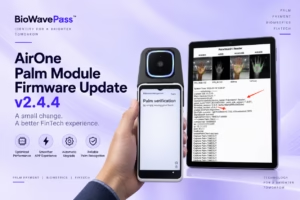
Optimizing Palm Payment Performance: AirOne Palm Module Firmware v2.4.4
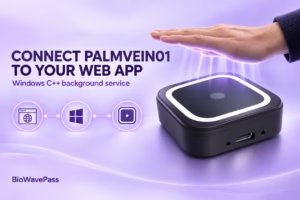
Bringing Palm Vein Scanning into a Web Workflow
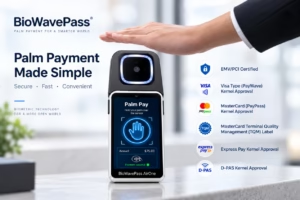
From Palm Payment MVP to Commercial Deployment: Building a Scalable Biometric Payment System
How to Integrate a USB Palm Vein Scanner with a POS Terminal
Palm Payment Goes Live in Azerbaijan: From Biometric Technology to Real-World Payment
From MVP to Market: Scaling Palm Vein Technology with BioWavePass