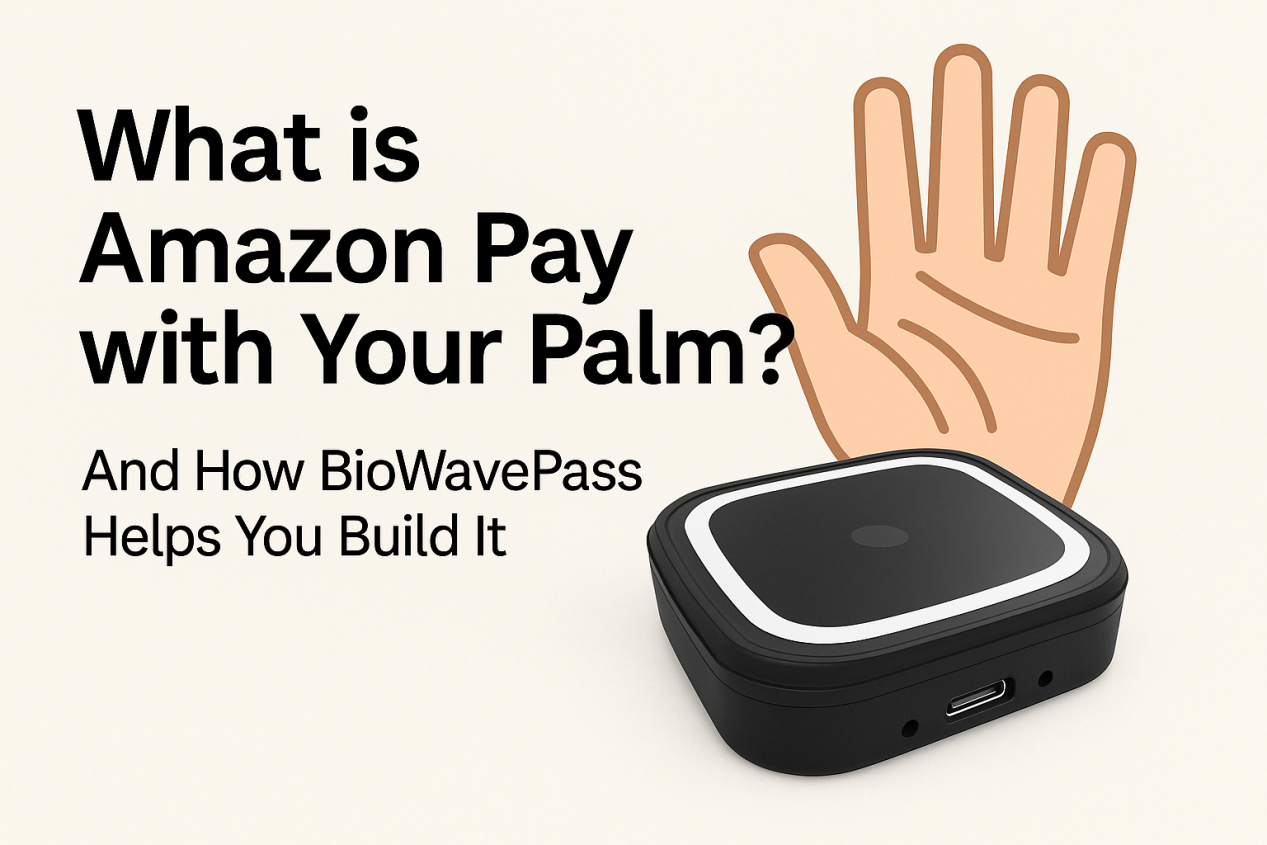
What is Amazon Pay with Your Palm? And How BioWavePass Helps You Build It
Palm-based payments are no longer a vision of the future—they’re live, fast, and secure.
Amazon One introduced a seamless palm payment experience, letting users simply hover their hand to complete transactions. At the heart of this experience is reconnaissance des veines de la paume, which verifies both internal vein structure et external palm print.
Avec BioWavePass palm vein readers, this powerful biometric solution is now open to innovators in fintech, retail, et transportation—without being Amazon.
🛒 What Exactly Is “Pay with Your Palm”?
Palm payments work by registering your hand’s unique biometric identity, combining:
- ✅ Subdermal vein layout (captured with IR light)
- ✅ Visible palm print (captured with RGB imaging)
Once enrolled, users can hover their hand above a scanner to complete a payment—no phone, no wallet, no card.
This system is already active in cashierless retail, airports, et transport networks globally.
🔍 How It Works: The Tech Behind Palm Authentication
-
Enrollment Phase
The system uses dual cameras to scan RGB (palm print) + IR (veins). -
Biometric Template Creation
These features are converted into encrypted identity templates—never storing raw images. -
Real-Time Authentication
On the next scan, the system compares your palm data to existing templates to approve payment or access instantly.
💼 Why This Matters for Fintech, Retail, and Smart Mobility
You don’t need to build everything from scratch—or work with big tech—to deploy palm biometrics.
Avec BioWavePass hardware, such as:
- Passeur d'ondes500 — Android-based palm scanner with NFC
- PalmVein 01 — USB palm vein reader compatible with Windows/Linux/Android
…your team can instantly:
- 💳 Launch your own Palm Pay solution
- 🧼 Deliver hygienic, contactless KYC for onboarding
- 🔐 Use private cloud or local server matching
- 🏷️ Build white-label biometric wallets or self-checkout solutions
🔐 What Makes BioWavePass Different?
Many systems rely only on IR sensors, which capture veins.
BioWavePass combines both IR + RGB, enabling:
- 🎯 Dual-mode recognition = 1 in 100 milliards d'euros false accept rate
- 📷 RGB also supports QR code capture for hybrid workflows
- 💡 RGB + IR fusion increases spoof resistance and liveness detection
✅ Additional features:
- SDK & API support for fast integration
- Supports multi-OS: Windows, Linux, Android
- Optional geo-lock & MDM integration
- OEM/ODM customization available for scale-up deployments
🌍 Bring Palm Payments to Your Region
Whether you’re creating:
- 🏬 A smart retail experience
- 🚆 A biometric transit pass
- 🧾 A next-gen self-service kiosk
- 🧑💼 A government eKYC gateway
BioWavePass gives you a robust biometric foundation—ready to deploy, ready to scale.
📩 Want to build your own “Pay with Palm” solution?
Let’s get started: [email protected]
📱 WhatsApp: +86 198 6084 3404
PalmPay #PalmScanner #PalmVein #BiometricPayments #BioWavePass #FintechInnovation #ContactlessPayment #KYC #SmartRetail #PalmVeinScanner
Partager cet article
A propos de l'auteur

Vous pourriez aussi aimer
Bringing Palm Vein Scanning into a Web Workflow
From Palm Payment MVP to Commercial Deployment: Building a Scalable Biometric Payment System
How to Integrate a USB Palm Vein Scanner with a POS Terminal
Palm Payment Goes Live in Azerbaijan: From Biometric Technology to Real-World Payment
From MVP to Market: Scaling Palm Vein Technology with BioWavePass
Palm Vein Payment: How Biometric Payments Work Without Cards or Phones
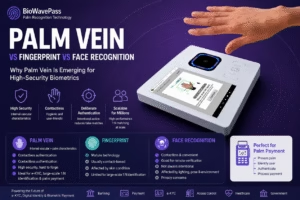
Palm Vein vs Fingerprint vs Face Recognition: Why Palm Vein Is Emerging for High-Security Biometrics
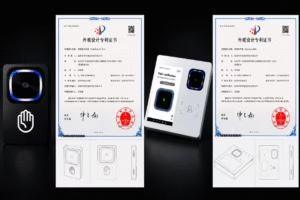
BioWavePass Palm Vein Scanner Products Receive Design Patent Certification
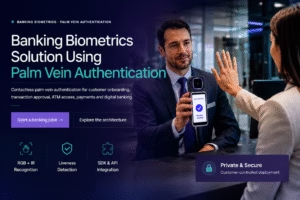
Palm Vein Authentication: The Future of Secure Digital Identity and Payments