How Can Banking Compliance Drive Palm Payment Innovation?
The Banking Compliance Puzzle
Working with banks is never simple. Financial institutions must follow PCI DSS regulations and EMV/PCI certification to protect data and guarantee trust. These certifications are not just formalities — they are the backbone of secure transactions and essential for banks to consider new technologies like Palm Payment.
The Hidden Hardware Challenge
Even with certified hardware, real deployment often faces obstacles:
- Mobile POS devices may not provide enough USB output current to power biometric devices.
- USB ports are frequently shared between charging and peripherals, forcing users to disconnect when charging.
- In high-demand environments such as banking halls or government subsidy kiosks, downtime becomes costly.
BioWavePass Engineering Solutions
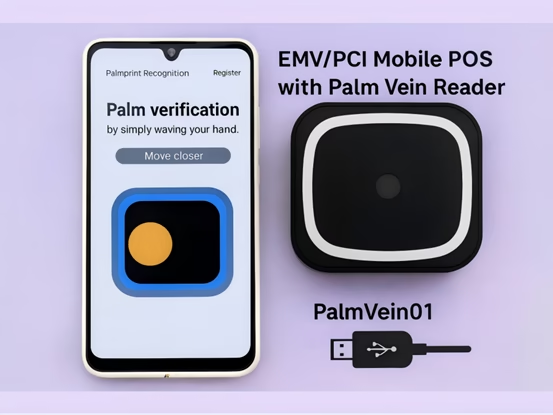
At BioWavePass, we customized our EMV/PCI-certified Banking Mobile POS to handle these exact issues. By modifying USB output current, the POS can directly connect to the PalmVein01 USB Palm Vein Reader, ensuring stable biometric authentication.
This enables:
- Palm Payment (Pay with Hand) alongside card or mobile transactions.
- Reliable biometric workflows for fintech and banking applications.
Flexible Deployment Options
To support different banking use cases, BioWavePass offers:
- Dual-device setups: swap devices to maintain uptime during charging.
- Custom casing designs: integrate PalmVein01 with POS in a handheld unit.
- Pop-ping port customization: provide dedicated power to the Palm Reader while leaving the Type-C port free for charging.
✅ Conclusion
Banking partnerships demand more than compliance — they require engineering innovation. By redesigning POS hardware for palm biometrics, BioWavePass helps banks deploy secure, compliant, and practical Palm Payment systems.
Share this article
About the Author

You might also like
Bringing Palm Vein Scanning into a Web Workflow
From Palm Payment MVP to Commercial Deployment: Building a Scalable Biometric Payment System
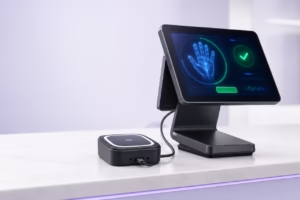
How to Integrate a USB Palm Vein Scanner with a POS Terminal
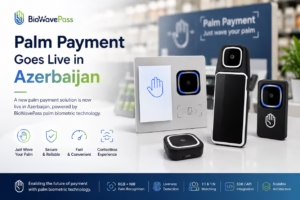
Palm Payment Goes Live in Azerbaijan: From Biometric Technology to Real-World Payment
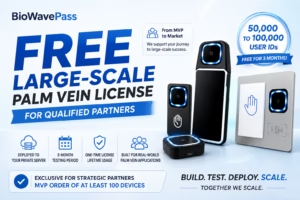
From MVP to Market: Scaling Palm Vein Technology with BioWavePass
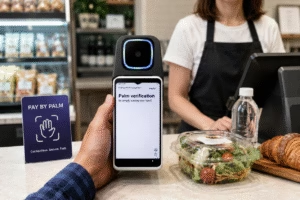
Palm Vein Payment: How Biometric Payments Work Without Cards or Phones
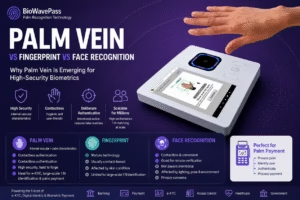
Palm Vein vs Fingerprint vs Face Recognition: Why Palm Vein Is Emerging for High-Security Biometrics
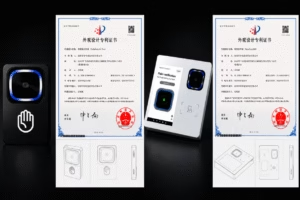
BioWavePass Palm Vein Scanner Products Receive Design Patent Certification
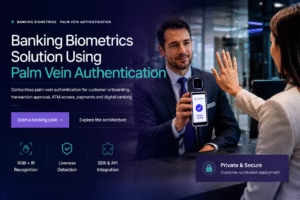
Palm Vein Authentication: The Future of Secure Digital Identity and Payments