Why Is the BioWavePass Palm Vein Reader SDK the Smartest Choice for Fintech Developers?
Fintech and eKYC teams often face the same challenge — getting a working biometric pilot up and running fast.
Traditional hardware and SDKs require long integration cycles, complex cloud setups, and security reviews that slow progress.
That’s why BioWavePass built its Biometric Palm Vein Scanner and Palm Vein Technology SDK with a developer-first mindset — designed for speed, privacy, and real-world deployment.
⚙️ What Slows Pilots Down?
Unclear APIs, fragmented SDK documentation, and dependency-heavy builds can delay project validation for weeks.
BioWavePass eliminates those obstacles through its simplified Flutter Plugin SDK, stable APIs, and lightweight deployment structure.
🚀 What Makes the BioWavePass SDK Different?
The BioWavePass Palm Vein Technology SDK includes a Flutter Plugin SDK that empowers developers to build and test faster across multiple platforms without complex bridging or native coding.
Key Benefits of the Flutter Plugin SDK:
- ⚙️ Cross-Platform Support — Build once, deploy across Android, Windows, and Linux.
- 💡 Rapid Integration — Use Flutter’s hot reload to test palm recognition instantly.
- 📱 Unified UI/UX — Develop native-feeling apps for mobile and POS devices.
- 🔐 Secure Data Flow — Maintain full control of biometric templates on your own server.
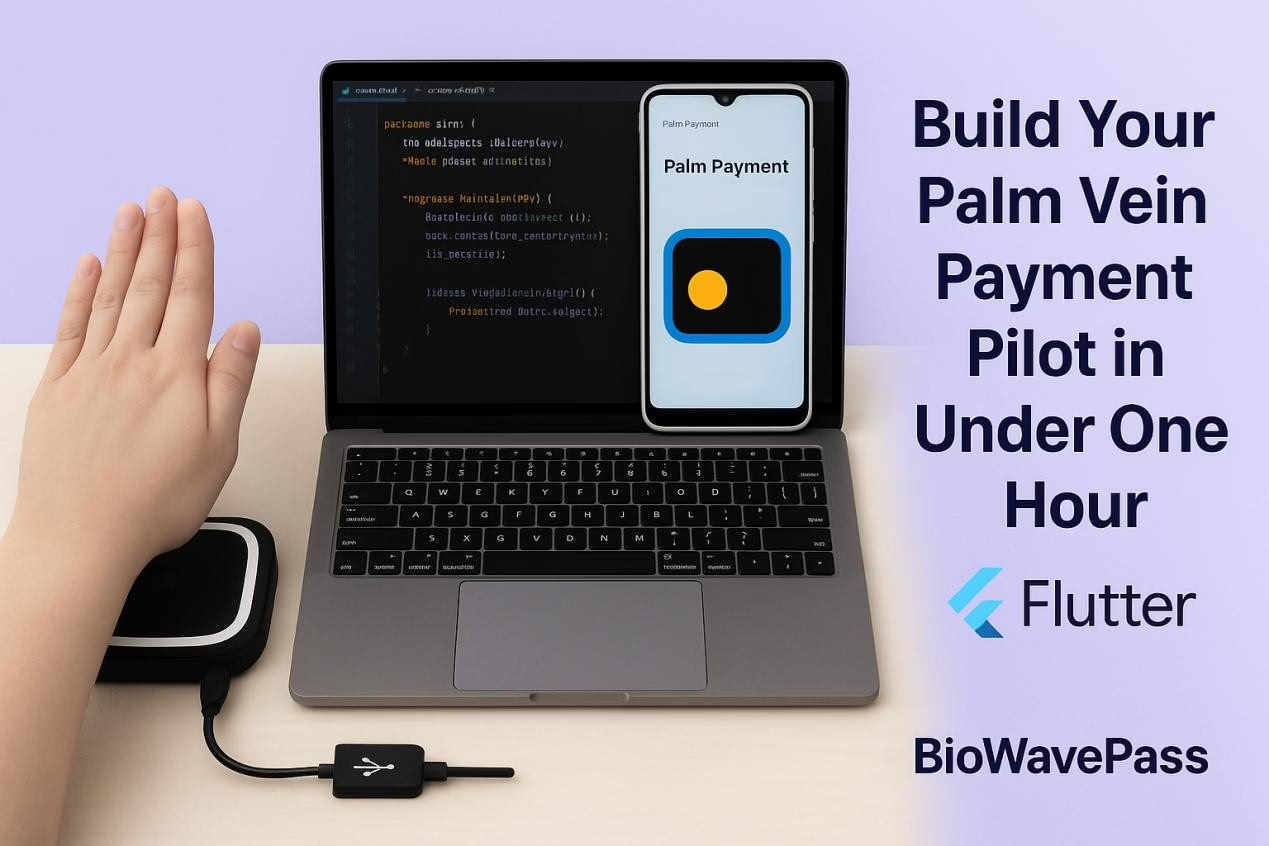
Developers can now launch their first Palm Vein Payment or eKYC pilot faster — no complex middleware, no third-party cloud dependency.
⏱️ How Quickly Can You Show Value?
- 7 minutes: Set up a private server with the SDK’s simple deployment guide.
- 1 hour: Validate Palm Vein Feature ID matching in your own cloud environment.
From setup to proof-of-concept, BioWavePass enables a full working demo in under an hour.
🧩 What Do Developers Get?
- ✅ Stable APIs for Enroll, Update, Revoke, and Match operations
- ✅ Reference projects for fintech and government use cases
- ✅ Dual support for Android, Linux, and Windows
- ✅ Free 10,000-ID cloud license for testing and sandbox pilots
Everything is designed to help you move from MVP to commercial deployment faster.
🔒 How Accurate and Secure Is It?
BioWavePass’s Palm Vein Scanner uses RGB + IR dual-sensor fusion for precise feature extraction and real liveness detection.
Performance Highlights:
- Recognition speed: 0.35 seconds
- Accuracy: 99%+ success rate in large-scale ID databases
- Spoof resistance: Detects fake palms or printed images instantly
- Privacy: All feature data and templates stay inside your own infrastructure
🧠 Why Storing Palm Images Matters
Even during small-scale pilots, BioWavePass recommends enabling image saving to support future scalability.
When moving from small (≤10K users) to large-scale algorithms, pre-stored palm images (RGB + IR) allow higher model accuracy without forcing users to re-register.
✅ Conclusion
For developers and fintech innovators, speed and precision are everything.
The BioWavePass Palm Vein Technology SDK, powered by the Flutter Plugin SDK, helps you build, test, and validate Palm Vein Payment or eKYC pilots in record time — securely and efficiently.
Go from zero to verified pilot in under one hour with BioWavePass Palm Vein Scanner SDK — built for the future of biometric payments.
Learn More: palm-payment-technology
Share this article
About the Author

You might also like
Bringing Palm Vein Scanning into a Web Workflow
From Palm Payment MVP to Commercial Deployment: Building a Scalable Biometric Payment System
How to Integrate a USB Palm Vein Scanner with a POS Terminal
Palm Payment Goes Live in Azerbaijan: From Biometric Technology to Real-World Payment
From MVP to Market: Scaling Palm Vein Technology with BioWavePass
Palm Vein Payment: How Biometric Payments Work Without Cards or Phones
Palm Vein vs Fingerprint vs Face Recognition: Why Palm Vein Is Emerging for High-Security Biometrics
BioWavePass Palm Vein Scanner Products Receive Design Patent Certification
Palm Vein Authentication: The Future of Secure Digital Identity and Payments